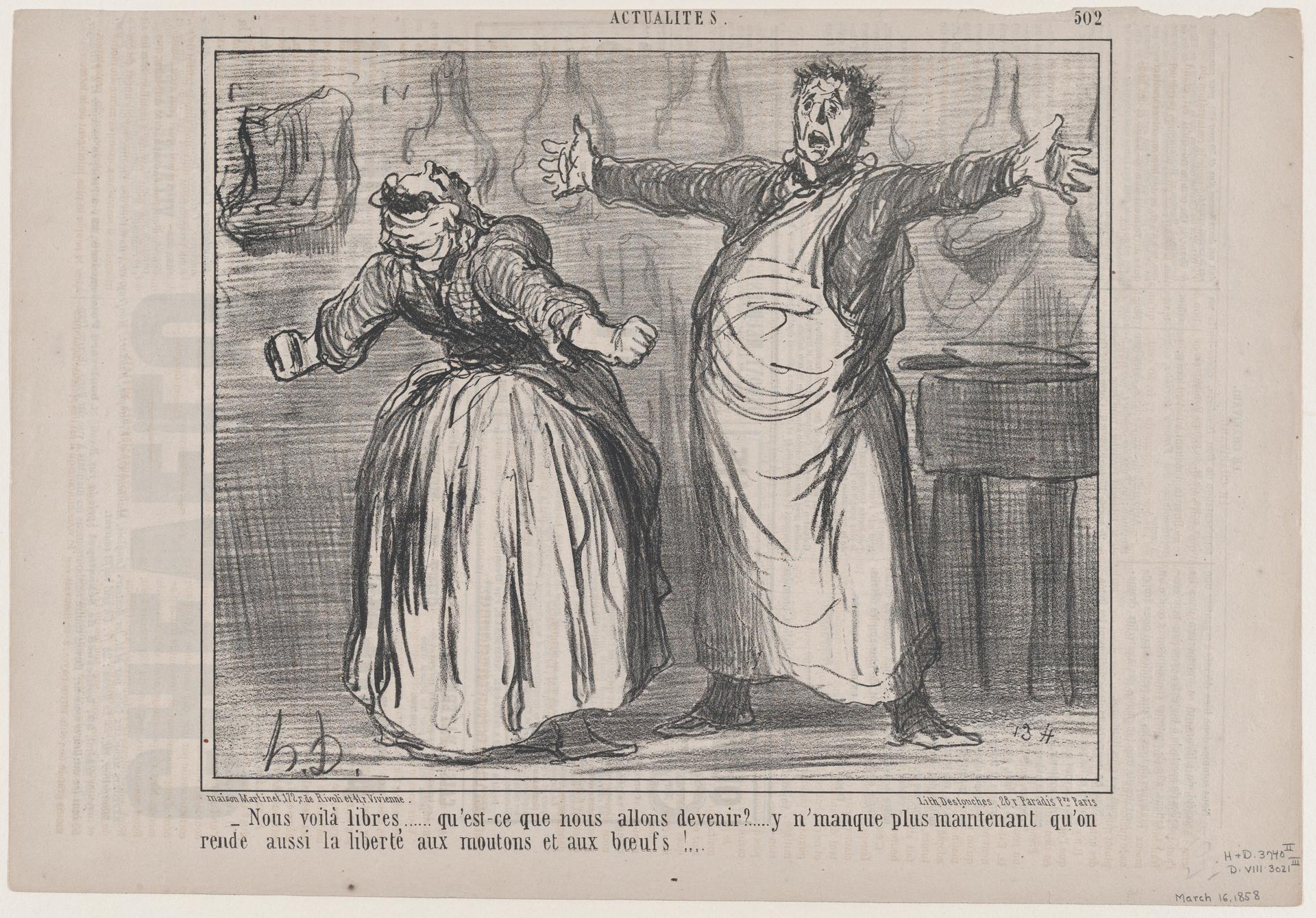
Nous voilà libres... qu'est-ce que nous allons devenir?
Original title: Nous voilà libres... qu'est-ce que nous allons devenir?, from "Actualités"
kurzbeschreibung
Unlike many sheets from Daumier's 'Actualités' series, this 1858 lithograph does not hinge on a single punchline. Instead it lets two figures wrestle with each other in an interior: 'Nous voilà libres... qu'est-ce que nous allons devenir?' is the title of the print, made on 16 March 1858. It is executed as a lithograph on newsprint, in the third state of three according to Delteil.
Description
Two figures share the pictorial space. On the left stands a person in a long dress, posture firm, while on the right a figure in a loose garment throws up their arms and gesticulates wildly; between them something like an argument unfolds. A table and presumably some clothing are hinted at in the background. Black on white, as lithography dictates, the layout draws the eye to the duo, whose agitation sustains the arrangement.
Context
The sheet was made for 'Le Charivari', the satirical journal in which Daumier's 'Actualités' series ran. Published on 16 March 1858, it targets a social or political event of the day, though the exact allusion cannot be identified with certainty today. Daumier was known for caricatures that attacked social ills and political conditions; the printing on newsprint points to 19th-century Paris, where such images circulated as mass-produced goods.
Impact
The exaggerated figures and their flailing gestures seem comic and bitter at once. Anyone who knows the title reads the scene as a mix of liberation and helplessness and is prompted to think about precisely that tension. Because everything is reduced to black and white and clear outlines, the two figures' performance gains in sharpness.
Technique
The work was done in planographic printing: drawn with greasy chalk on a limestone, lithography allowed reproduction on newsprint, as was usual for the 'Actualités'. Daumier used fine hatching and set contrasts to model light and shadow and to give the figures physical presence.
AI-generated description text
Source: Metropolitan Museum of Art · Public Domain (CC0 1.0)