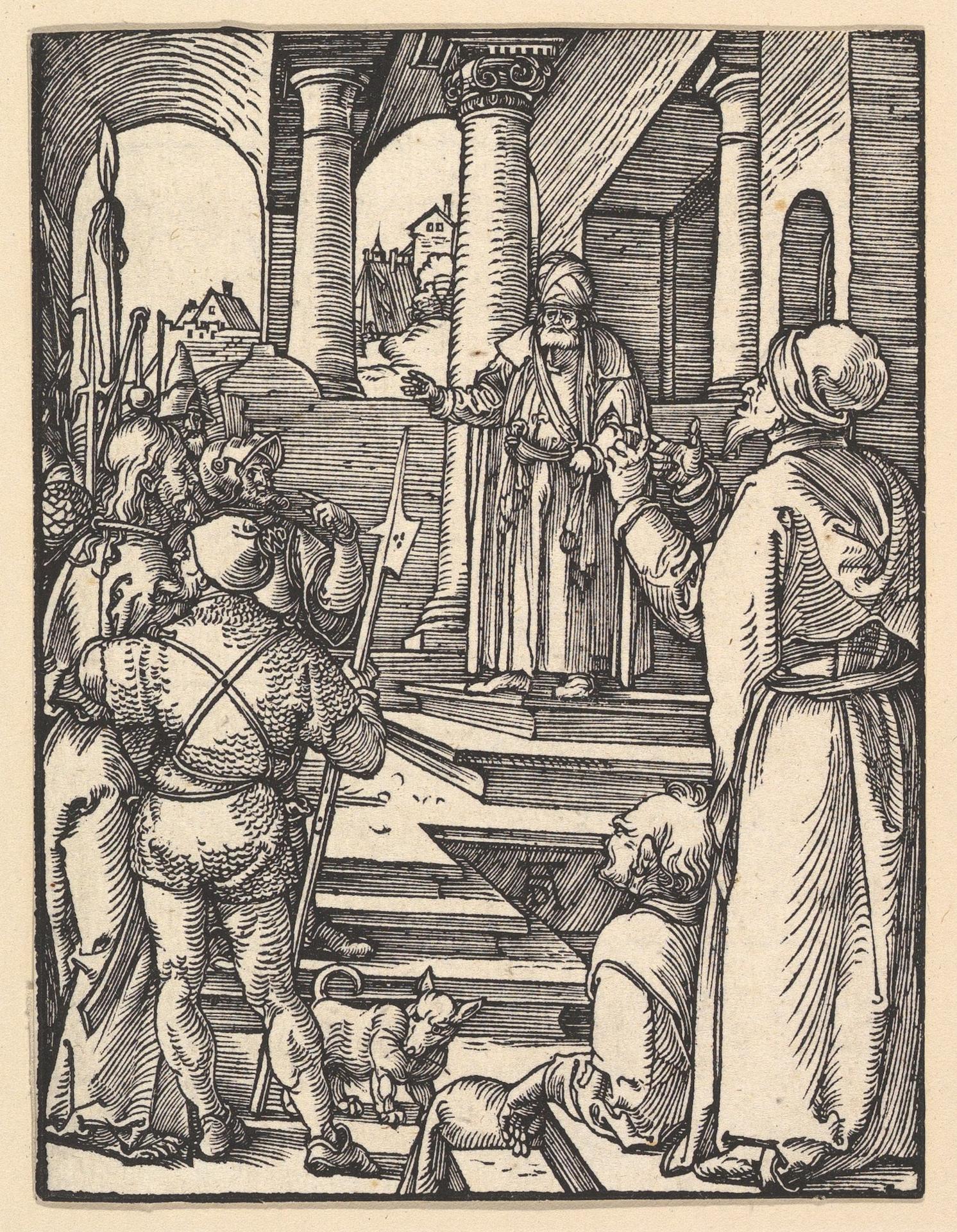
Christ before Pilate, from "The Small Passion"
Original title: Christ before Pilate, from "The Small Passion"
kurzbeschreibung
This woodcut, created by Albrecht Dürer around 1508, depicts the biblical scene of Christ standing before Pontius Pilate. It is part of Dürer's renowned series 'The Small Passion,' which illustrates key moments from the Passion of Christ. The work showcases Dürer's mastery in woodcut technique, with intricate lines and detailed figures.
Description
The composition centers on Christ, who stands on a raised platform, facing Pilatus seated on a higher step, wearing a turban and long-sleeved robe. To the left, soldiers in armor hold weapons—one carries a spear, another a shield—while a figure in a long robe stands to the right, possibly a servant or another key character. Below Christ, a man kneels in a simple garment, seemingly in prayer or submission. In the background, columns and part of a building suggest a temple or palace, and the scene is rendered in monochrome with sharp lines and cross-hatching, with light from above highlighting the contours.
Context
Dürer created 'The Small Passion' between 1508 and 1512, a series of 37 woodcuts that was published as a book in 1511. This series was intended for a broad audience, reflecting the growing demand for devotional imagery in early 16th-century Europe. Dürer's innovative use of woodcut elevated the medium from simple illustration to high art, and his prints were widely distributed, influencing artists across the continent.
Impact
The woodcut conveys a sense of dramatic tension through the spatial arrangement and the contrasting poses of the figures. The detailed textures and dynamic lines draw the viewer into the narrative, emphasizing the gravity of the moment. Dürer's ability to depict emotion and architectural depth in a monochrome medium is striking, making the scene both immediate and timeless.
Technique
Dürer employed the woodcut technique, carving the design into a wooden block, inking it, and then pressing it onto paper. His use of fine, varied line work and cross-hatching allowed for subtle gradations of tone and shadow, achieving a remarkable level of detail. This print is part of a series that demonstrates Dürer's technical precision and his ability to adapt complex compositions to the constraints of relief printing.
AI-generated description text
Source: Metropolitan Museum of Art · Public domain (CC0)