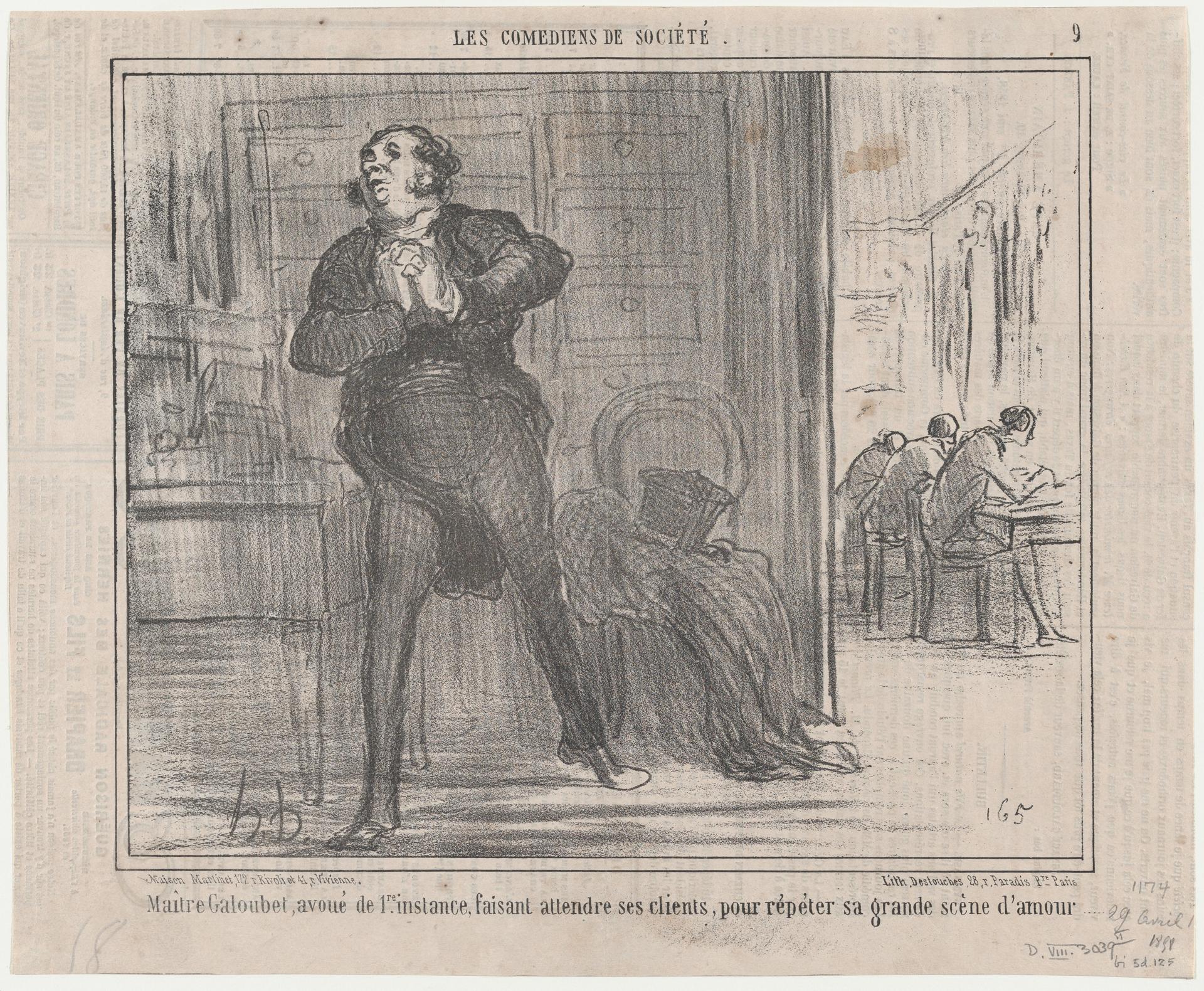
Maître Galoubet, avoué de 1re. instance, faisant attendre ses clients, pour répéter sa grande scène d'amour..., from Les Comédiens de Société, published in Le Charivari, April 29, 1858
Original title: Maître Galoubet, avoué de 1re. instance, faisant attendre ses clients, pour répéter sa grande scène d'amour..., from Les Comédiens de Société, published in Le Charivari, April 29, 1858
kurzbeschreibung
Honoré Daumier drew this lithograph in April 1858 for his series Les Comédiens de Société. It presents Maître Galoubet, a lawyer who leaves his clients waiting while he rehearses a grand love scene instead of attending to them. The print appeared in the magazine Le Charivari and survives in the second state described by Delteil; it was pulled on newsprint.
Description
On the left stands a gentleman in a suit and cap, his sweeping arm gesture suggesting either a farewell or a plea. Toward the middle a woman in a long dress leans forward and hides her face behind one hand. Behind her, other figures remain absorbed in conversation at their tables. The arrangement is asymmetrical: the seated woman acts as the visual anchor, while the standing man at the left supplies the tension. Everything is rendered in black and white with dense lines and hatching, and the light seems to fall evenly from the front.
Context
The lithograph was made in 1858 for Le Charivari, the satirical paper in which Daumier regularly published social criticism in caricature. Within Les Comédiens de Société he mocked the hypocrisy and self-staging of the bourgeoisie under the Second Empire. A sharp observer of social types, Daumier here targets the vain lawyer who neglects his professional duties for the sake of private vanity.
Impact
Humorous and ironic, the caricature exposes the absurdity of a lawyer who puts his role as a lover above his profession. That the woman hides her face heightens the comic contrast between theatrical gesture and actual situation. The print invites a smile without losing Daumier's usual bite.
Technique
This sheet was produced as a lithograph on newsprint: drawn with greasy chalk on a stone and then printed. The second state (Delteil) points to revisions made after the first pull. The process allows fine lines and shading that bring figures and surroundings vividly forward.
AI-generated description text
Source: Metropolitan Museum of Art · Public Domain (CC0 1.0)