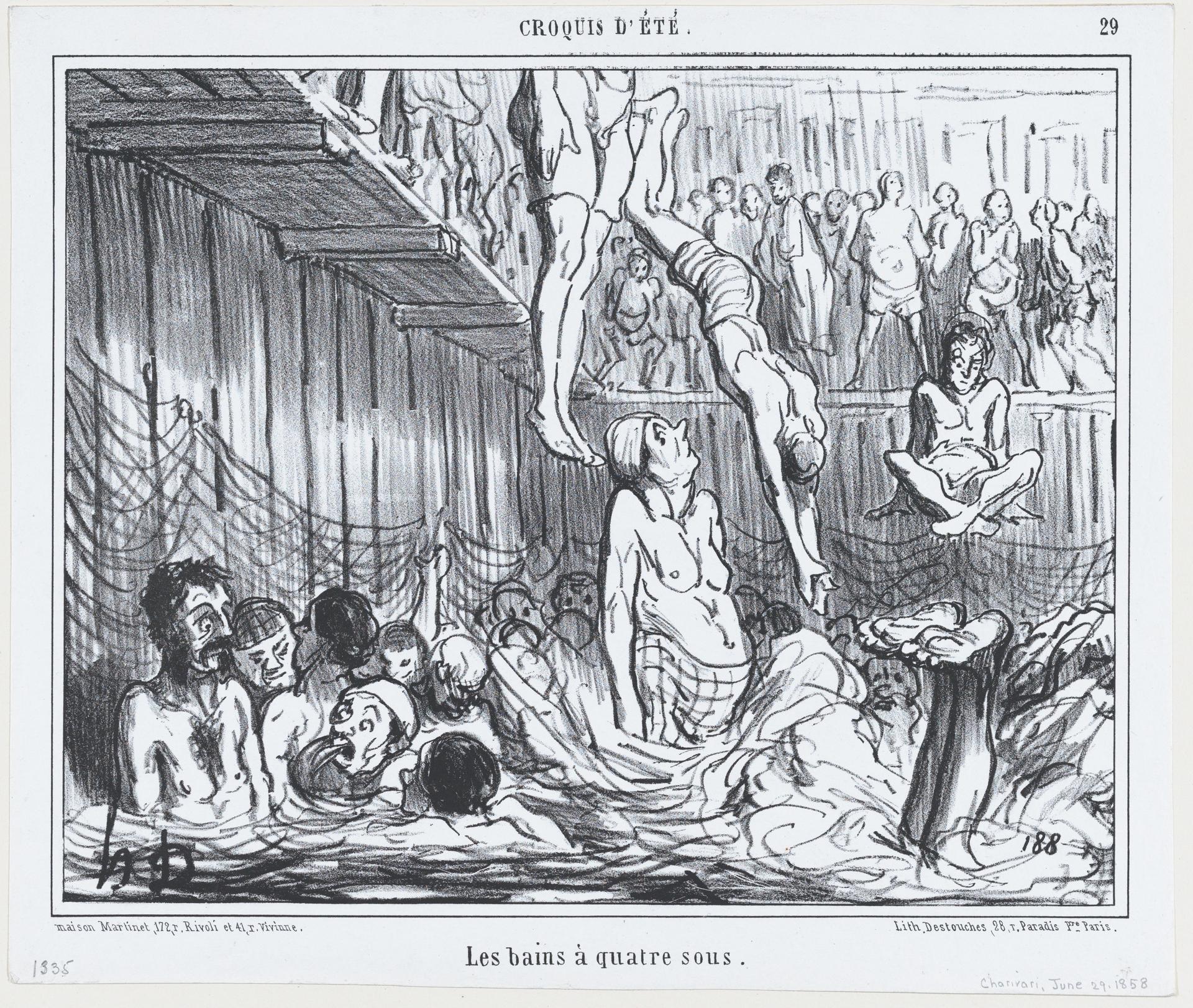
Les bains à quatre sous, from Croquis d'Été, published in Le Charivari, June 29, 1858
Original title: Les bains à quatre sous, from Croquis d'Été, published in Le Charivari, June 29, 1858
kurzbeschreibung
Unlike many bathing scenes of the period that dwell on innocent pleasure, Honoré Daumier's lithograph 'Les bains à quatre sous' turns its attention to the crush and comedy of a public swimming bath. The sheet belongs to the series 'Croquis d'Été' and appeared on 29 June 1858 in 'Le Charivari'. People of various ages and both sexes splash about and rest. This is the second state of two (Delteil); the print measures 24.5 × 29.1 cm.
Description
What sets this view apart from calmer bathing pictures is the lively jumble of numerous figures in every kind of pose: some seem to hang in mid-air, as if leaping or performing acrobatic turns, while further bathers crowd the water beyond them. The layout feels restless, and exaggerated facial expressions give the whole a caricatural, cheerful tone. Printed in black and white, the lithograph's greys model light and shadow.
Context
Next to Daumier's political caricatures, everyday life comes to the fore here: the series 'Croquis d'Été' was published in 1858 in the satirical paper 'Le Charivari', for which the artist worked regularly. The 'bains à quatre sous' were cheap public bathing establishments in Paris, popular in the nineteenth century and open to every social class. Daumier took up how Parisians spent their leisure and mocked the often chaotic conditions in these places. That the lithograph was printed as a second state points to the artist's reworking of the plate.
Impact
What distinguishes the sheet from mere documentation is its immediate comedy: the overstated figures and the hectic atmosphere raise a smile because they pick up the everyday absurdities of bathhouse life. The dynamism of the arrangement and the humorous details make the lithograph a vivid record of its time.
Technique
Unlike relief printing, this lithograph depends on a process in which a drawing is made on stone with greasy chalk and then printed. That permits fine lines and nuanced greys, which here bring figures and water into relief. The second state shows changes from the first, suggesting Daumier corrected or refined the plate.
AI-generated description text
Source: Metropolitan Museum of Art · Public Domain (CC0 1.0)