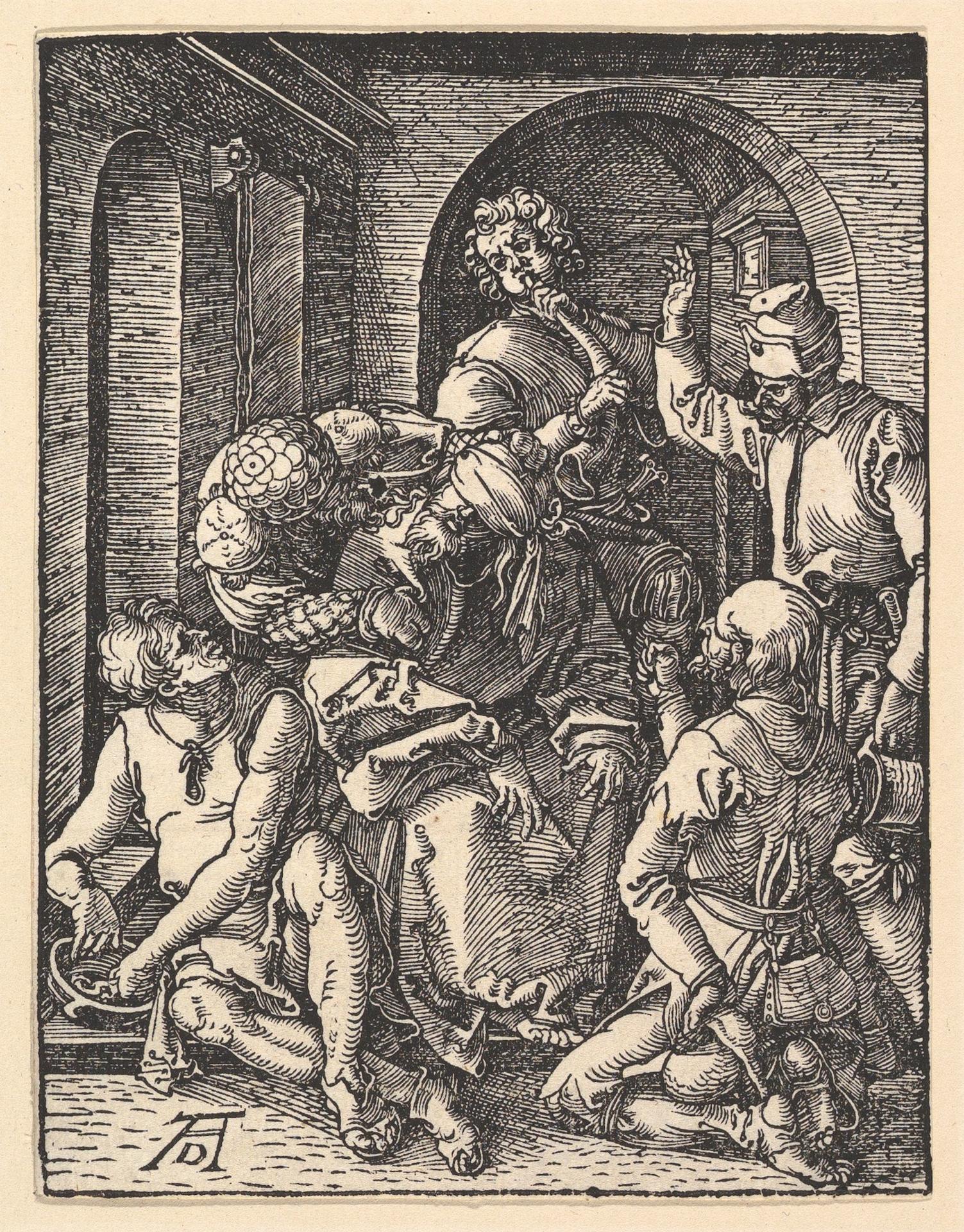
The Mocking of Christ, from "The Small Passion"
Original title: The Mocking of Christ, from "The Small Passion"
kurzbeschreibung
This woodcut by Albrecht Dürer, created around 1508, depicts the mocking of Christ from his series "The Small Passion." It shows Christ surrounded by soldiers who taunt him, with one offering a crown of thorns. The scene is rendered in Dürer's detailed Renaissance style.
Description
In the center, Christ stands with a cloth wrapped around his head and a robe, as a soldier reaches out with a crown of thorns. Around him, several soldiers kneel and gesture, their poses conveying a sense of mockery and violence. The background features an archway with a door and a window, framing the action. The composition is dynamic, drawing the eye to the interaction between Christ and his tormentors. The monochrome woodcut relies on fine lines and cross-hatching to create depth and shading.
Context
Dürer created "The Small Passion" between 1507 and 1513, a series of 37 woodcuts illustrating the life and suffering of Christ. This print was part of a popular devotional work that was widely distributed and influential. Dürer's skill as a printmaker allowed him to reach a broad audience, making religious themes accessible to the public.
Impact
The woodcut evokes a strong emotional response, capturing the cruelty and humiliation of Christ with stark realism. The detailed expressions and gestures of the soldiers intensify the sense of mockery, while Christ's calm demeanor contrasts sharply with the chaos around him. The monochrome palette focuses attention on the narrative and the artist's technical mastery.
Technique
Dürer employed the woodcut technique, carving the image into a wooden block, inking it, and then pressing it onto paper. His precise linework and use of cross-hatching allowed for subtle gradations of tone, giving the print a painterly quality. This method required great skill and control, as each cut affected the final print.
AI-generated description text
Source: Metropolitan Museum of Art · Public domain (CC0)