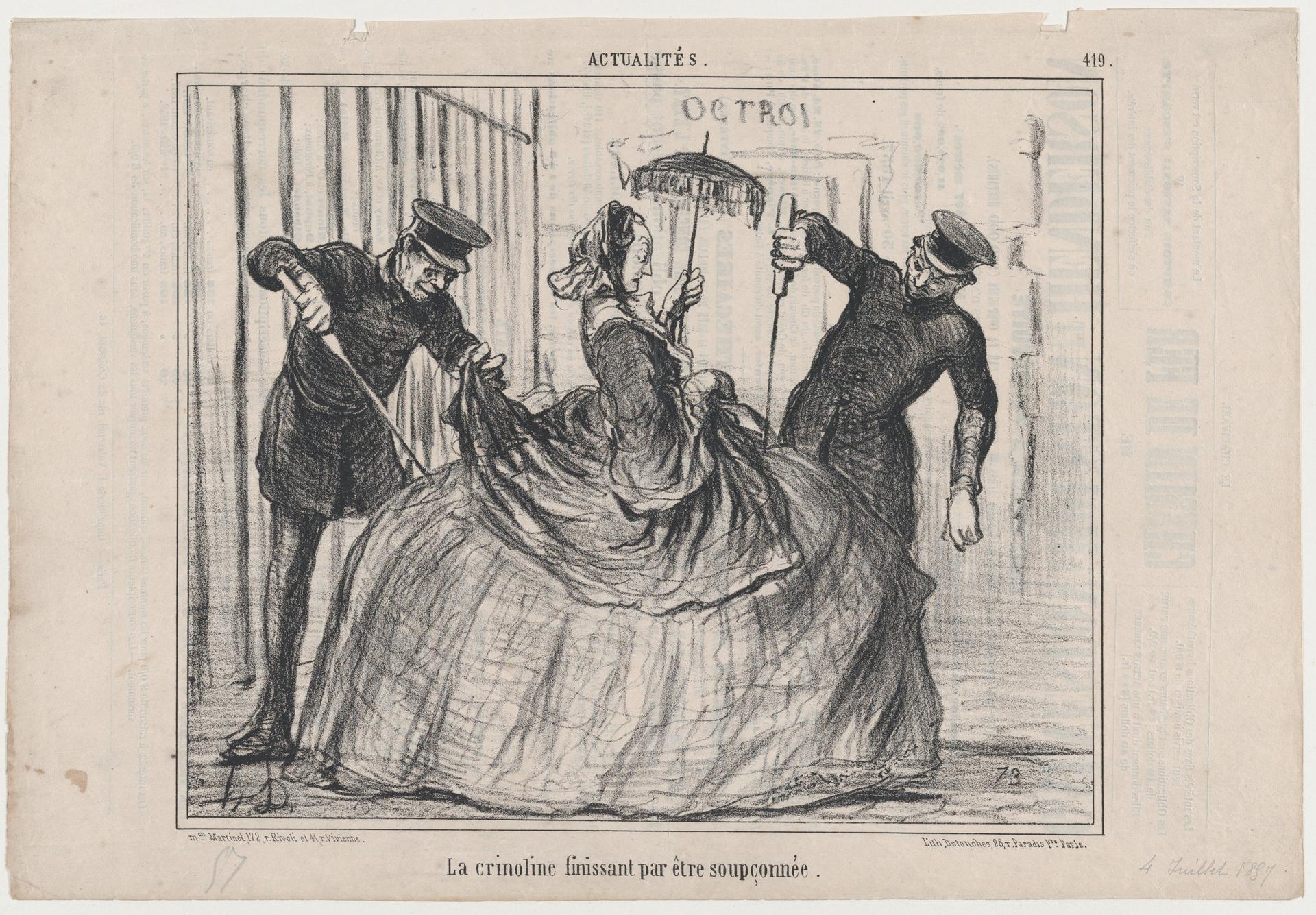
La crinoline finissant par être soupçonnée, from Actualités, published in Le Charivari, July 4, 1857
Original title: La crinoline finissant par être soupçonnée, from Actualités, published in Le Charivari, July 4, 1857
kurzbeschreibung
Honoré Daumier's lithograph of 1857 presents a lady in a voluminous crinoline being inspected by two customs officers at a toll station. The print came out of the 'Actualités' series and was published in 'Le Charivari'.
Description
A woman whose skirt spreads wide dominates the lower half of the image. Two uniformed customs officers stand at her sides; one bends to examine the hem of her dress. She carries an umbrella and a cigarette, while a sign reading 'OCTROI' can be made out behind her. The lithograph stays monochrome, with firm outlines and forms pushed into caricature.
Context
This caricature appeared in the satirical journal 'Le Charivari' on 4 July 1857. It belongs to the 'Actualités' series, which took aim at current events and social phenomena. The crinoline was a fashion of the 1850s whose girth kept growing, and it was often mocked. The setting at a toll station picks up the absurd notion that contraband might be hidden beneath the wide skirt.
Impact
The humour comes from the exaggeration that turns the crinoline into an object of suspicion. A comic tension builds between fashionable appearance and bureaucratic control. Daumier's drawing stays precise and lively, which sharpens the situation and makes it memorable.
Technique
The print was made as a lithograph on newsprint, a common method for caricature at the time. It is the second state of two (Delteil). Lithography allowed both fine lines and fast print runs, an advantage for the satirical press.
AI-generated description text
Source: Metropolitan Museum of Art · Public Domain (CC0 1.0)