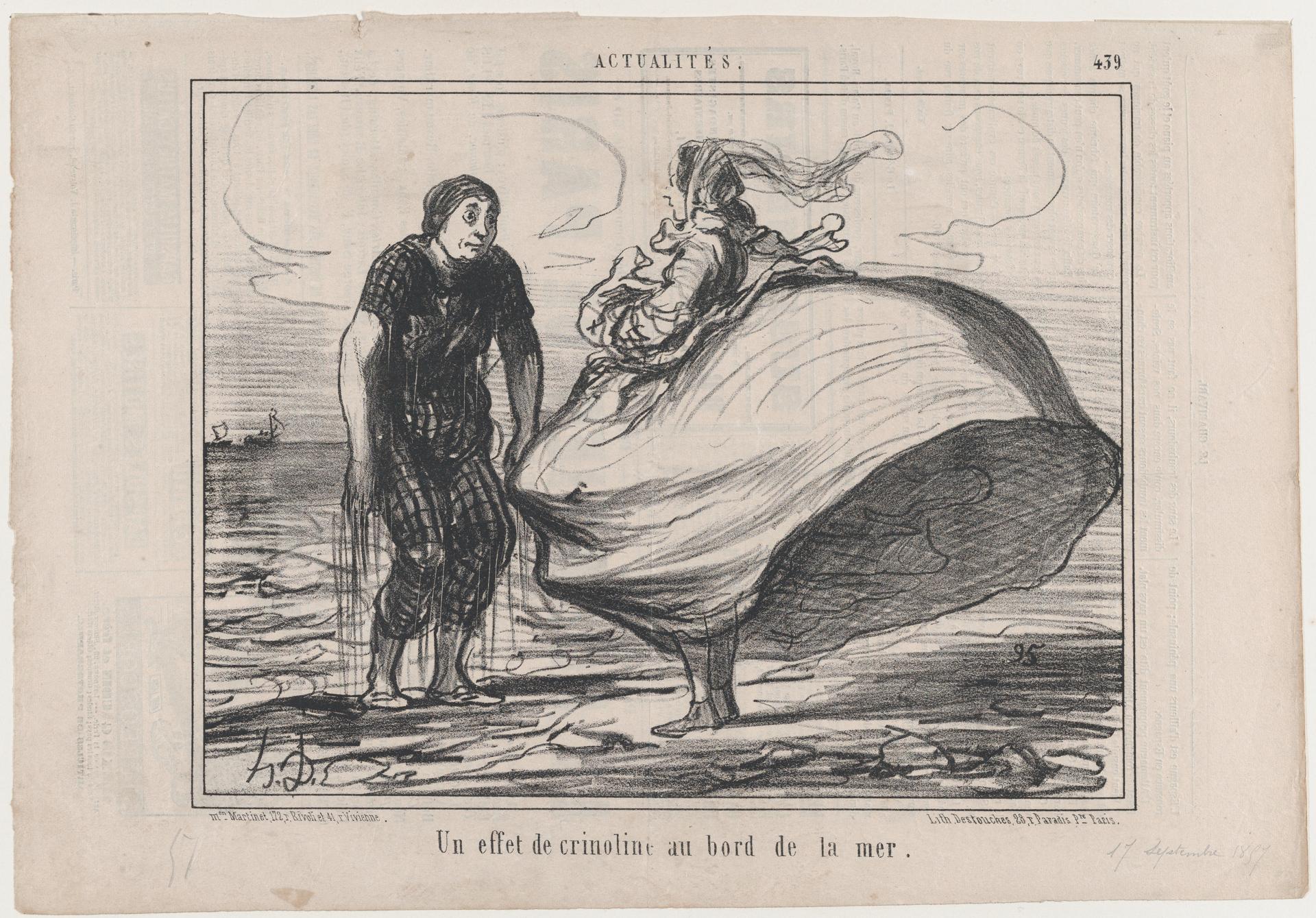
Un effet de crinoline au bord de la mer, from Actualités, published in Le Charivari, September 17, 1857
Original title: Un effet de crinoline au bord de la mer, from Actualités, published in Le Charivari, September 17, 1857
kurzbeschreibung
Honoré Daumier's lithograph from 1857 presents a comic seaside episode: a woman is caught by a huge crinoline that the wind whirls about mercilessly. The print belongs to the 'Actualités' series and was published in Le Charivari; it is the second state of two (Delteil).
Description
Two figures enliven the scene: on the left stands someone in conventional dress, while from the right approaches a figure with an enormous, shapeless crinoline that the wind sends swirling through the air. Beyond, the sea stretches out with two tiny boats. Rendered in black and white, the light feels natural and emphasizes the skirt's violent motion. Caricatural exaggeration—especially the huge crinoline and the characters' facial reactions—drives the humor.
Context
In 1857 the crinoline, a hoop skirt of steel or whalebone, was ubiquitous in women's fashion and offered plenty of material for mockery. Daumier published the lithograph in the 'Actualités' series of the satirical journal Le Charivari, famous for its political and social caricatures. The motif targets the absurdity of contemporary women's fashion, which could produce comic effects even on a seaside stroll.
Impact
The exaggerated crinoline and dynamic movement create a comic effect that invites a smile. Daumier's caricature precisely demonstrates how fashion distorts the human figure and puts it in ridiculous situations—a satirical jab at the taste of the time.
Technique
Lithography on newsprint—a common process for satirical prints in the 19th century. Daumier used lithography to produce fine lines and shading that convey movement and the texture of clothing. The print is the second state of two, meaning it was printed after the plate was reworked.
AI-generated description text
Source: Metropolitan Museum of Art · Public Domain (CC0 1.0)