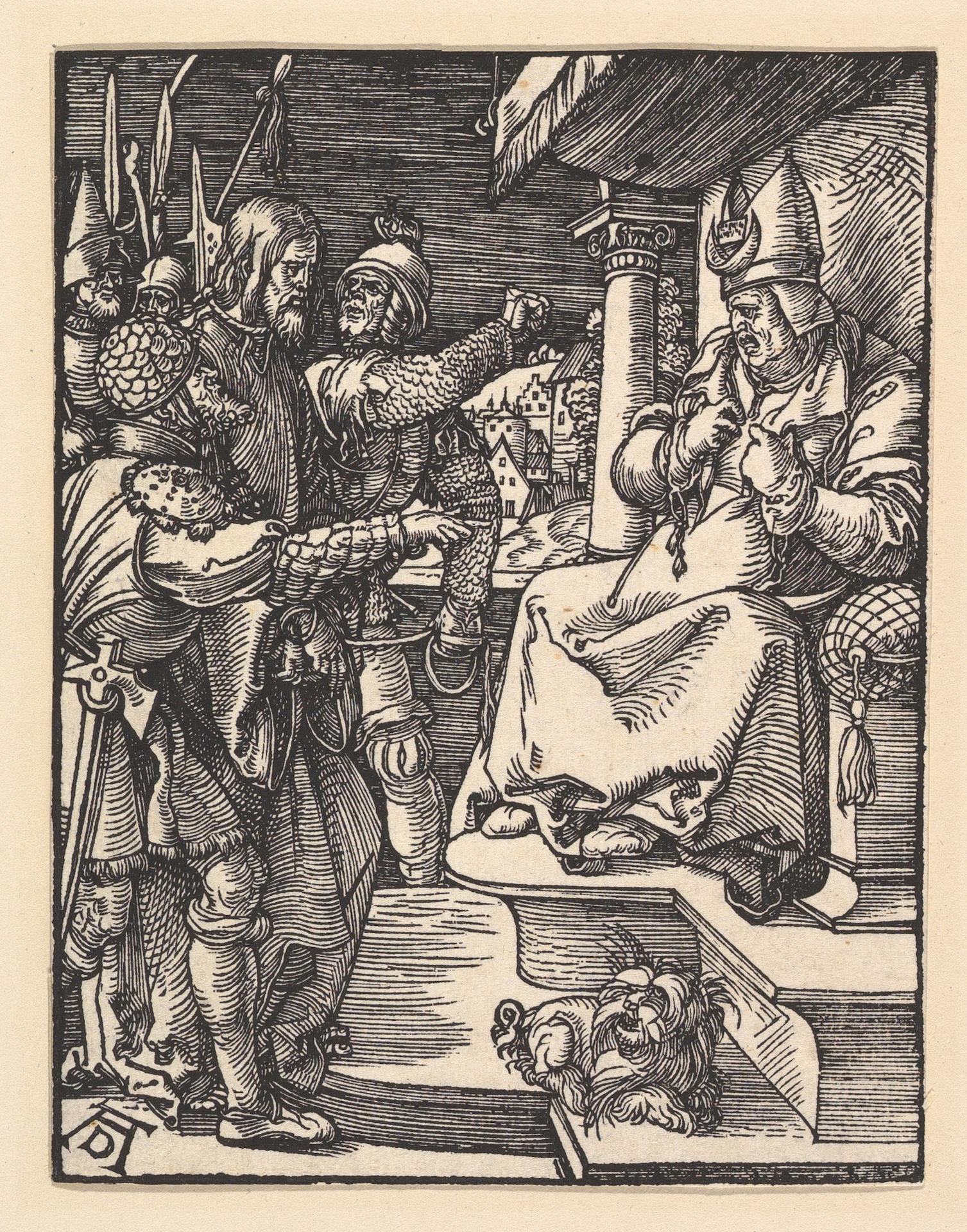
Christ before Caiaphas, from "The Small Passion"
Original title: Christ before Caiaphas, from "The Small Passion"
kurzbeschreibung
This woodcut by Albrecht Dürer, created around 1508, depicts Christ standing before the high priest Caiaphas. Part of the series "The Small Passion," it illustrates a key moment in the Passion narrative with dramatic intensity.
Description
The scene centers on Christ, who stands calmly before a seated figure on a throne, likely Caiaphas, surrounded by armed men in armor. The composition is crowded, with figures interacting closely, and the background shows urban buildings and a landscape. A bearded face appears in the lower right, adding a curious detail. The black-and-white woodcut uses fine lines and cross-hatching to define textures and contours.
Context
Dürer created "The Small Passion" between 1507 and 1512, a series of 37 woodcuts illustrating the Passion of Christ. This particular scene, Christ before Caiaphas, follows the biblical account where Jesus is brought before the high priest after his arrest. The series was highly popular and contributed to Dürer's reputation as a master printmaker.
Impact
The woodcut conveys tension and solemnity through the contrast between Christ's composed figure and the agitated crowd. The detailed hatching creates a sense of depth and texture, drawing the viewer into the dramatic moment. The composition effectively highlights the confrontation between spiritual authority and temporal power.
Technique
This is a woodcut, a relief printing technique where the image is carved into a wooden block, inked, and pressed onto paper. Dürer's skill is evident in the intricate line work and varied hatching, which achieve a remarkable range of tonal values and detail. The print is monochrome, relying on the interplay of black ink and paper.
AI-generated description text
Source: Metropolitan Museum of Art · Public domain (CC0)