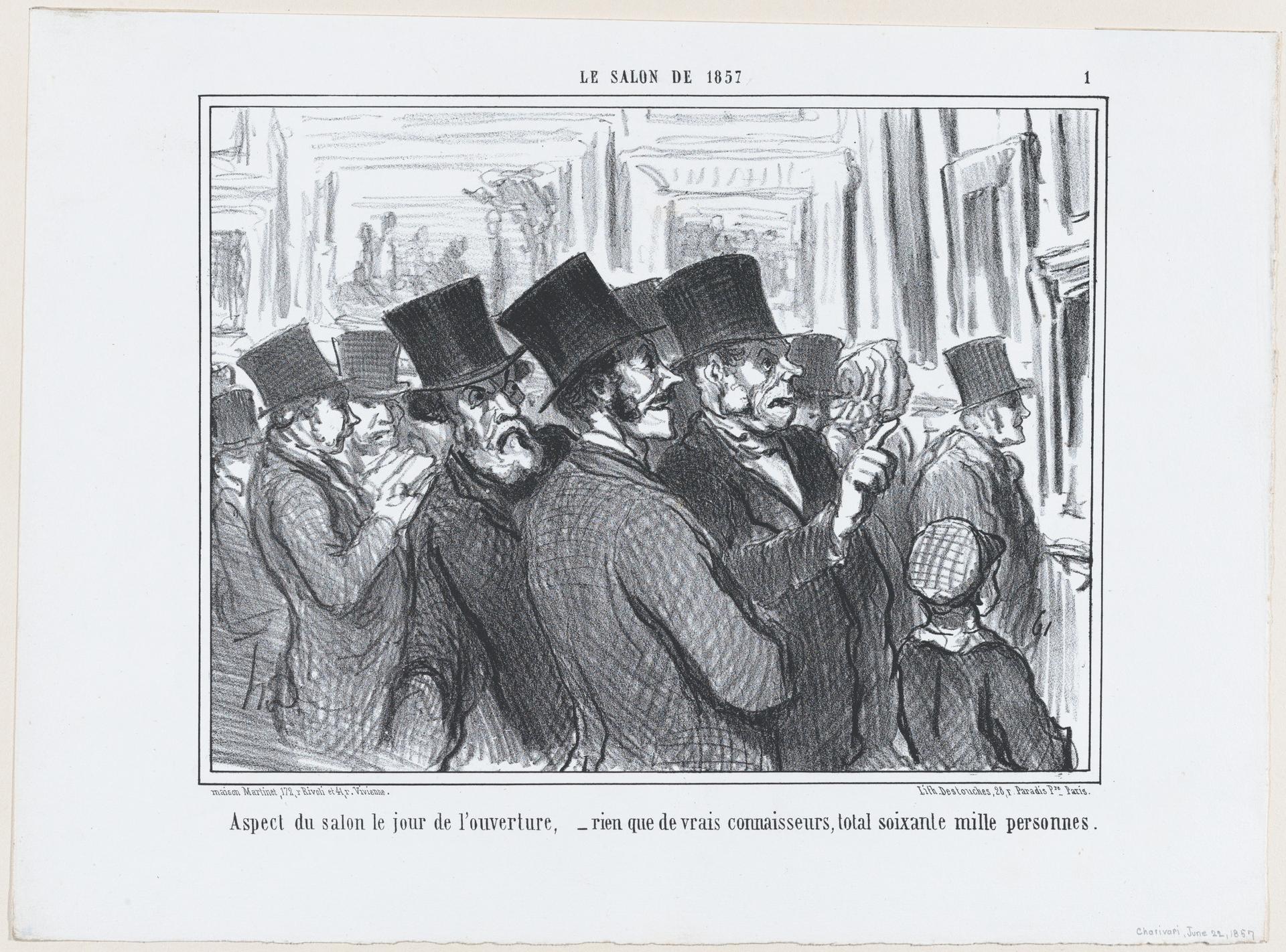
Comment, c'est dans cette cave que sont les scultpures?..., from Le Salon de 1857, published in "Le Charivari"
Original title: Comment, c'est dans cette cave que sont les scultpures?..., from Le Salon de 1857, published in "Le Charivari"
kurzbeschreibung
Men in formal dress stand in a narrow stairwell or passage, talking animatedly. Honoré Daumier drew this scene in 1857 as a lithograph for the series 'Le Salon de 1857', published in the satirical magazine 'Le Charivari'. The print pokes fun at the behavior of the public at the Paris art exhibition.
Description
Several gentlemen in top hats and jackets have gathered in a cramped corridor or stairwell. Some of them look straight out of the picture, while others are deep in conversation. Further back, more people and an open door come into view. The layout is wide and draws the eye into the depth of the space. The lithograph stays in shades of gray, with even light and no strong shadows. The style combines realistic observation with caricatured exaggeration of the figures.
Context
Daumier made the lithograph for the series 'Le Salon de 1857', which he produced for the satirical newspaper 'Le Charivari'. The Salon of 1857 was an official art exhibition in Paris showing contemporary works. In his prints, Daumier regularly commented on the behavior of the public and the art world of his time. The series appeared in July 1857, during the run of the Salon.
Impact
The exaggerated figures and the cramped space create a mood that is both humorous and critical. Because some of the people look outward, the viewer feels directly addressed and almost like a confidant. The monochrome lithograph has a documentary feel, but the caricatural features break that impression again.
Technique
This is a lithograph, a planographic print in which a fatty crayon is drawn on a stone. The present sheet is the second state of two (Delteil), indicating later reworking of the printing plate. It was printed on paper; the linework is fine and shows subtle gradations of gray.
AI-generated description text
Source: Metropolitan Museum of Art · Public Domain (CC0 1.0)