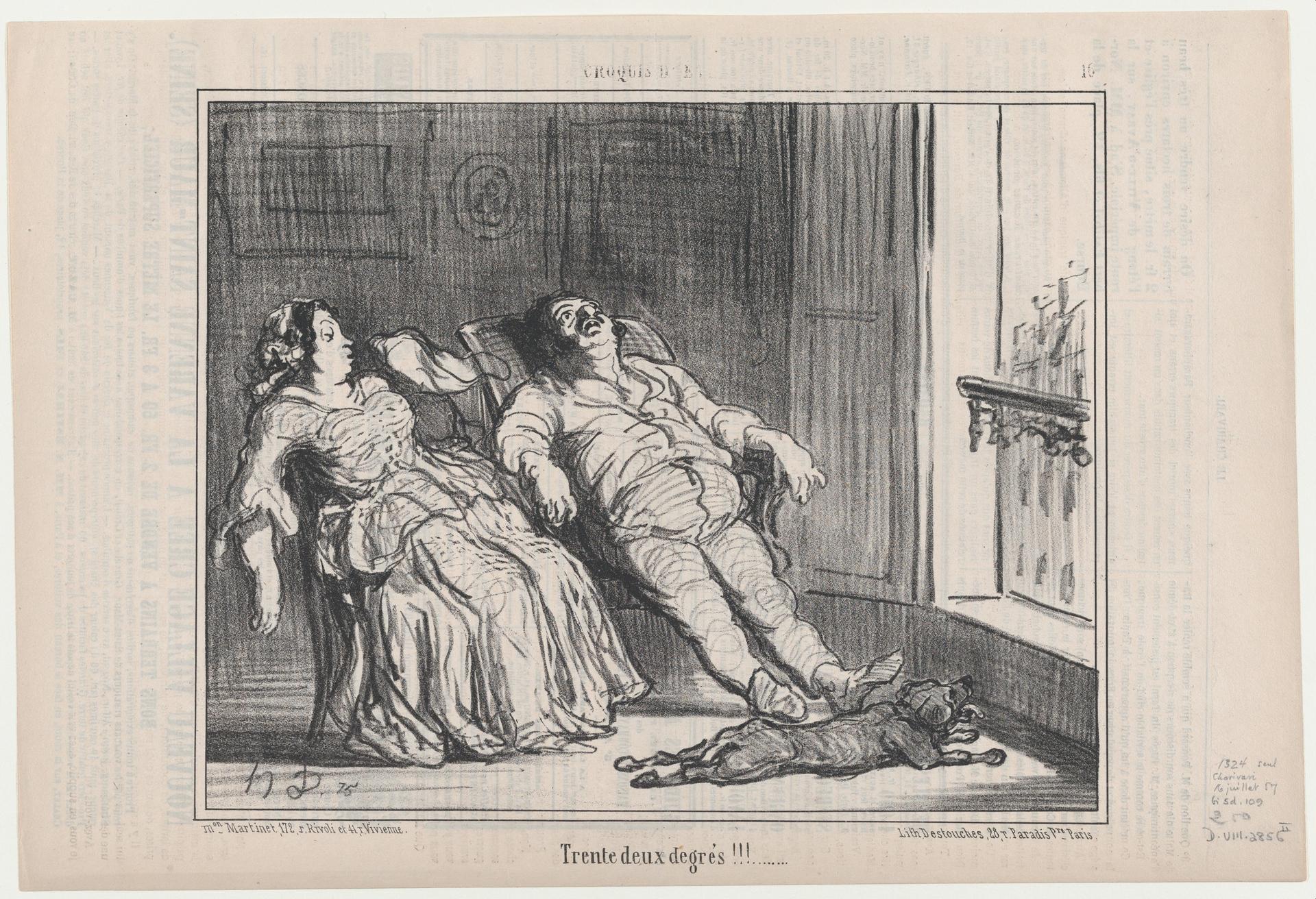
Trente deux degrés, from Croquis d'Été, published in Le Charivari, July 16, 1857
Original title: Trente deux degrés, from Croquis d'Été, published in Le Charivari, July 16, 1857
kurzbeschreibung
Under the exclamation 'Trente deux degrés' — thirty-two degrees — Honoré Daumier made a lithograph on 16 July 1857 for his series 'Croquis d'Été'. The print presents two people in an interior: a seated woman and a man stretched out on a bed. The title comments on the oppressive summer heat and gives the everyday situation a humorous note.
Description
A woman has taken a seat on a chair and looks across at a man lying on a bed. His head appears disproportionately large; he wears a shirt and trousers, his legs spread wide — an uncomfortable pose. The woman is in a long dress and looks worried. A window with curtains and a picture frame on the wall structure the room. Below the image area runs the inscription 'Trente deux degrés !!!'.
Context
On 16 July 1857 the satirical journal 'Le Charivari' published this sheet as part of the series 'Croquis d'Été', which took aim at everyday summer life. The second state of a lithograph is present, of which two impressions are known. Daumier was then working regularly for Paris newspapers and commenting on social and everyday observations.
Impact
The man's exaggerated pose and the dry title immediately provoke laughter. A detailed interior and ironic commentary combine into a relatable, comic atmosphere of heat in which it is hard to endure.
Technique
The sheet was printed as a lithograph on newsprint — a common process for Daumier's satirical series. The black-and-white execution uses fine hatching to model shadows and surfaces. Only minor details on the plate changed from the first to the second state; the image arrangement remained essentially untouched.
AI-generated description text
Source: Metropolitan Museum of Art · Public Domain (CC0 1.0)