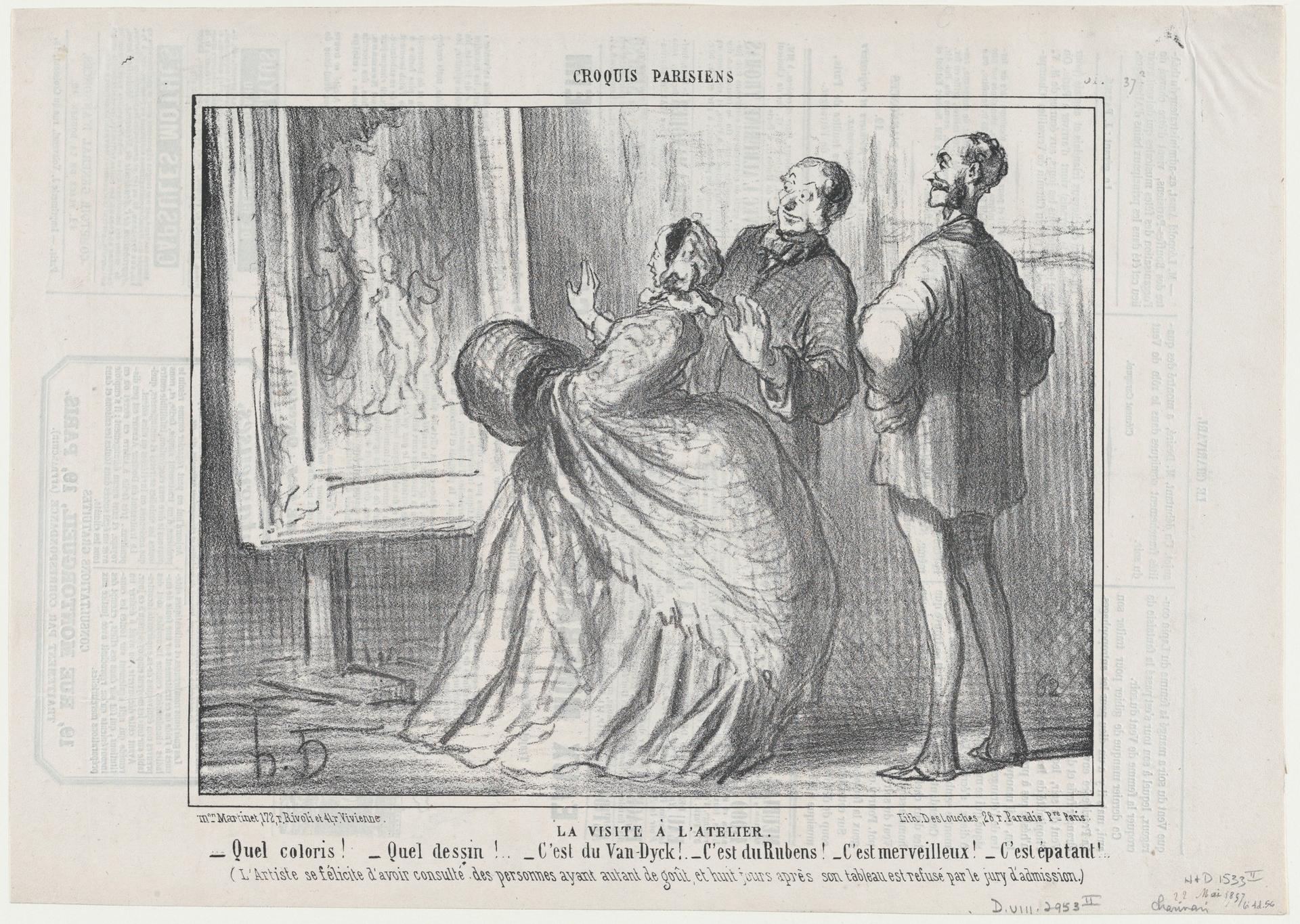
La Visite à l'Atelier, from Croquis Parisiens, published in Le Charivari, May 22, 1857
Original title: La Visite à l'Atelier, from Croquis Parisiens, published in Le Charivari, May 22, 1857
kurzbeschreibung
Issued in 1857, Honoré Daumier's lithograph 'Der Besuch im Atelier' (The Visit to the Studio) presents a small party of visitors inspecting a painter's workspace. The print belongs to the 'Croquis Parisiens' series and appeared in 'Le Charivari'. Four figures are gathered, all taking in a single canvas.
Description
At the front left a woman leans forward, one hand motioning toward a canvas set back in the room. Two men beside her follow her gesture with their eyes; the one on the right wears ordinary street clothes, the other a costume in the Renaissance manner. On the canvas a figure can be made out, partly hidden by a curtain. Drapery and a panel define the studio, rendered entirely in black and white. Everyone faces the middle of the sheet, which gives the layout a sense of movement.
Context
Daumier drew this lithograph for the satirical journal 'Le Charivari', where he regularly caricatured the types of Parisian city life. The 'Croquis Parisiens' series was devoted to everyday scenes and trades of the metropolis. The sheet came out on 22 May 1857 and was printed as the second state of two (Delteil).
Impact
Lively gestures and strong contrasts of light and dark give the print a direct, humorous presence. The viewer feels drawn into a familiar studio situation and watches the interplay between artist and public.
Technique
A lithograph, the work relies on planographic printing, in which a greasy crayon is drawn on the stone. Delicate strokes and graded shading record figures and space in detail. It was printed in black and white, as was usual for press illustrations of the period.
AI-generated description text
Source: Metropolitan Museum of Art · Public Domain (CC0 1.0)