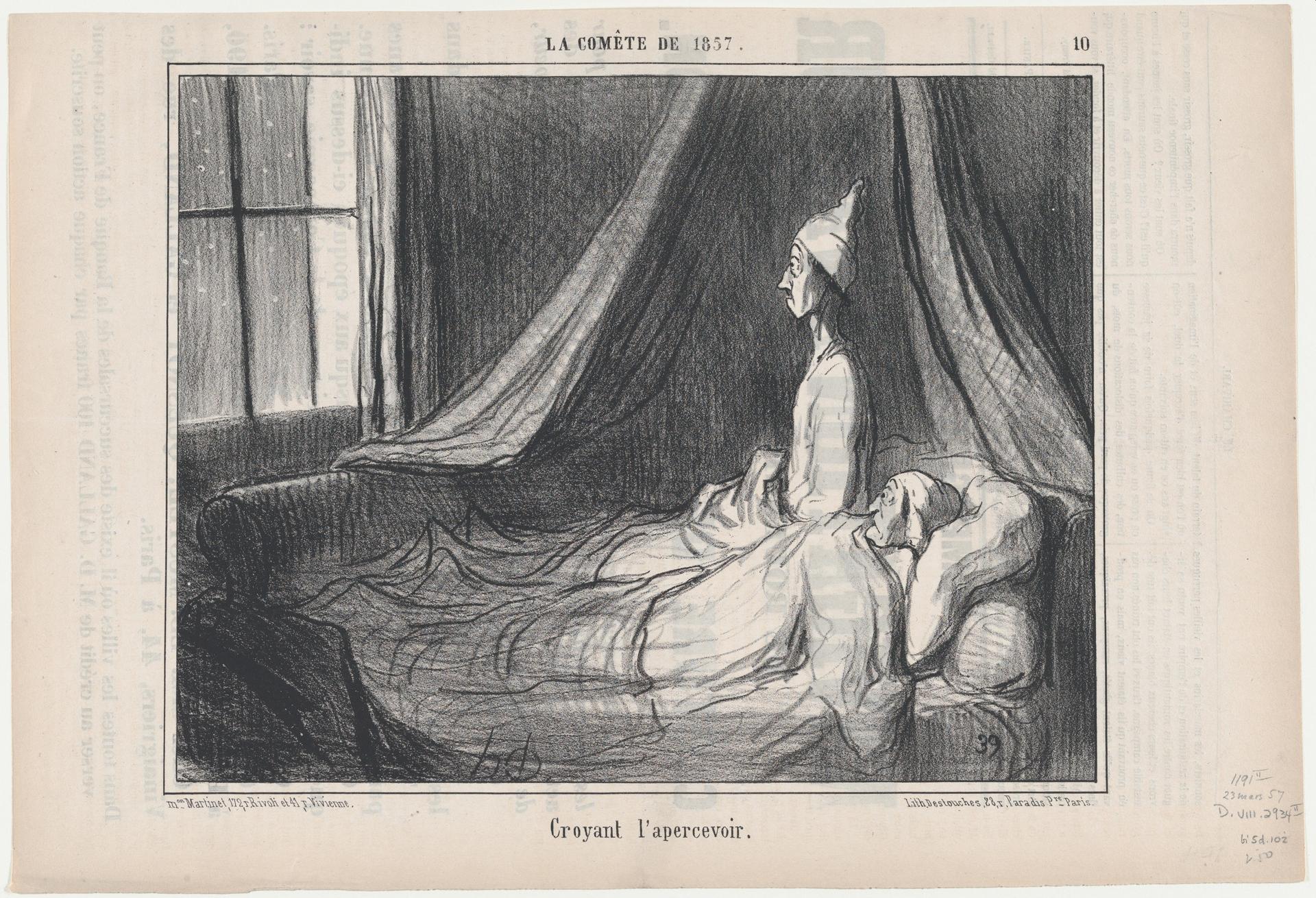
Croyant l'apercevoir, from 'Croquis Parisiens', published in 'Le Charivari'
Original title: Croyant l'apercevoir, from 'Croquis Parisiens', published in "Le Charivari"
kurzbeschreibung
In March 1857, the satirical journal Le Charivari published Honoré Daumier's lithograph 'Croyant l'apercevoir' (I thought I saw her), part of his series 'Croquis Parisiens'. The print leads into a bare Parisian apartment: one person sits on a sofa, another lies on a bed. Both figures are wrapped in the clothing of the 19th century.
Description
On the left, a person sits on a sofa, looking left; on the right, another lies on a bed, gaze also turned left. Both wear 19th-century dress. Curtains and a window structure the background, where daylight falls in, creating contrasts of light and dark. The layout feels balanced: the seated figure on the left, the reclining one on the right. The lithograph's greys give the sheet a monochrome effect with clear contours and nuanced shading.
Context
The 'Croquis Parisiens' were conceived as satirical observations of big-city life. Daumier published this sheet on 23 March 1857 in Le Charivari, a journal known for caricature and political satire. The present impression is the second state of two. The lithograph belongs to Daumier's extensive printed oeuvre, which he produced alongside his work as a painter and sculptor.
Impact
A quiet, intimate mood emanates from the sparse furnishings and the incoming light. The balanced arrangement of the two figures and the monochrome tonality draw attention to their togetherness. The image feels everyday and yet thoughtful, without dramatic escalation.
Technique
The sheet was made as a lithograph, drawn with greasy chalk on a stone. The second state of two points to later reworking of the printing stone. The sheet measures 25.8 × 35.6 cm, the image itself 21 × 25 cm; the technique is evident in the typical sharp contours and fine shading.
AI-generated description text
Source: Metropolitan Museum of Art · Public Domain (CC0 1.0)