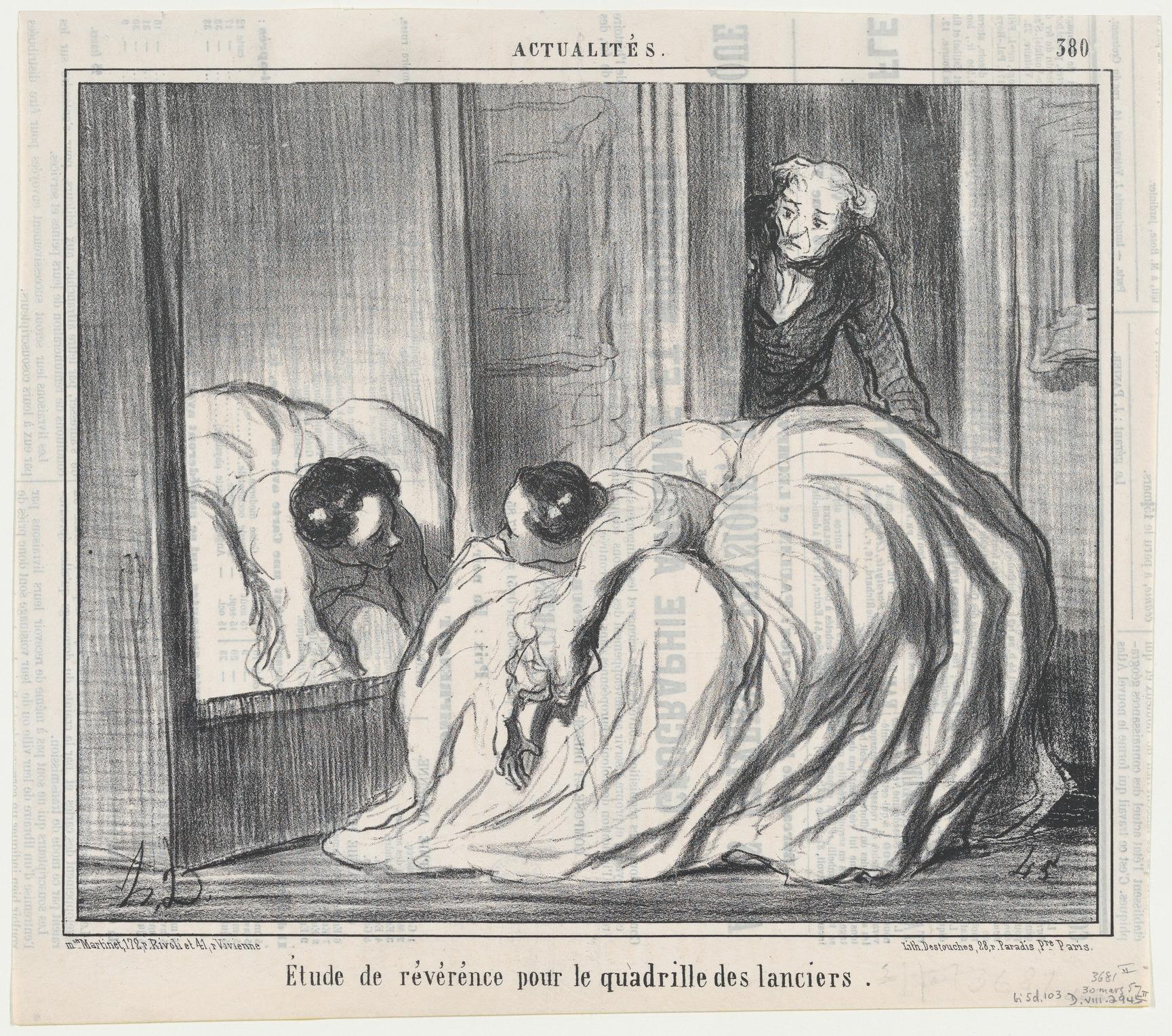
Étude de révérence pour le quadrille des lanciers
Original title: Étude de révérence pour le quadrille des lanciers, from Actualités, publlished in Le Charivari, March 30, 1857
kurzbeschreibung
Honoré Daumier captured three women in traditional dress in 1857, bowing before a mirror as they rehearse a lanciers quadrille. The print appeared on 30 March of that year in the satirical journal Le Charivari; this is the second state of the lithograph according to Delteil.
Description
On the right, a pair kneels with heads lowered, while the third woman on the left directs her gaze into the mirror. An older observer stands behind, watching the younger ones. The layout feels orderly: the practitioners in front, the spectator behind. Light falling from the front sharply defines contours and shadows. Realistic touches blend with caricatural exaggerations in posture and accessories.
Context
Le Charivari, known for political and social satire, published the sheet on 30 March 1857. Within Daumier's Actualités series, it takes up a contemporary social phenomenon. The lanciers quadrille was among the popular dances in France at the time, so the dancers' preparations offered a welcome occasion for mockery.
Impact
Stiff bows and restrained poses appear exaggerated, holding the courtly dance ritual at an ironic distance. Viewers watch a private rehearsal that is at once comic and elegant. A subtle tension arises between grace and absurdity.
Technique
The artist worked with greasy chalk on the stone, using the planographic process of lithography. The black-and-white impression relies on fine hatching and clear contours typical of Daumier. Delteil records two states; the present one is the second.
AI-generated description text
Source: Metropolitan Museum of Art · Public Domain (CC0 1.0)