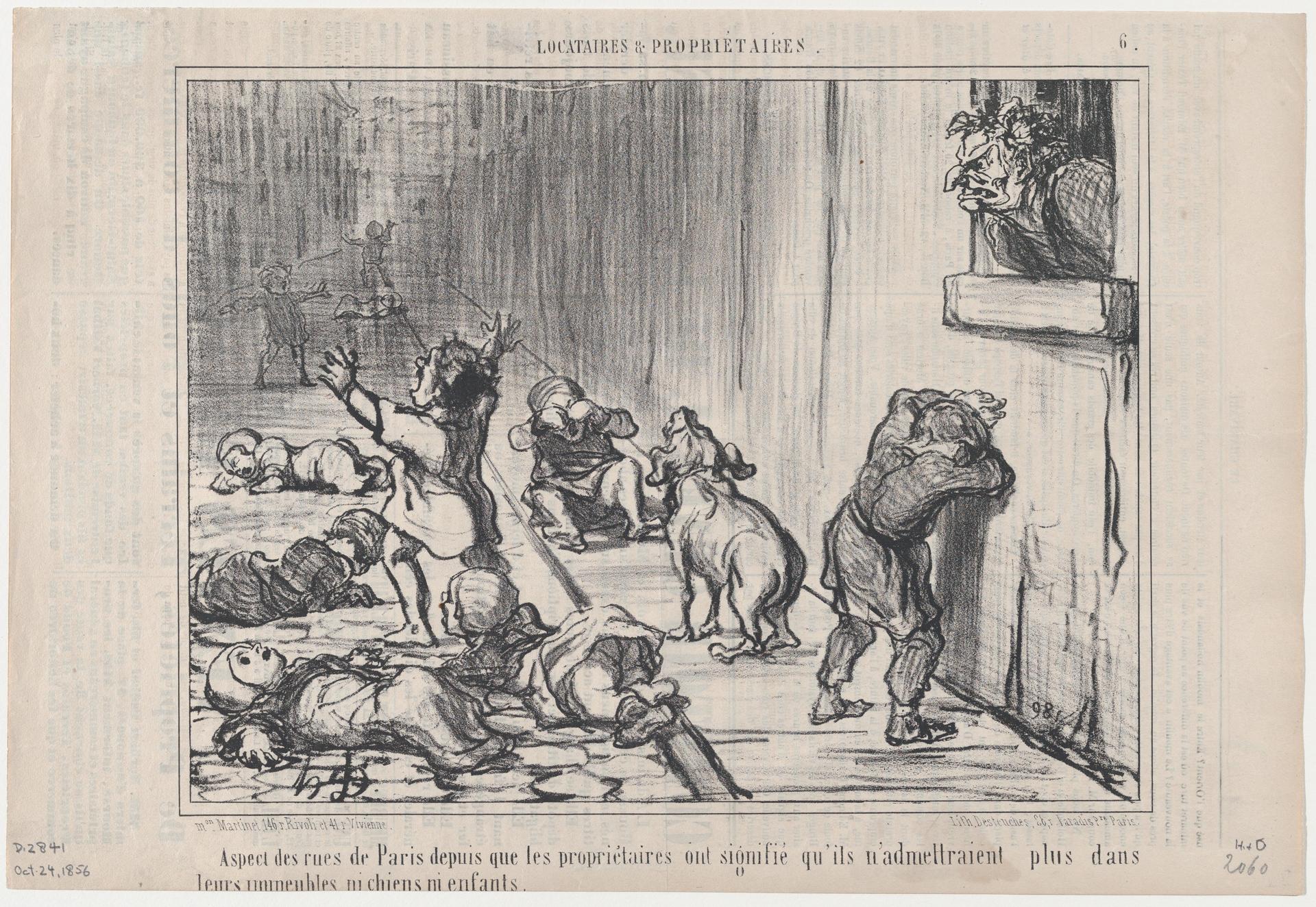
Aspect des rues de Paris depuis..., from Locataires et Propiétaires, published in Le Charivari, October 24, 1856
Original title: Aspect des rues de Paris depuis..., from Locataires et Propiétaires, published in Le Charivari, October 24, 1856
kurzbeschreibung
Honoré Daumier's 1856 lithograph stages a chaotic Paris street scene. It belongs to the series Locataires et Propriétaires (Tenants and Landlords) and survives in the third of three states (Delteil). What Daumier puts on view is an exaggerated account of a violent incident in everyday big-city life.
Description
Across the foreground floor several figures lie sprawled, some plainly wounded or dying. One figure at the middle throws up both arms, as if fending something off or calling for help. Just to the right stands someone in a defensive posture, while further back other people mill about in assorted poses, a few of them seemingly dancing. At the upper left a figure with a stick points at another, and at the upper right a face glowers from a window. Everything stays in a single tone, evenly lit and wholly shaped by the caricatural manner, with distorted features and a restless layout.
Context
The print appeared in the satirical journal Le Charivari on 24 October 1856. Daumier made it for the series Locataires et Propriétaires, in which he worked through the tense relationship between renters and owners in nineteenth-century Paris. The view can be read as an echo of the social friction and cramped housing of a fast-growing city.
Impact
The overwrought figures and dramatic staging hit the viewer at once. Daumier's blend of violence and grotesque humor leaves an unsettling impression and prompts reflection on the social grievances of the period.
Technique
Daumier worked in lithography, drawing with greasy chalk directly onto the stone. That method allowed him fine strokes and gradations of shading, which carry the expressive force of his figures. The third state represents the final form of the print.
AI-generated description text
Source: Metropolitan Museum of Art · Public Domain (CC0 1.0)