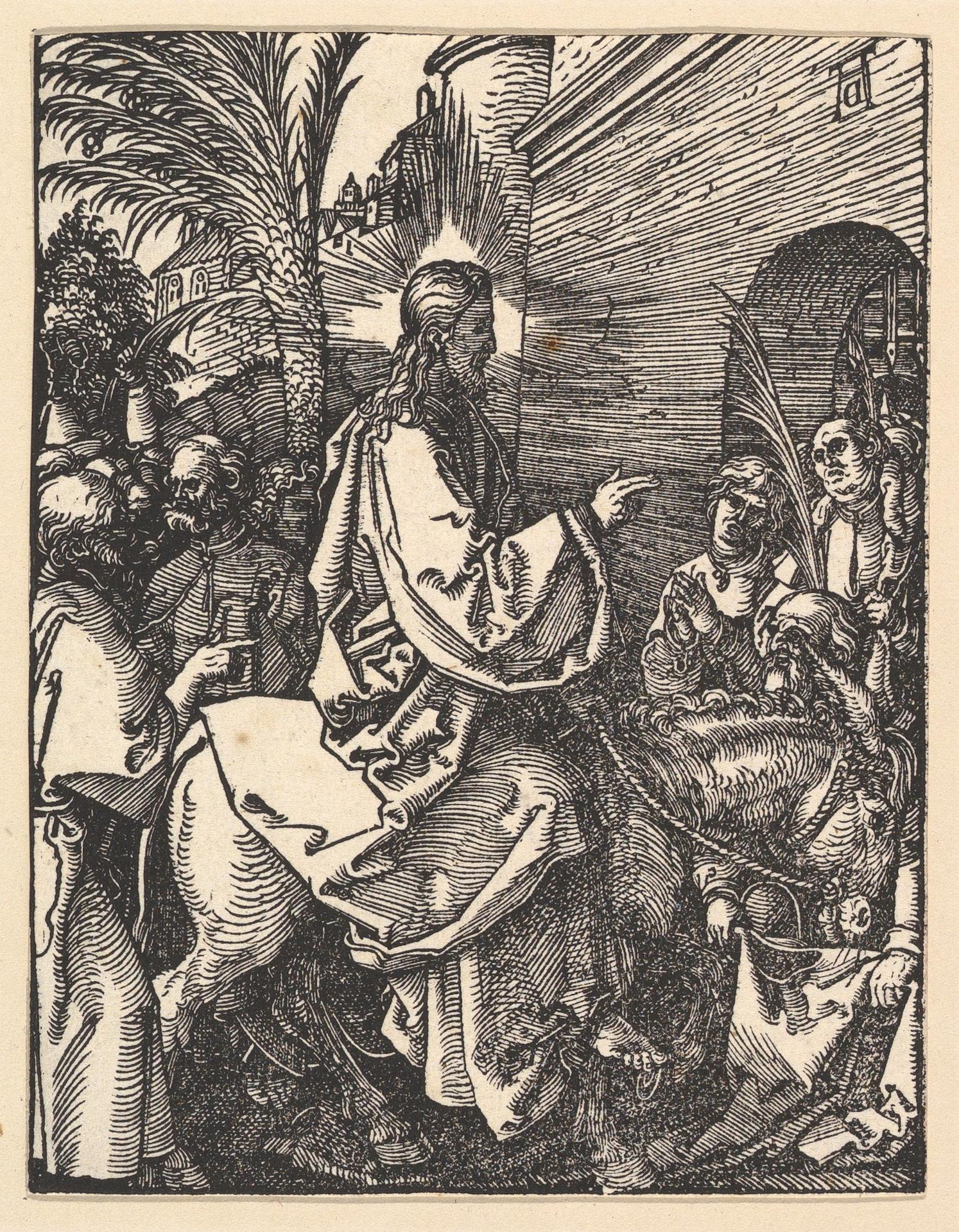
Christ's Entry into Jerusalem, from "The Small Passion"
Original title: Christ's Entry into Jerusalem, from "The Small Passion"
kurzbeschreibung
Albrecht Dürer's woodcut, created around 1508, depicts Jesus entering Jerusalem on a donkey, surrounded by a crowd holding palm branches. This print is part of the renowned series "The Small Passion." The scene is set in a city with buildings and palms in the background, rendered in monochrome.
Description
The composition centers on Jesus riding a donkey, making him the focal point. A group of figures, dressed in traditional robes, surrounds him, some holding palm branches. The background features urban architecture and palm trees, indicating the city setting. The monochrome palette uses various shades of gray, created by intricate line work and shading. The light is diffuse and even, typical of woodcuts from this period.
Context
Dürer created this woodcut as part of "The Small Passion," a series of 37 prints illustrating the Passion of Christ, published in 1511. The series was highly popular and contributed to Dürer's fame across Europe. Dürer was a master of printmaking, and his woodcuts were known for their technical precision and expressive detail.
Impact
The dynamic composition draws the viewer's eye to Jesus, emphasizing his significance in the narrative. The detailed line work and shading give the scene a sense of depth and texture, making the woodcut visually engaging despite its monochrome nature. The overall effect is both dramatic and reverent, fitting for the subject matter.
Technique
This is a woodcut, a relief printing technique where the image is carved into a wooden block. Dürer's precise cutting allows for fine lines and subtle shading, creating a rich tonal range. The print is monochrome, using black ink on paper to produce varying grays through line density and cross-hatching.
AI-generated description text
Source: Metropolitan Museum of Art · Public domain (CC0)