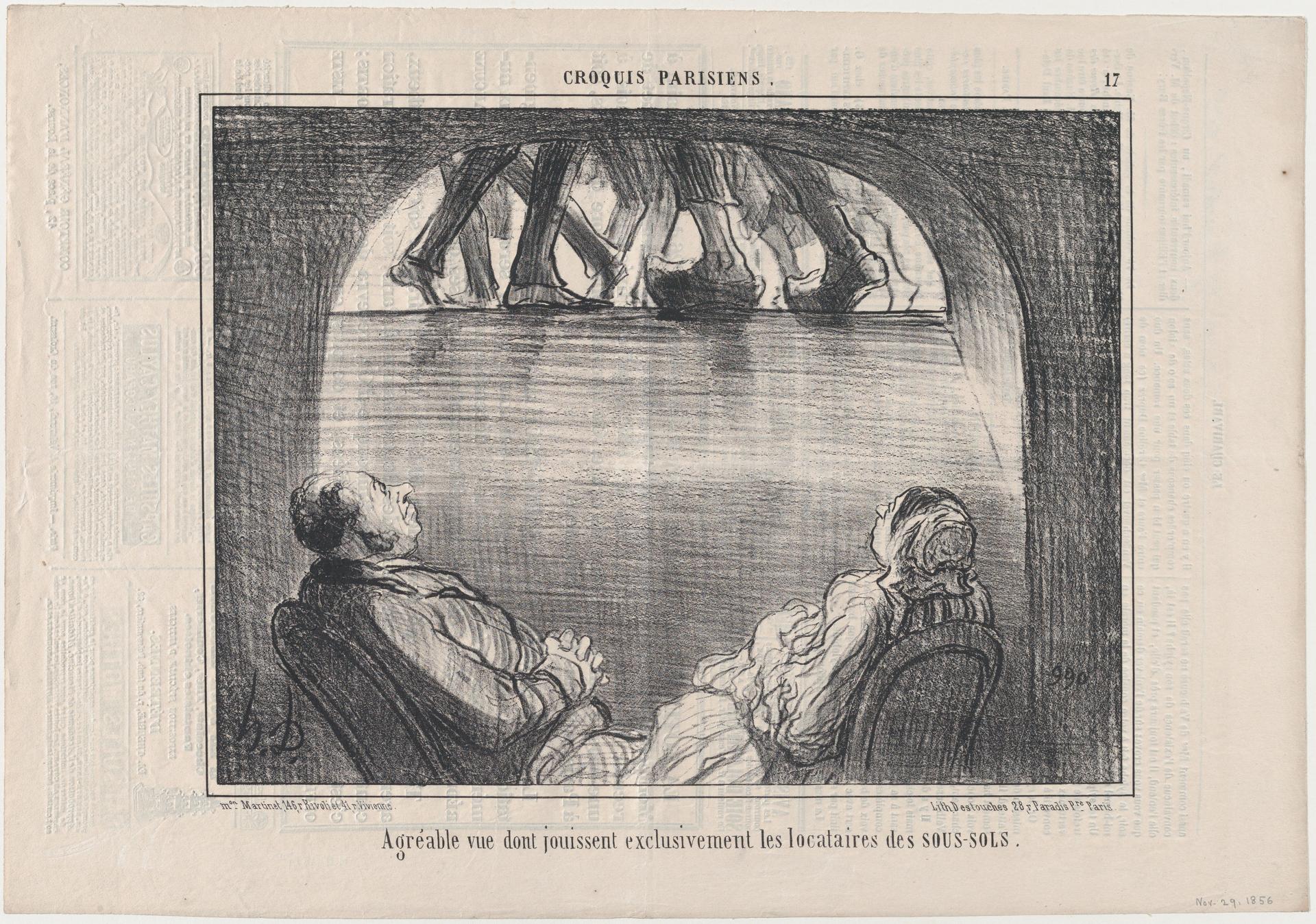
Agréable vue...des sous-sous, from Croquis Parisiens
Original title: Agréable vue...des sous-sous, from Croqius Parisiens, published in Le Charivari, November 29, 1856
kurzbeschreibung
Honoré Daumier's lithograph "Agréable vue... des sous-sous" from 1856 appeared in the series "Croquis Parisiens" in the journal Le Charivari. The print presents two figures in a gloomy underground room, their gazes directed through an open doorway with columns and arched light. Executed in monochromatic grays, the work is the second of two known print states (Delteil).
Description
Two seated figures in the foreground draw the eye toward an open door in the background, through which bright arched light enters. This contrast plunges the shadow-streaked room into a deep, almost oppressive atmosphere. The figures are rendered with precise detail, while fine hatching and graduated grays provide the modeling. The symmetrical arrangement of the layout leads the eye directly to the illuminated portal at the center.
Context
For the satirical newspaper Le Charivari, Daumier created the series "Croquis Parisiens," in which this print was published on November 29, 1856. It belongs among everyday scenes that observed Parisian city life with a critical eye. The title ironically alludes to basement apartments, which in the Second Empire often meant cramped living conditions. Daumier was by then an experienced caricaturist who addressed social ills through his picture series.
Impact
Deep shadows and harsh arched light create a mysterious, almost stifling mood. The symmetrical arrangement and the waiting figures give the scene a quiet but tense atmosphere. The contrast between darkness and light draws the viewer to the central doorway and at the same time evokes curiosity and unease.
Technique
As a lithograph—a planographic process in which a design is drawn with greasy chalk on limestone and then printed—the print uses fine hatching and graduated grays to model light and shadow precisely. It exists in the second of two known states, indicating later reworking of the printing plate. The image measures 19.4 × 25.8 cm on a sheet of 26 × 37.2 cm.
AI-generated description text
Source: Metropolitan Museum of Art · Public Domain (CC0 1.0)