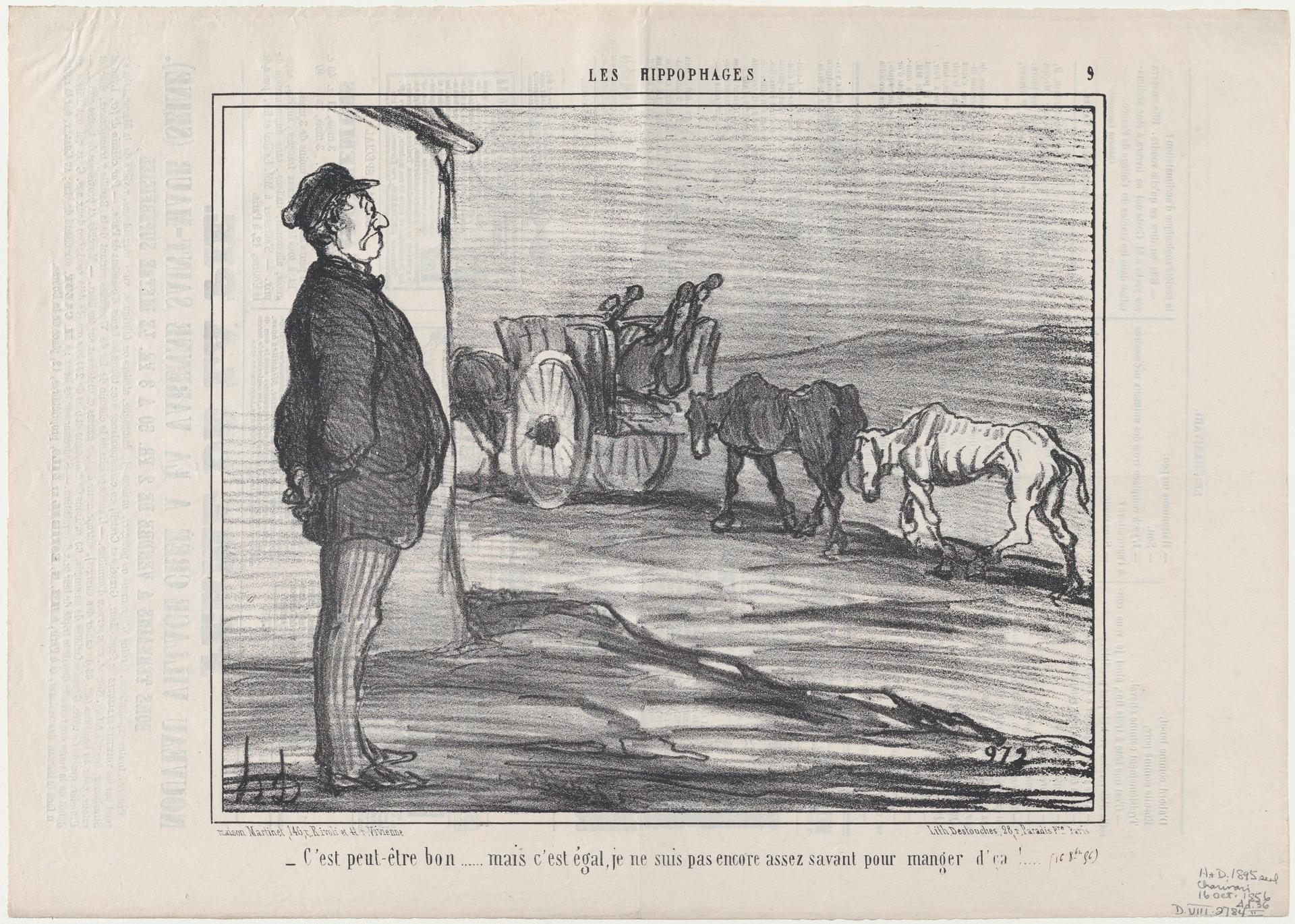
C'est peut-être bon...mais c'est égal..., from Les Hippophages
Original title: C'est peut-être bon...mais c'est égal..., from Les Hippophages, published in Le Charivari, October 23, 1856
kurzbeschreibung
Unlike many equestrian images of its day, this 1856 lithograph by Honoré Daumier settles on an ordinary, almost offhand moment: a man stands beside a horse, while behind them a wagon pulled by two horses is loaded with musical instruments. The sheet belongs to the series 'Les Hippophages' and appeared on 23 October 1856 in the journal 'Le Charivari'. A flat landscape provides the quiet setting for this unusual grouping.
Description
Turned to the side and wrapped in a coat and cap, a man stands in the foreground and looks out of the picture thoughtfully. Beside him a horse has turned its head toward the wagon, which is drawn by two more horses and piled with objects that resemble musical instruments. The backdrop is a flat stretch of land with a few trees and a sky crossed by horizontal strokes. Black and white throughout, the drawing relies on contours and shading to create depth and texture.
Context
This lithograph was published in the satirical journal 'Le Charivari'; it comes from the series 'Les Hippophages', which takes a humorous look at the eating of horse meat. Daumier made the work during the Second Empire, a time of political and social tension in France. The series refers to the then-controversial practice of horse-meat consumption, which some circles promoted as a response to food shortages.
Impact
With its caricatural exaggeration of the figures and the odd situation, the print feels humorous and at the same time prompts reflection. The pared-down imagery and clear outlines draw attention to the relationship between human and animal, producing a quiet irony.
Technique
For this sheet Daumier chose lithography, a planographic process in which a design is drawn on stone with greasy chalk. The work is the second state of two (Delteil), indicating later revisions to the printing stone. Fine hatching and the use of shadow give it a lively texture characteristic of Daumier's prints.
AI-generated description text
Source: Metropolitan Museum of Art · Public Domain (CC0 1.0)