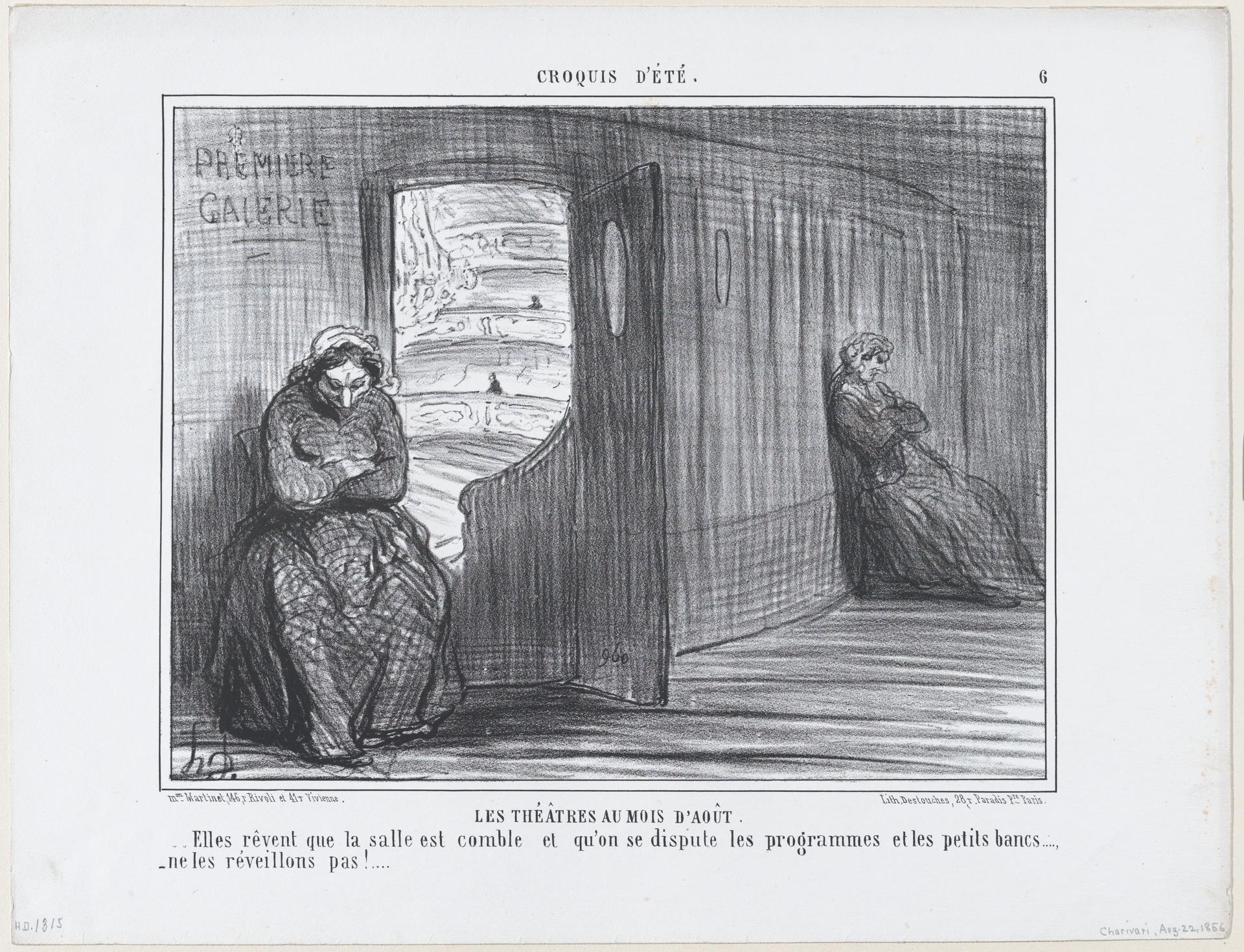
Les Théâtres au Mois d'Août, from Croquis d'Été, published in Le Charivari, August 21, 1856
Original title: Les Théâtres au Mois d'Août, from Croquis d'Été, published in Le Charivari, August 21, 1856
kurzbeschreibung
Two women sit in a theatre auditorium and let the performance wash over them, a subject Honoré Daumier captured in a lithograph in 1856. The print belongs to the series "Croquis d'Été" and appeared in the satirical journal Le Charivari. With humour, the artist looks at the summer outing to the theatre.
Description
Two women occupy a theatre box. The one on the left has her arms crossed and her eyes shut; the one on the right, arms likewise folded, looks pensive. A sign reading "Première Galerie" can be made out behind them. Light enters from the left and picks out shadows and textures. Everything stays in shades of grey.
Context
The lithograph was published on 21 August 1856 in Le Charivari, a French satirical journal. It comes from Daumier's series "Croquis d'Été", in which he recorded summer observations of everyday Parisian life. The print takes up the era's social habit of theatregoing and comments on it with a satirical edge.
Impact
Caricatural exaggeration makes the scene funny and thoughtful at once. The restrained monochrome treatment draws attention to the women's expressions and postures, which give off a tired or bored mood. Everyday observation thus meets quiet irony about the theatre habits of the day.
Technique
This impression is a lithograph in the second state of two (Delteil). It measures 27.5 × 35.8 cm for the sheet and 19.7 × 25.7 cm for the image. Lithography allowed the subtle shading and precise detail that Daumier used for his satirical work.
AI-generated description text
Source: Metropolitan Museum of Art · Public Domain (CC0 1.0)