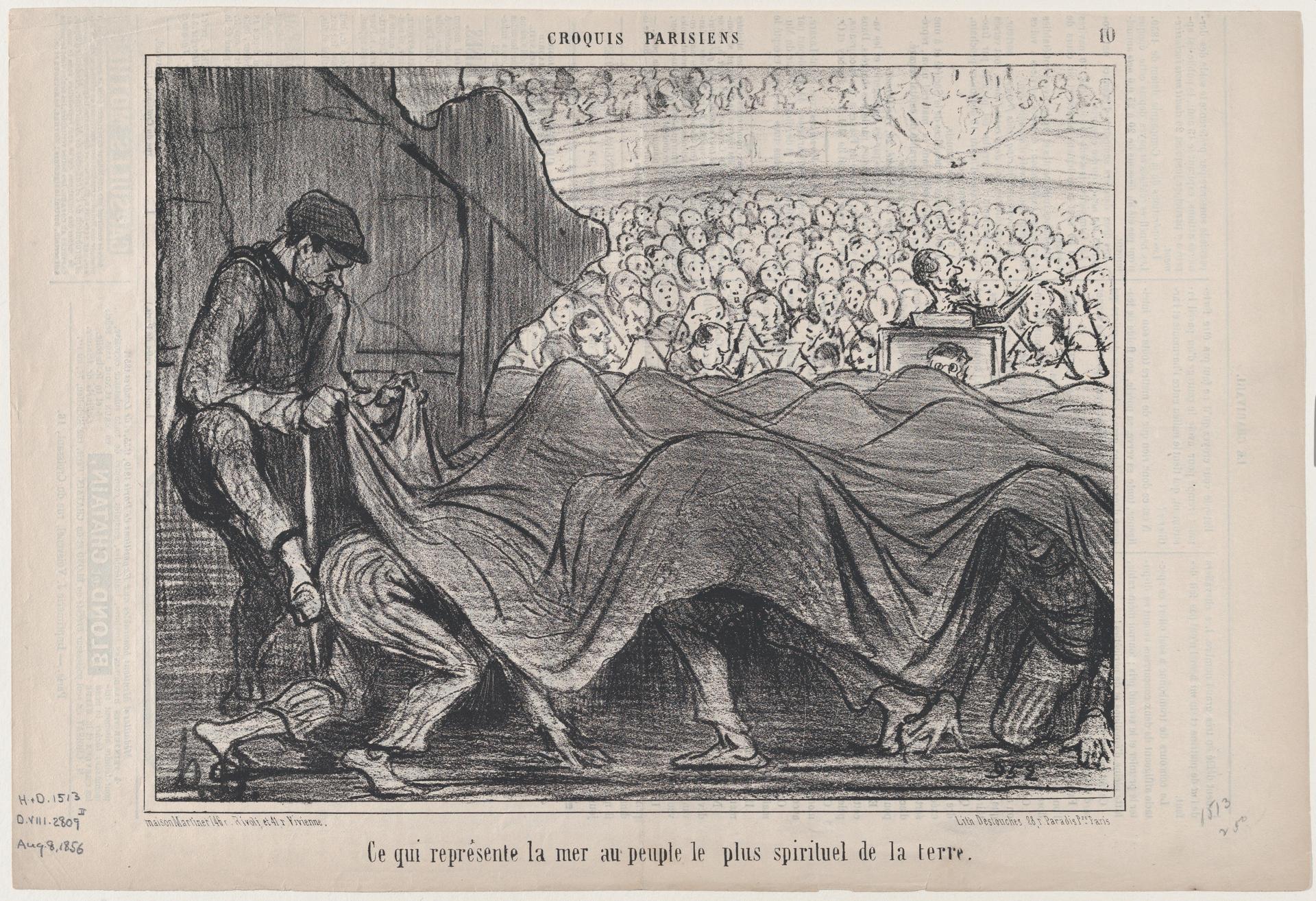
Ce qui représente la mer au peuple..., from "Croquis Parisiens"
Original title: Ce qui représente la mer au peuple..., from "Croquis Parisiens"
kurzbeschreibung
Unlike many sheets in the 'Croquis Parisiens' series, this 1856 lithograph by Honoré Daumier does not focus on a single type but on the audience itself. A crowd in a theater hall follows a figure on stage. This is the second state of two (Delteil).
Description
An interior recognizable as a theater or meeting hall opens across the rows of spectators toward the stage. Many people are seated, some stand, and nearly all faces are turned forward. There, a lone figure in jacket and cap holds a microphone or similar device. Grays and blacks dominate; frontal light picks out the contours of the figures and the structure of the space. The strong perspective toward the stage and the speaker gives the layout dynamism.
Context
Daumier drew this sheet in August 1856 for the 'Croquis Parisiens' series, in which he followed Parisian city life with a satirical eye. He was known for socially critical motifs that skewered the manners and types of Parisian society. That a crowd here follows a speech points to the political gatherings and public lectures common under Napoleon III in the Second Empire.
Impact
The viewer feels placed in the audience rows, so close is the view to the action. Tense postures and concentrated gazes create a dense atmosphere that makes the speaker the focal point of attention. Because the image remains largely restricted to grays, the documentary aspect of the scene stands out.
Technique
The sheet was produced by lithography: drawing with greasy chalk on a limestone, from which prints are then taken. Daumier used the process for fine shading and lively lines. The second state means that the stone was reworked after the first printing before the final version was made.
AI-generated description text
Source: Metropolitan Museum of Art · Public Domain (CC0 1.0)