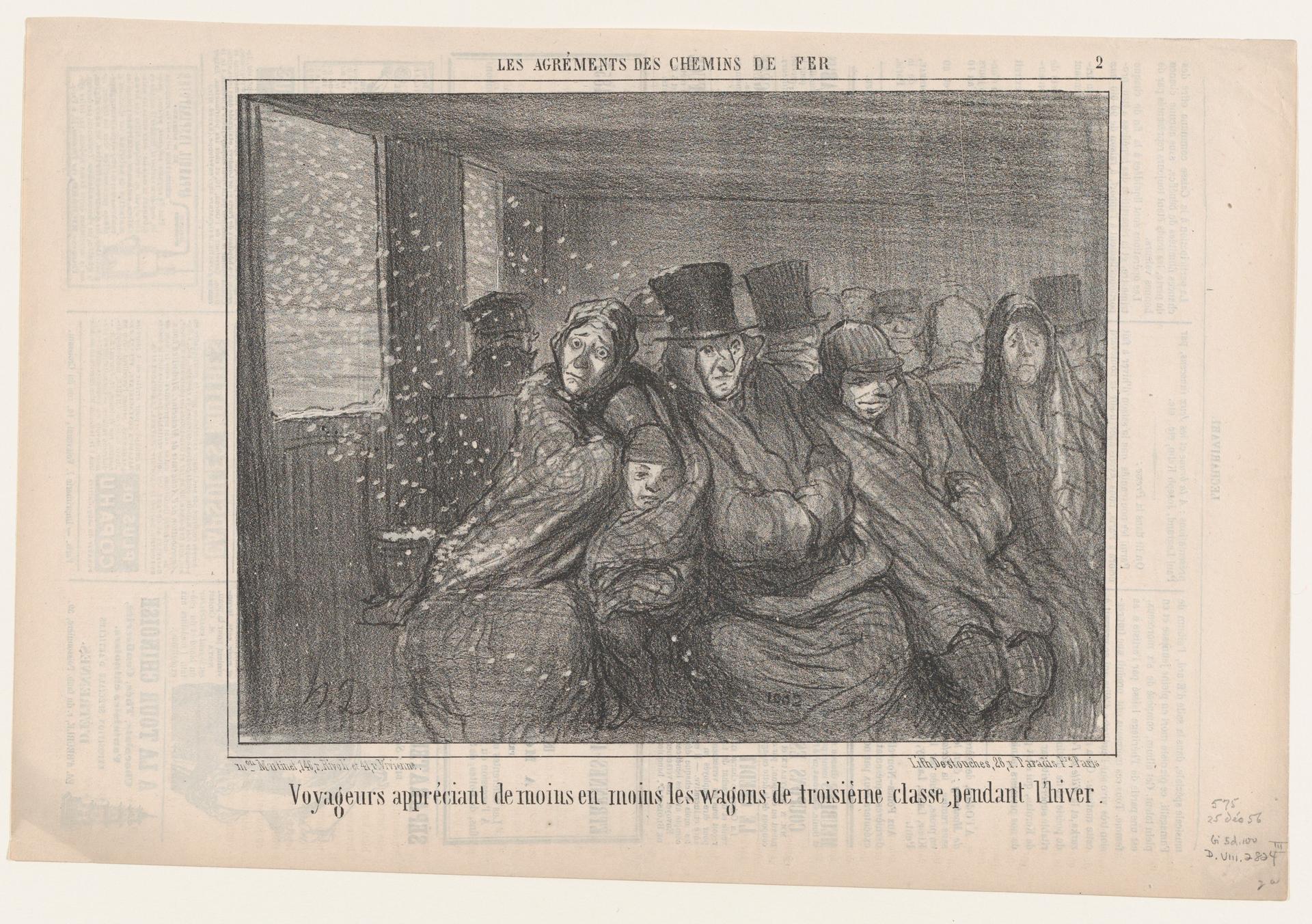
Voyageurs appréciant de moins en moins les wagons de troisième classe pendant l'hiver
Original title: Voyageurs appréciant de moins en moins les..., from Les Agréments des Chemins de Fer, published in Le Charivari, December 25, 1856
kurzbeschreibung
Honoré Daumier's lithograph from 1856 presents a crowd of passengers exposed to the winter cold in a third-class carriage. It belongs to the series 'Les Agréments des Chemins de Fer' and appeared on December 25, 1856, in 'Le Charivari'. The image is executed in monochrome gray tones; the image area measures 18.7 × 25 cm.
Description
Wrapped in heavy winter clothing, the travelers sit in the compartment, some with caps, scarves, or blankets. Tired, dissatisfied expressions mark their faces, making the cold and discomfort palpable. On the left side of the image, a window opens onto falling snow, underscoring the winter's severity. The layout runs horizontally, with the figures as the focal point. Fine strokes and hatching of the lithograph produce graduated gray tones.
Context
At the time of its creation, the railway was gaining increasing importance in France, and third-class travel was an everyday reality for many. In 1856, Daumier published the series 'Les Agréments des Chemins de Fer' in the satirical journal 'Le Charivari'. The print of December 25, 1856, represents the second of two states (Delteil). It is part of Daumier's critical view of social grievances in modern transport.
Impact
Cold and oppressiveness are immediately felt when looking at the image, reinforced by the winter atmosphere and the resigned expressions of the passengers. The finely graded shading draws attention to clothing and facial expressions, thus clearly highlighting the social situation of the third class. The tight composition allows the viewer to empathize with the travelers' distress.
Technique
The drawing was made with greasy chalk on the stone, from which it was subsequently printed. Varying hatching and the grain of the chalk create fine lines and gray gradations. The present work is the second of two states, indicating a reworking of the plate. The sheet measures 24.7 × 36.8 cm, the image area 18.7 × 25 cm.
AI-generated description text
Source: Metropolitan Museum of Art · Public Domain (CC0 1.0)