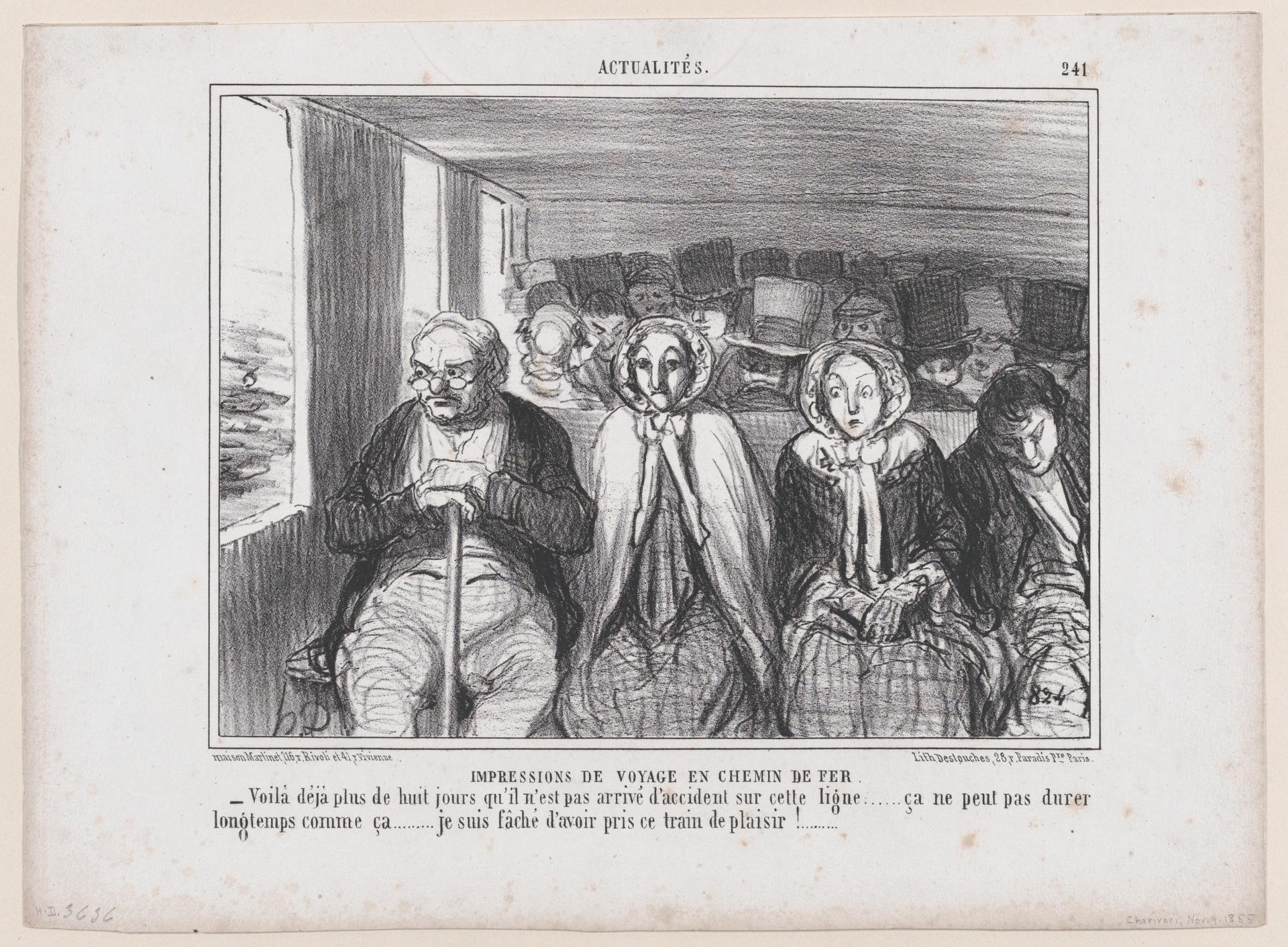
Impressions de Voyage en Chemin de Fer, from Actualités, published in "Le Charivari"
Original title: Impressions de Voyage en Chemin de Fer, from Actualités, published in "Le Charivari"
kurzbeschreibung
Honoré Daumier made this lithograph in 1855 under the title 'Impressions de Voyage en Chemin de Fer'. It pictures a group of travellers inside a railway carriage. The print belongs to the series 'Actualités' and came out on 9 November 1855 in the satirical journal 'Le Charivari'. In it Daumier pokes fun at the different ways passengers react to the still fairly new experience of riding a train.
Description
Several people sit packed closely together in a compartment. Up front an elderly gentleman has taken his place with a walking stick, and behind him other travellers are arranged, among them women in traditional dress. The faces vary widely and register quite different feelings during the journey. Light falls into the carriage from outside and brings the action into view. The image stays in shades of grey and keeps a caricatural, humorous character throughout.
Context
By the time the lithograph appeared in 1855, the railway was long established in France, yet many people still found it unfamiliar. Daumier published the sheet in the satirical journal 'Le Charivari', known for its socially critical caricatures. The 'Actualités' series took up current events and social phenomena of the Second Empire. Train passengers recur again and again in Daumier's work, where they negotiate how industrialisation was changing everyday life.
Impact
The exaggerated faces and the comic line-up of figures set the viewer laughing straight away. What is caught here is the absurdity and unease that the new technology of travel stirred in many contemporaries. One smiles at the scene, which remains at the same time a critical observation of modern life.
Technique
For this sheet Daumier chose lithography: the image is drawn with greasy chalk on a limestone and then transferred to paper. The grey tones come about through strokes and hatching of varying density. This method allowed the artist to work quickly and in large editions, which a journal like 'Le Charivari' required.
AI-generated description text
Source: Metropolitan Museum of Art · Public Domain (CC0 1.0)