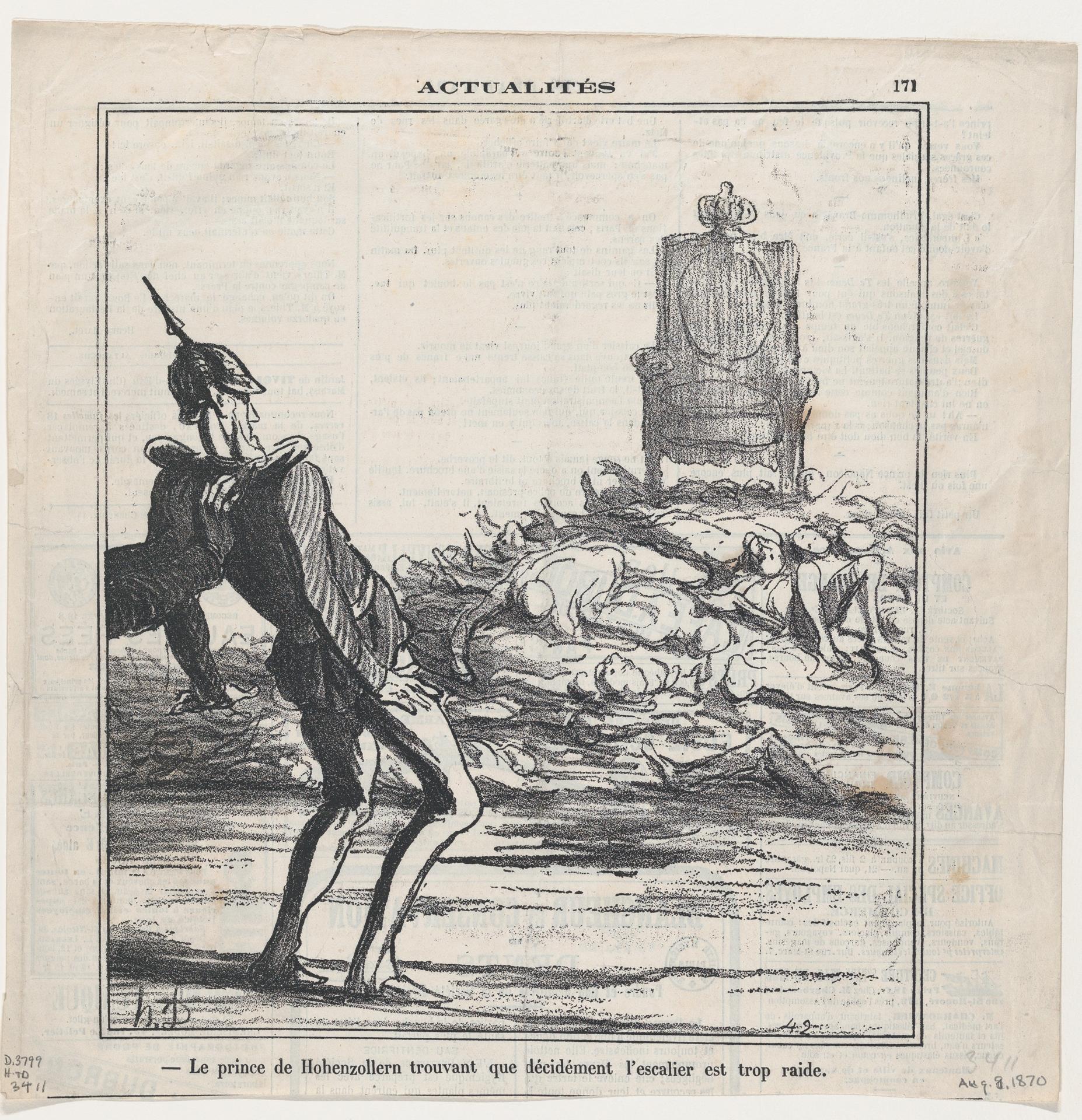
Intérieur d'un magasin de St. Pétersbourg..., from Actualités, published in Le Charivari, December 23, 1854
Original title: Intérieur d'un magasin de St. Pétersbourg..., from Actualités, published in Le Charivari, December 23, 1854
kurzbeschreibung
Honoré Daumier drew a caricature in 1854 titled 'Intérieur d'un magasin de St. Pétersbourg', published in the satirical journal Le Charivari as part of the 'Actualités' series. It shows a weary man in uniform standing before a throne with a crown, while figures lounge on the ground around him.
Description
In the foreground, a man in uniform has propped himself up: one hand rests on his knee, the other holds his hat—a posture that betrays fatigue. Behind him rises a throne topped with a crown, surrounded by many people lying stretched out or slumped on the floor. These figures look asleep or drained, creating an impression of general exhaustion. The rendering stays monochrome, with even lighting and no strong contrasts, as was typical for lithographs of the period.
Context
The print was published on December 23, 1854, in Le Charivari, a French journal known for political and social caricatures. It was made during the Crimean War (1853–1856), in which Russia played a major role. The view inside a St. Petersburg shop likely alludes to Russian society or the course of the war; contemporary readers understood the exact reference without explanation. The print is recorded as the second state of two (Delteil), issued in the 'Actualités' series.
Impact
The caricature is both comic and critical, because the figures' exhaustion is exaggerated and the throne and lounging people stand oddly side by side. The spare, monochrome execution lets the eye wander over the contrasts in the layout—here standing, there lying figures. All in all, an ironic distance from the events shown remains perceptible.
Technique
The print was made by lithography: drawn with greasy chalk on a limestone, then transferred. Daumier often used this method for his satirical series because it allowed quick and inexpensive production of editions. The sheet measures 36.7 × 24.8 cm, the image area 23 × 20.4 cm; it survives as the second of two states.
AI-generated description text
Source: Metropolitan Museum of Art · Public Domain (CC0 1.0)