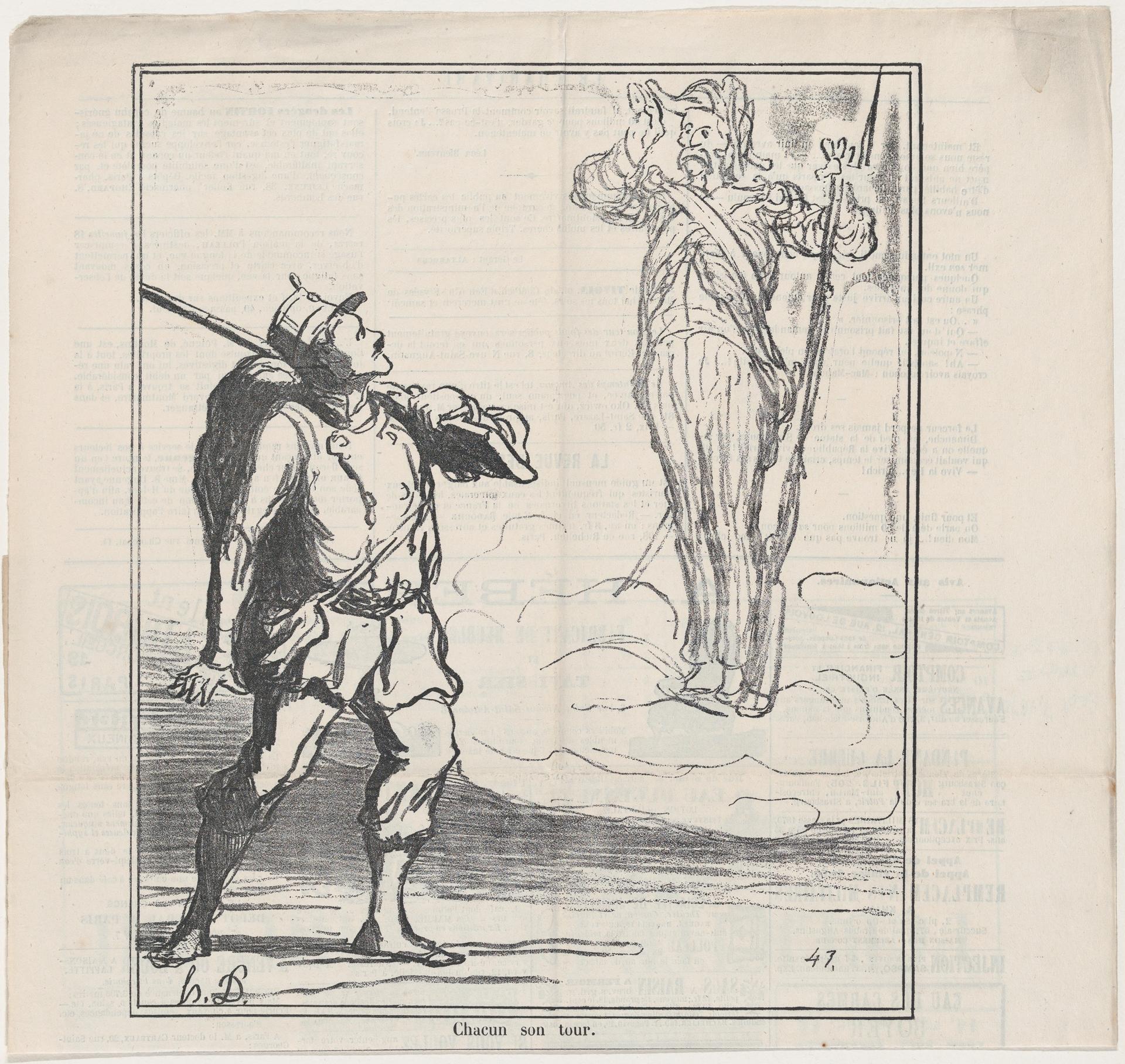
Un Leçon de Botanique, from "Croquis Parisiens"
Original title: Un Leçon de Botanique, from "Croquis Parisiens"
kurzbeschreibung
Honoré Daumier made this lithograph, titled 'Un Leçon de Botanique', on December 2, 1851, as part of his 'Croquis Parisiens' series. Two figures face each other: on the left, someone in a hat with a walking stick; on the right, a figure standing on a cloud, holding a stick and an arrow-like object. Rendered in shades of gray, the print bears the caption 'Chacun son tour'.
Description
Two figures confront each other on the sheet: at left, a hat-wearer with a long stick; at right, a person on a cloud holding a stick in one hand and something arrow- or sword-like in the other. The right-hand figure is placed slightly higher, giving it an otherworldly or mythical air. The background stays plain; along the bottom edge runs the text 'Chacun son tour'. The layout feels asymmetrical, the style sketchy, with grays and whites dominating.
Context
Daumier created this lithograph in Paris in 1851, during a period of political upheaval following the February Revolution of 1848 and Louis Napoleon's coup d'état on December 2, 1851. Known for his satirical prints, Daumier published the 'Croquis Parisiens' series in journals such as 'Le Charivari'. The motif reflects the social tensions of the time and the role of botany as a metaphor for order and nature in the modern city.
Impact
The print produces an unsettling mix of the everyday and the supernatural that invites reflection. The subdued palette and sketchy linework give the work an immediacy that feels almost documentary.
Technique
This is a lithograph in the third state of three, as recorded in the Delteil catalogue. In lithography, a flat printing process, the artist draws with greasy chalk on a limestone block, which is then printed. The gray tones come from strokes and hatching of varying density, creating a lively surface.
AI-generated description text
Source: Metropolitan Museum of Art · Public Domain (CC0 1.0)