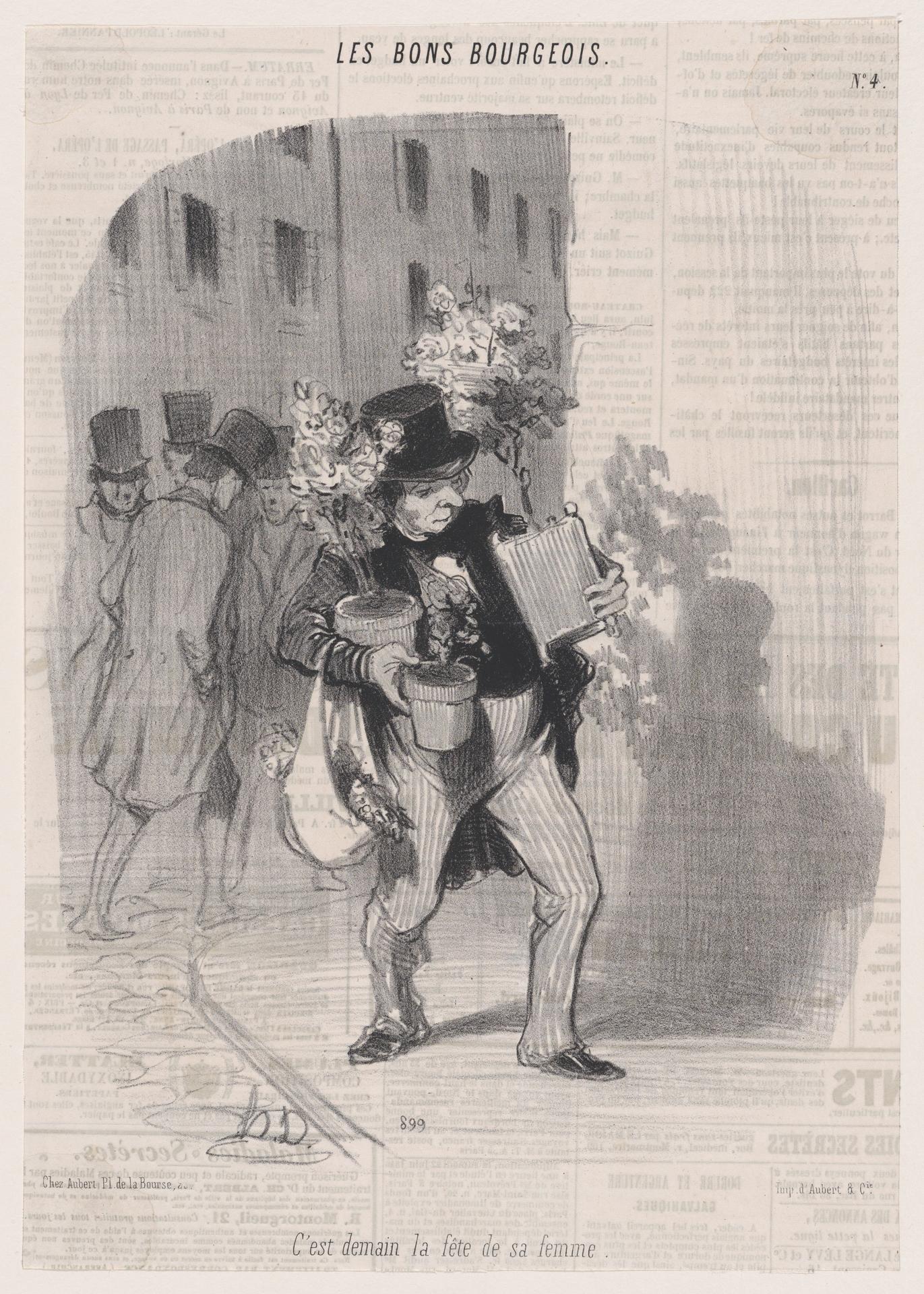
Tomorrow is his wife's birthday, from 'The good bourgeois,' published in Le Charivari, June 18, 1846
Original title: Tomorrow is his wife's birthday, from 'The good bourgeois,' published in Le Charivari, June 18, 1846
kurzbeschreibung
Honoré Daumier's lithograph 'Morgen ist der Geburtstag seiner Frau' (Tomorrow Is His Wife's Birthday) appeared on June 18, 1846, in the series 'Les bons bourgeois' in the journal 'Le Charivari'. The print shows a bourgeois man walking through a street laden with numerous gifts.
Description
At the front strides a figure in a striped suit, top hat on head, face serious. He carries a bouquet, a basket, a box, and other small containers. Behind him, in the street space, other people in formal dress can be seen. The layout feels dynamic: the main figure large in the foreground, the others staggered behind. Light-dark contrasts and hatching, typical of lithography, produce a finely graded, texture-rich view.
Context
The lithograph was published in the satirical journal 'Le Charivari', known for its social criticism. Daumier created the series 'Les bons bourgeois', which caricatured the everyday life and habits of the bourgeoisie in 19th-century France. The motif of the worried husband shopping for his wife's birthday was an ironic allusion to bourgeois rituals and expectations.
Impact
The overloaded burden of gifts together with the figure's serious expression strikes the viewer as humorous and critical at once. The print conveys a sense of the constraints and absurdities of bourgeois conventions.
Technique
The work was made as a lithograph, a planographic printing process based on the repulsion of grease and water. It is the second state of two (Delteil). The technique allowed fine lines and shading, which were used for the detailed reproduction.
AI-generated description text
Source: Metropolitan Museum of Art · Public Domain (CC0 1.0)