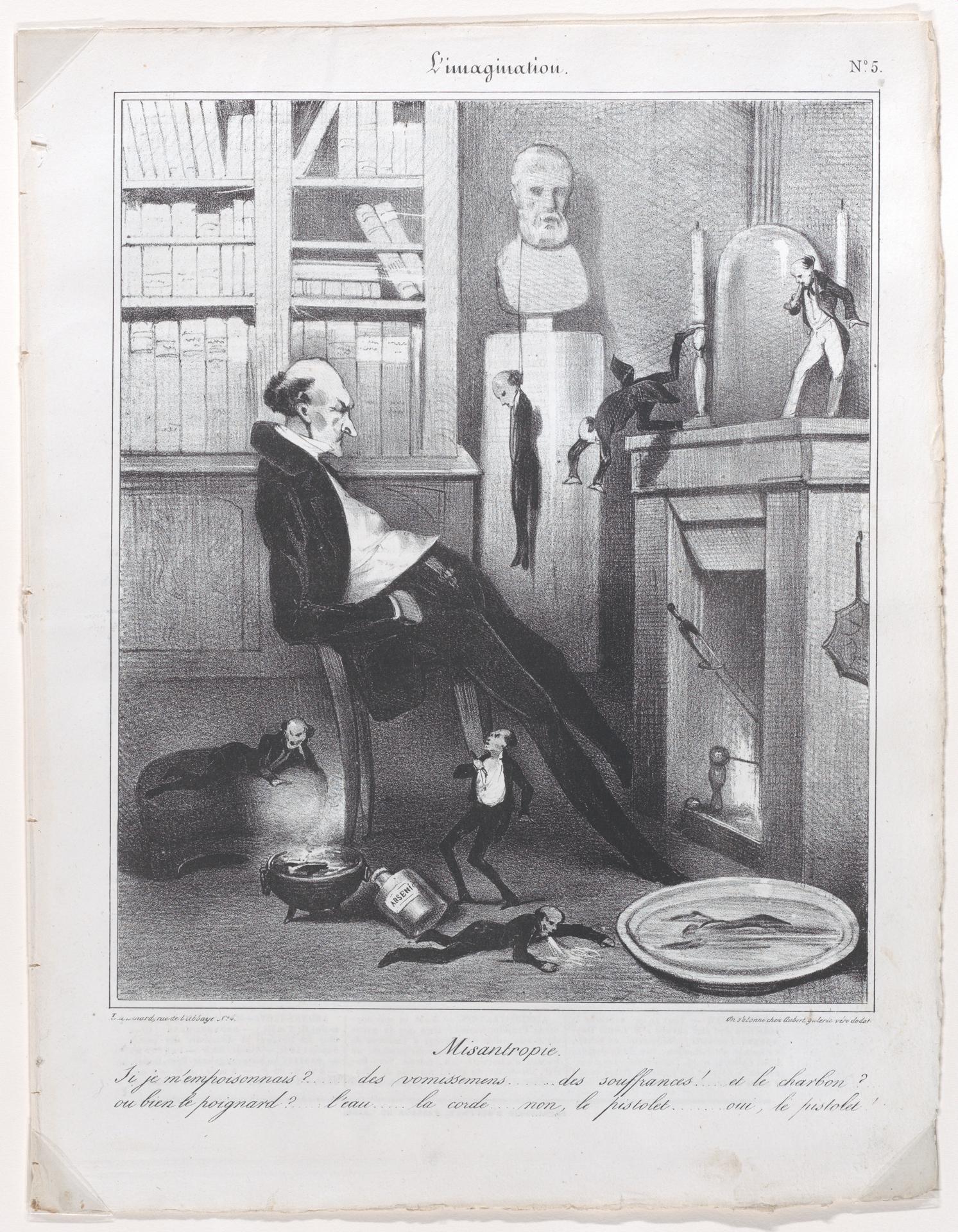
The Misanthropist (Misantropie), from L'imagination
Original title: The Misanthropist (Misantropie)..., from L'imagination, published in Le Charivari, February 10, 1833
kurzbeschreibung
Honoré Daumier's lithograph Der Menschenfeind (Misanthropy), made in 1833, presents a brooding man in a study crowded with books and assorted objects. The sheet belongs to the series L'imagination and appeared in Le Charivari on 10 February 1833. This is the second state of two known printings.
Description
A man sits motionless on a chair, his posture pensive or worn down. Bookcases fill the wall behind him. A bust stands on the table, surrounded by small figures carrying cups and baskets. On the floor lies a plate with a snake, and a pot and a gourd are among the other props. Muted, dark tones and light falling from above pick out the contours and give the image a somber mood.
Context
The lithograph was made during the July Monarchy, a period of political and social tension in France. Daumier drew for the satirical journal Le Charivari, known for its critical caricatures. In the series L'imagination he took up human folly and social grievances. The sheet carries the date 3 February 1833 and was published on 10 February of the same year.
Impact
An oppressive, inward-turned atmosphere emanates from the print and invites reflection. Realistic detail and caricatural touches sit side by side, giving the work its peculiar tension. The somber mood underlines the protagonist's misanthropic stance.
Technique
Executed as a lithograph, a printing process that relies on the repulsion of grease and water. Daumier used this technique to achieve fine lines and shading. The sheet is the second state of two, meaning further corrections or additions were made after the first printing.
AI-generated description text
Source: Metropolitan Museum of Art · Public Domain (CC0 1.0)