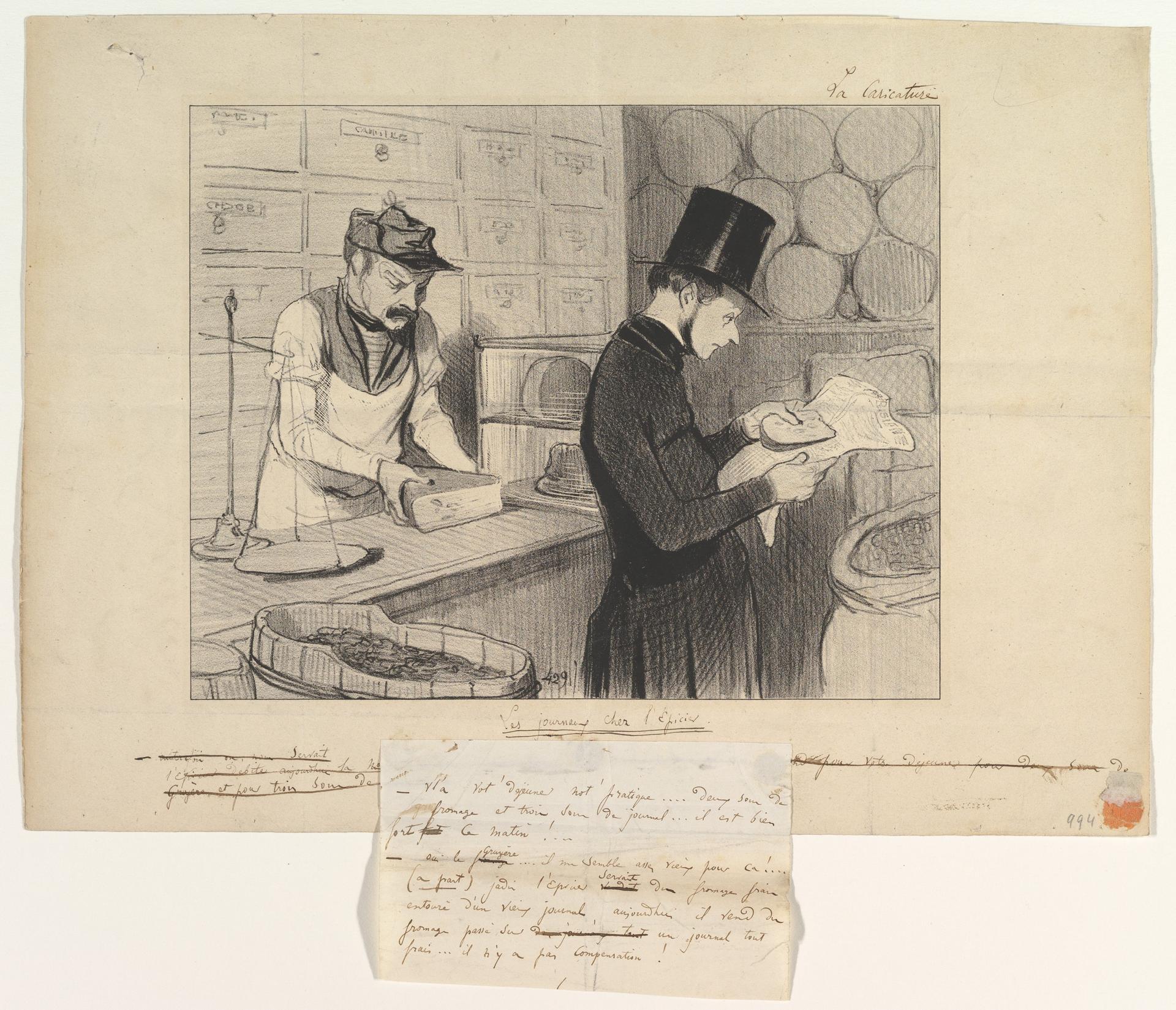
Newspapers at the Grocers (Les journaux chez l'épicier)
Original title: Newspapers at the Grocers (Les journaux chez l'épicier) from La Caricature, October 23, 1842
kurzbeschreibung
Honoré Daumier made this lithograph, 'Newspapers at the Grocer's', in 1842. Two men face each other across a shop counter. The sheet belongs to the 'La Caricature' series and survives in the first of three states, with a handwritten note added on a slip of paper.
Description
On the left stands a man in an apron behind the sales counter; on the right, a well-dressed gentleman in a tall hat. Each holds something in his hands, and their gestures are pushed well past naturalism into caricature. Shelves crowded with boxes and assorted goods fill the background. Along the lower edge a small slip of paper is pasted down, covered in ink handwriting. Everything stays black and white, the light even and without hard shadows.
Context
The print appeared on 23 October 1842 in the satirical journal 'La Caricature', known for its political and social mockery. Daumier drew it during the July Monarchy, when press freedom and newspaper reading were expanding sharply in France. The manuscript addition on a pasted-on scrap suggests a later revision or dedication.
Impact
Exaggerated gestures and the contrast between the two figures give the scene a comic, pointed edge. The clear layout draws the eye to the exchange between the men, while the shelves behind them carry the everyday atmosphere of the shop. The result is an ironic look at bourgeois daily life.
Technique
The image was produced as a lithograph, a planographic process in which a design is drawn on stone with greasy chalk. For the first state, lettering in pen and brown ink was added on an attached piece of paper, a handwritten supplement to the printed image. An ink inscription also appears on the verso.
AI-generated description text
Source: Metropolitan Museum of Art · Public Domain (CC0 1.0)