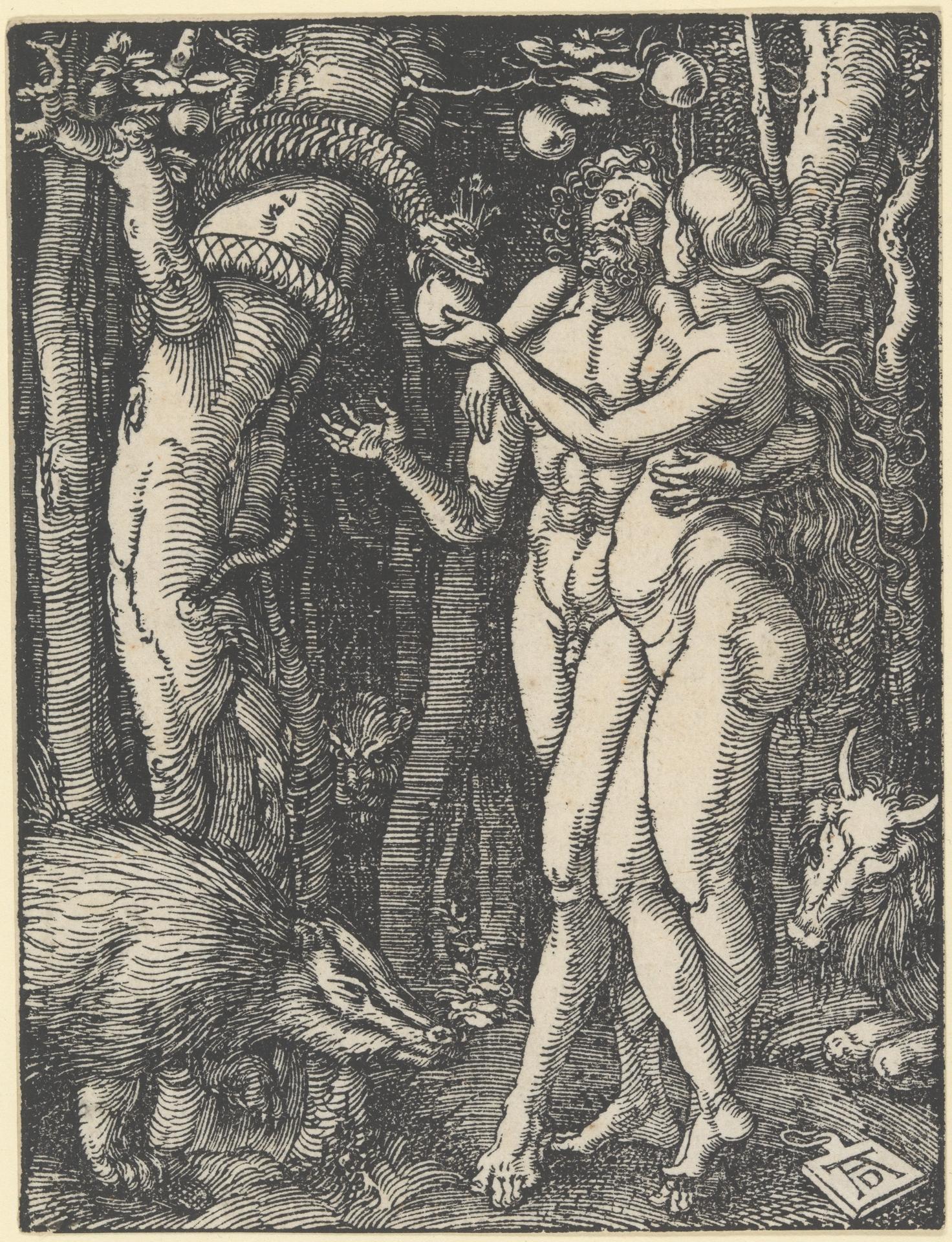
The Fall of Man, from "The Small Passion"
Original title: The Fall of Man, from "The Small Passion"
kurzbeschreibung
This woodcut, created by Albrecht Dürer around 1510, depicts Adam and Eve in the Garden of Eden at the moment of the Fall. Part of the series "The Small Passion," it shows the couple amid a dense forest, with the serpent (depicted as a dragon) coiled in a tree. The scene is rendered in stark black-and-white, characteristic of Dürer's printmaking.
Description
The composition centers on Adam and Eve, who stand in a forest clearing surrounded by trees and branches. Adam holds a fruit in his hand, which Eve gently touches, drawing the viewer's eye to the pivotal action. Behind them, a dragon-like serpent climbs the trunk of a tree, its body winding upward. At the lower edge, animals—possibly a pig and a donkey—are visible, grounding the scene in a natural setting. The ground is strewn with leaves and twigs, and the entire image is monochrome, with shading achieved through fine, varied lines.
Context
Dürer produced "The Small Passion" between 1509 and 1511, a series of 37 woodcuts illustrating the life and passion of Christ. This particular print, however, focuses on the Fall of Man, a subject that was popular in Northern Renaissance art for its moral and theological implications. Dürer's work reflects his deep engagement with biblical narratives and his mastery of the woodcut medium, which he elevated to new artistic heights. The series was widely disseminated and contributed to Dürer's fame across Europe.
Impact
The print conveys a sense of quiet tension, as the figures appear calm yet poised at a moment of irreversible consequence. The intricate linework and careful composition draw the eye across the scene, from the central couple to the serpent and the animals below. The monochrome palette lends a timeless, almost monumental quality to the subject, emphasizing the gravity of the biblical event.
Technique
This is a woodcut, a relief printing technique in which the image is carved into a wooden block, inked, and pressed onto paper. Dürer's exceptional skill in this medium is evident in the precise, flowing lines that create texture and depth without the use of color. The fine cross-hatching and varied line weights demonstrate his ability to achieve tonal variation through purely linear means.
AI-generated description text
Source: Metropolitan Museum of Art · Public domain (CC0)