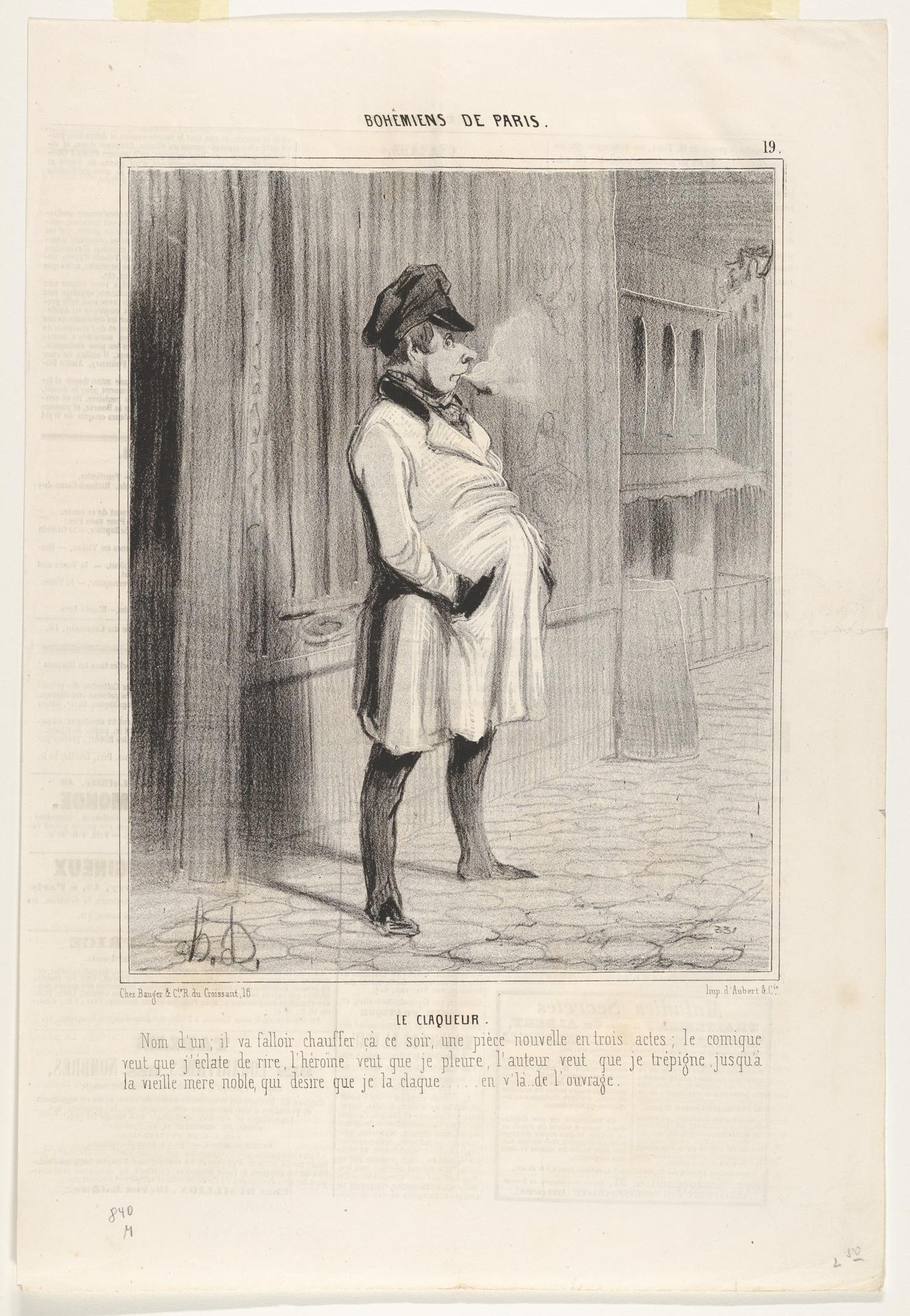
The Hired Clapper, plate 19 from "Artists and Bonvivants of Paris"
Original title: The Hired Clapper, plate 19 from "Artists and Bonvivants of Paris"
kurzbeschreibung
A man with a cigar stands casually on the street, captured in a lithograph by Honoré Daumier from 1842. This print belongs to the series 'Bohémiens de Paris' and to the collection 'Artists and Bonvivants of Paris'. It is the second state of three; the dimensions are 38 x 26 cm.
Description
Cap, jacket, trousers, and an apron tied around his waist: that is how the man stands, cigar in mouth, smoking. His gaze drifts into the distance, while the background hints at a street with a building and a door. This backdrop stays plain so that the figure stands out all the more. Even gray tones run through the print, and the light seems to fall from the front onto the man and his surroundings. The style is realistic, yet the slightly exaggerated portrayal of the figure betrays the caricatural intent.
Context
This lithograph was made on February 13, 1842, for the series 'Bohémiens de Paris', which Daumier drew for the collection 'Artists and Bonvivants of Paris'. It shows a 'clapper'—someone who organizes applause in theaters for payment, a typical phenomenon of 19th-century Parisian cultural life. Daumier was known for his satirical portrayals of Parisian society, especially in lithographs for magazines such as 'Le Charivari'.
Impact
At first the scene seems ordinary and quiet, but the caricatural features give it an ironic note and expose the clapper's profession. The reduced layout draws attention to the figure and his posture, which wavers between nonchalance and calculation. Without pathos, the print reads as a precise social portrait.
Technique
For printing, Daumier used lithography on newsprint, a method common at the time for satirical prints. In the second state of three, fine shadings and clear contours stand out, achieved through the fat-crayon technique on the lithographic stone. The thin, slightly yellowed paper matches the practices of the period.
AI-generated description text
Source: Metropolitan Museum of Art · Public Domain (CC0 1.0)