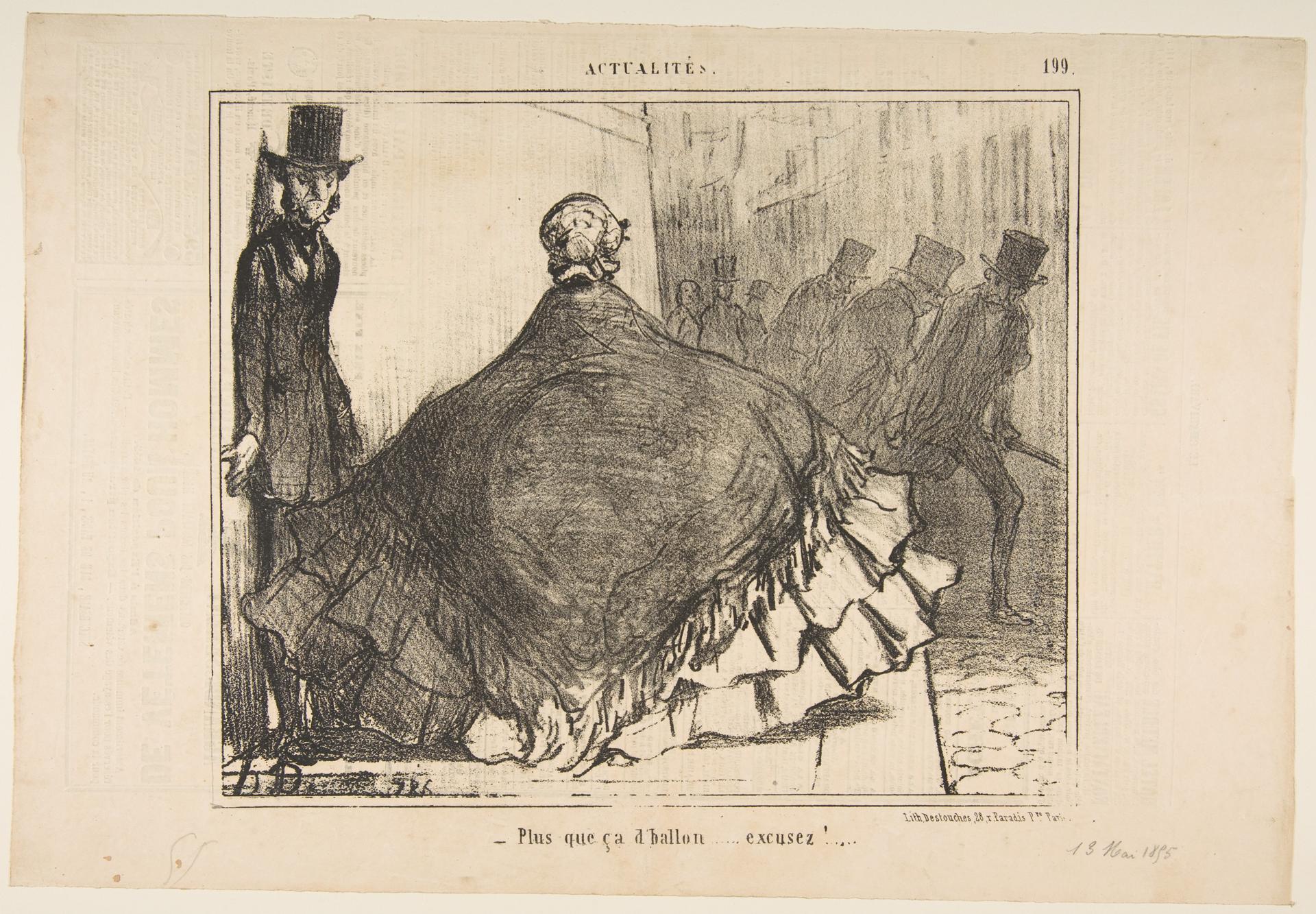
Plus que ça d'ballon...excusez!, from Actualités, published in Le Charivari, June 13, 1855
Original title: Plus que ça d'ballon...excusez!, from Actualités, published in Le Charivari, June 13, 1855
kurzbeschreibung
Honoré Daumier created the lithograph 'Plus que ça d'ballon...excusez!' in 1855. It shows a woman in a voluminous balloon dress while a man in a suit scrutinizes her. The print belongs to the 'Actualités' series and was published on 13 June 1855 in the satirical journal 'Le Charivari'. It is the second state of two (Delteil).
Description
A woman in a voluminous, balloon-shaped dress dominates the left half of the image, almost entirely concealing her figure. To her right stands a gentleman in a suit and top hat, his gaze fixed on her. Other figures in similar attire appear in the background, suggesting a social gathering. The layout is asymmetrical, with a clear emphasis on the figure in the balloon dress. The lithograph remains in grayscale; the light appears even, without strong shadows.
Context
At the time of its creation in 1855, the crinoline—a hoop skirt that greatly expanded the skirts of upper-class women—was in fashion. In his 'Actualités' series for 'Le Charivari', Daumier addressed contemporary social and political issues. The print, published on 13 June 1855, reflects the criticism of exaggerated women's fashion of the day. The series was aimed at the urban audience of the July Monarchy and the Second Empire.
Impact
The exaggerated balloon dress is both comic and satirical, exposing the absurdity of fashion. The contrast between the woman's massive silhouette and the slender man beside her heightens the caricatural effect. The image remains amusing and critical without tipping into the grotesque.
Technique
This print was made using lithography, a planographic printing process in which a design is drawn with greasy chalk on a stone and then printed. Daumier used fine lines and hatching to bring out the folds of the dress and the faces of the figures. The work was printed in the second state of two, indicating that the plate was reworked.
AI-generated description text
Source: Metropolitan Museum of Art · Public Domain (CC0 1.0)