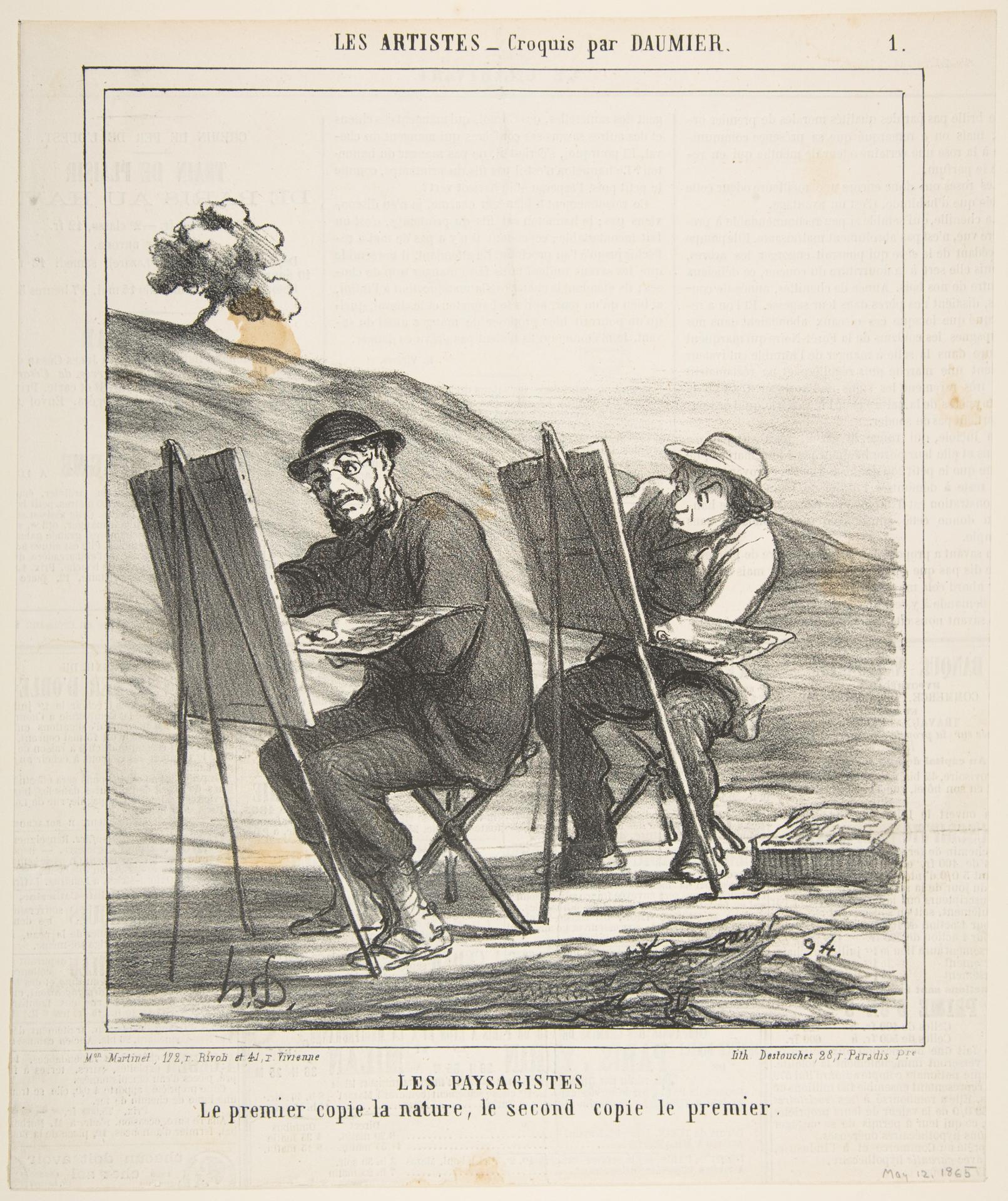
The landscape painters, the first copies nature, the second copies the first, from 'The artists,' published in Le Charivari, May 12, 1865
Original title: The landscape painters, the first copies nature, the second copies the first, from 'The artists,' published in Le Charivari, May 12, 1865
kurzbeschreibung
Unlike many landscape studies of the period, which treat painting outdoors as a noble pursuit, Honoré Daumier's 1865 lithograph puts two painters on view while they copy. It belongs to the series 'Die Künstler' and appeared on 12 May 1865 in the satirical journal Le Charivari. The impression is recorded as the second state of two (Delteil).
Description
Two men have settled on folding stools in the foreground, each facing an easel. On the left sits the older one in a dark jacket, trousers and hat, his gaze turned thoughtfully on his own work. To the right the younger, in shirt and broad-brimmed hat, stares hard at his canvas. Beyond them a soft hilly landscape opens up, with a single tree and a rising plume of smoke. The black-and-white print relies on a clear layout, even light and the absence of harsh shadows.
Context
For Le Charivari, Daumier drew the series 'Die Künstler', following the art world of his day. This sheet mocks the practice of copying in artistic training and the ranking of nature study against the copy. In doing so it takes up a debate then very much alive about originality and imitation, shaped by the rise of photography and by academic convention.
Impact
The caricatural exaggeration gives the sheet its humorous, ironic edge. A landscape view that would otherwise be calm is pulled into a satirical frame by the intent painters and by the title, which tends to draw a smile from the viewer.
Technique
The lithograph was printed on newsprint: the drawing is made on the stone with greasy chalk, then pulled. The second state of two allows any reworking or corrections made after the first impression to be read off. The process yields fine lines and a clear black-and-white rendering, typical of Daumier's satirical sheets.
AI-generated description text
Source: Metropolitan Museum of Art · Public Domain (CC0 1.0)