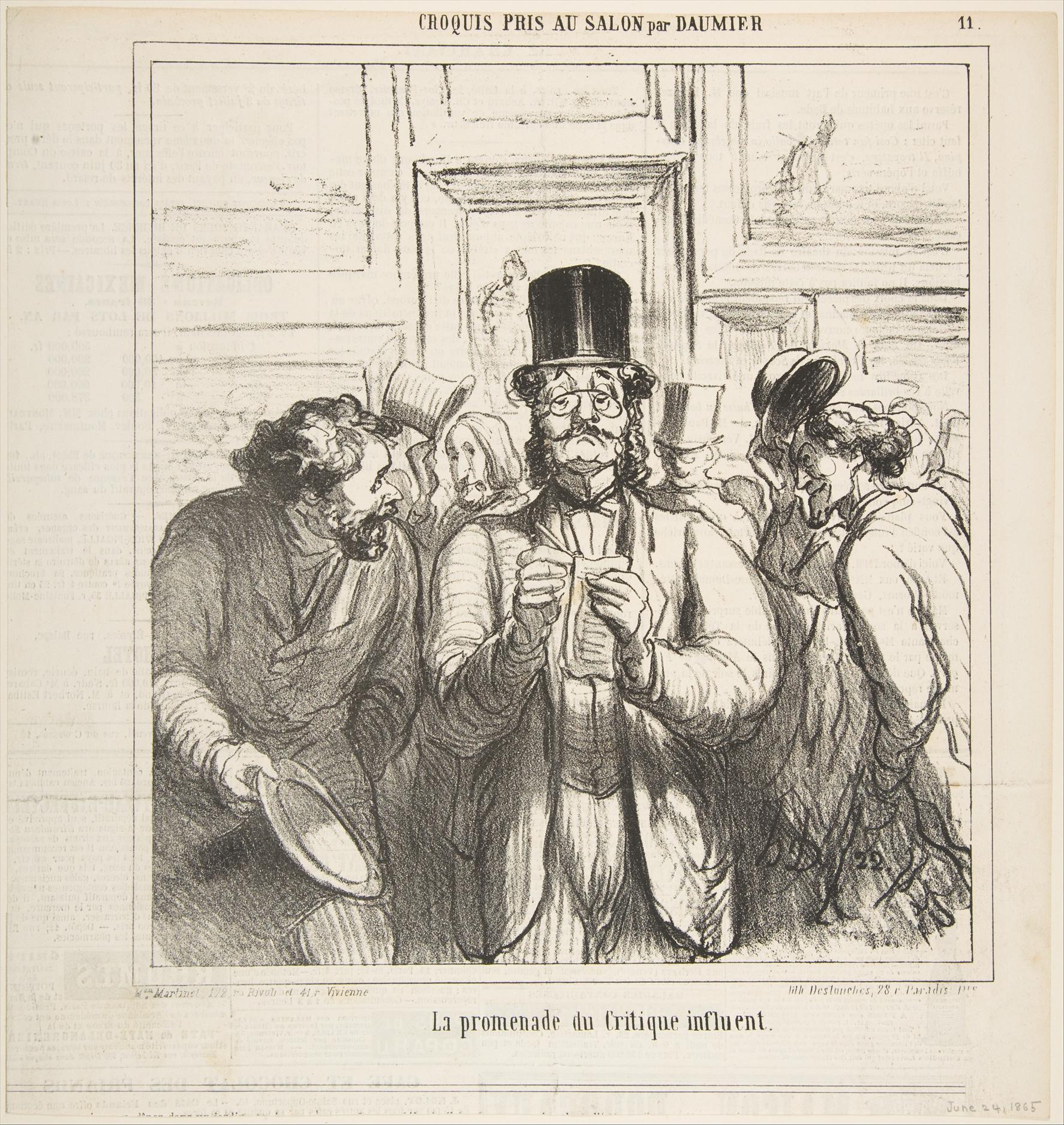
Walk-through of an influential critic, from 'Sketches from the Salon,' published in 'Le Charivari,' June 24, 1865
Original title: Walk-through of an influential critic, from 'Sketches from the Salon,' published in 'Le Charivari,' June 24, 1865
kurzbeschreibung
Honoré Daumier's lithograph from 1865 presents a group of men crowded tightly around a central figure wearing a top hat and holding a glass. The print belongs to the series 'Skizzen vom Salon' and appeared on June 24, 1865, in 'Le Charivari'. It was printed as a second state (Delteil) in lithography on newsprint.
Description
Men in historical dress surround a main character with a top hat and a raised glass. The figures' postures vary and point in different directions, creating movement and interaction. Monochrome in shades of grey, the image shows even light without strong shadows. Caricatural exaggeration of faces and body language highlights the individuals' quirks.
Context
Daumier created the series 'Skizzen vom Salon' as satirical accompaniments to the Paris art exhibitions, the Salon. These lithographs appeared regularly in the satirical journal 'Le Charivari', known for political and social criticism. By placing a critic among artworks or visitors, the print reflects contemporary debate about the influence of art criticism. The second state (Delteil) suggests a revision or reissue of the print.
Impact
The lithograph feels lively and humorous thanks to the animated arrangement of figures and the caricatural distortion. The critic at the center appears as a dominant, almost theatrical figure who draws the gazes of those around him. The monochrome technique emphasizes the graphic, reportorial character of the print.
Technique
Daumier used lithography, a planographic printing process that allows fine lines and gradations of tone. It was printed on newsprint, as was customary for publication in 'Le Charivari'. The second state (Delteil) designates a specific printing variant recorded in art-historical literature.
AI-generated description text
Source: Metropolitan Museum of Art · Public Domain (CC0 1.0)