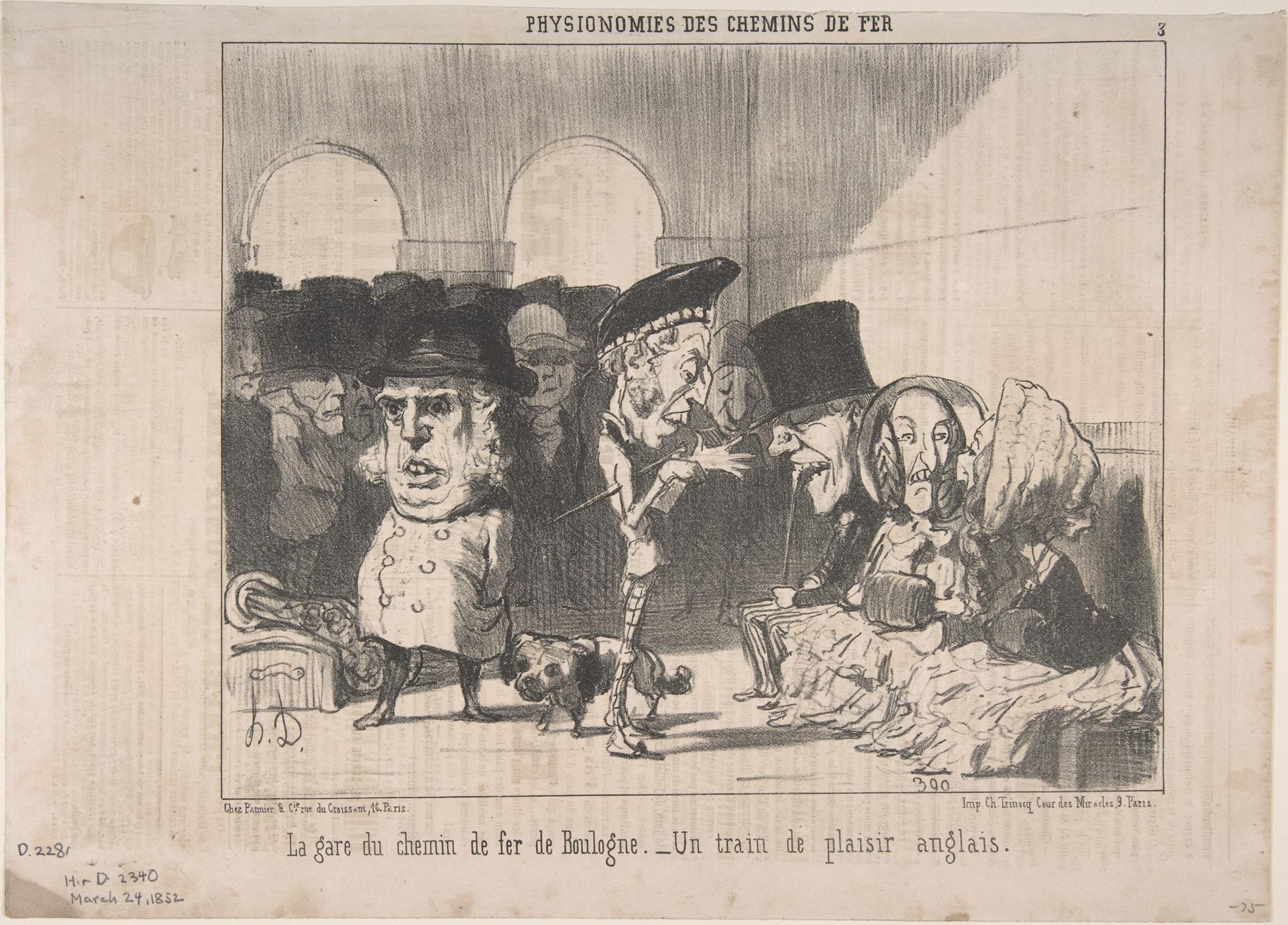
The Boulogne Train Station. An English Excursion Train (La gare de chemin de fer de Boulogne. Un train de plaisir anglais), from Physionomies des Chemins de Fer (Physiognomies of the Railways)
Original title: The Boulogne Train Station. An English Excursion Train (La gare de chemin de fer de Boulogne. Un train de plaisir anglais), from Physionomies des Chemins de Fer (Physiognomies of the Railways)
kurzbeschreibung
A train compartment packed with passengers jostling one another in familiar poses: Honoré Daumier's 1852 lithograph pokes fun at the arrival of an English excursion train at Boulogne. The print belongs to the series 'Physionomies des Chemins de Fer' and parades the social types of the dawning railway age.
Description
Hats and caps crowd together inside a railway carriage, the passengers' faces stretched into caricature. Around the seated group more figures stand, while platform edges and windows are only hinted at. The layout feels tightly packed; the lithograph stays in greys, with detailed line work and muted light.
Context
Daumier made the print in 1852 for 'Physionomies des Chemins de Fer', a series published in the satirical journal 'Le Charivari'. It took aim at the social upheavals brought by the railway, which spread rapidly through France after 1848. Boulogne-sur-Mer served as a major ferry port for travellers to England, hence the reference to English tourists.
Impact
The exaggerated figures and cramped arrangement produce a view that is humorous and critical at once. Muted light and the dense seating leave a suffocating mood that makes the crowding and anonymity of travel palpable.
Technique
Daumier used lithography, a printing method widespread at the time that allowed fine lines and shading. Printed on paper, the sheet measures roughly 25.2 x 35.4 cm. The grey tones come from differing applications of tusche on the lithographic stone.
AI-generated description text
Source: Metropolitan Museum of Art · Public Domain (CC0 1.0)