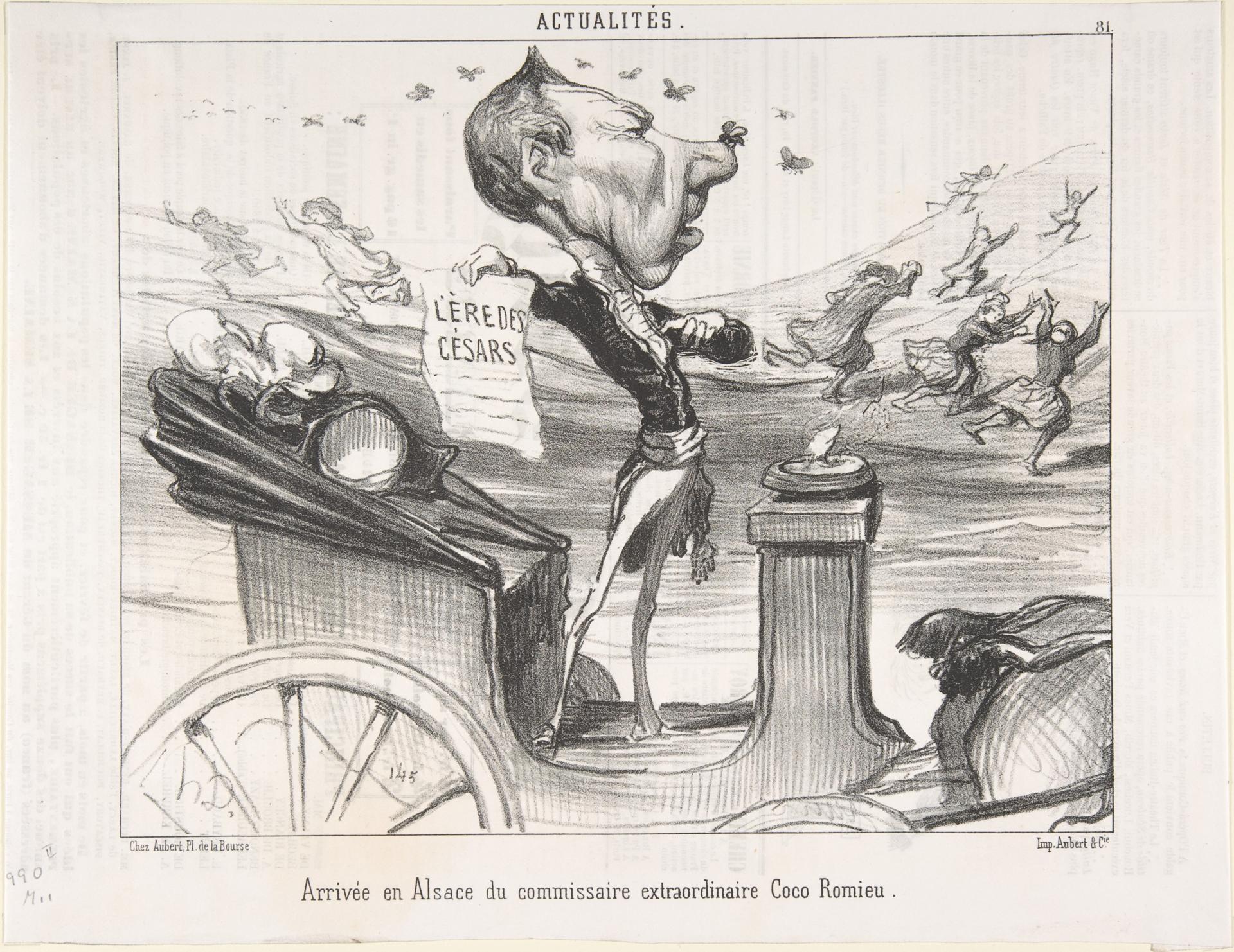
Arrivée en Alsace du commissaire extraordinaire Coco Romieu
Original title: Arrivée en Alsace du commissaire extraordinaire Coco Romieu, published in Le Charivari
kurzbeschreibung
Honoré Daumier's 1850 lithograph lampoons the arrival of Commissioner Coco Romieu in Alsace. Published in the satirical journal Le Charivari, the print is dominated by an oversized face holding a sign that reads “L'ÈRE DES CÉSARS” (The Era of the Caesars).
Description
A gigantic face with a pointed nose and wide mouth fills the middle of the image, holding up a sign inscribed “L'ÈRE DES CÉSARS.” The man sits in a horse-drawn carriage pulled by a single horse. Around him, people strike various poses—some seem to fly or leap, creating a chaotic atmosphere. The figures wear traditional clothing, and the landscape features mountains and a river. Light falls evenly without visible shadows; contours are strong and shading delicate.
Context
The lithograph appeared on February 28, 1850, in the satirical journal Le Charivari, for which Daumier regularly drew political and social caricatures. Coco Romieu was a French official sent to Alsace as an extraordinary commissioner. The inscription “L'ÈRE DES CÉSARS” points to the political circumstances after the Revolution of 1848 and the growing exercise of authority. With this work, Daumier criticized bureaucracy and the staging of state power.
Impact
The exaggerated face and the chaotic movements of the background figures are comic, almost absurd. Combining a monumental face with a small carriage emphasizes the ridiculousness of the official depicted. The humorous but pointed style makes the political criticism immediately understandable.
Technique
The lithograph was printed on paper measuring 25.4 x 32.8 cm. Extremely fine lines and various gray tones define the figures and the landscape. The even distribution of light without shadows is typical of Daumier's lithographic works from this period.
AI-generated description text
Source: Metropolitan Museum of Art · Public Domain (CC0 1.0)