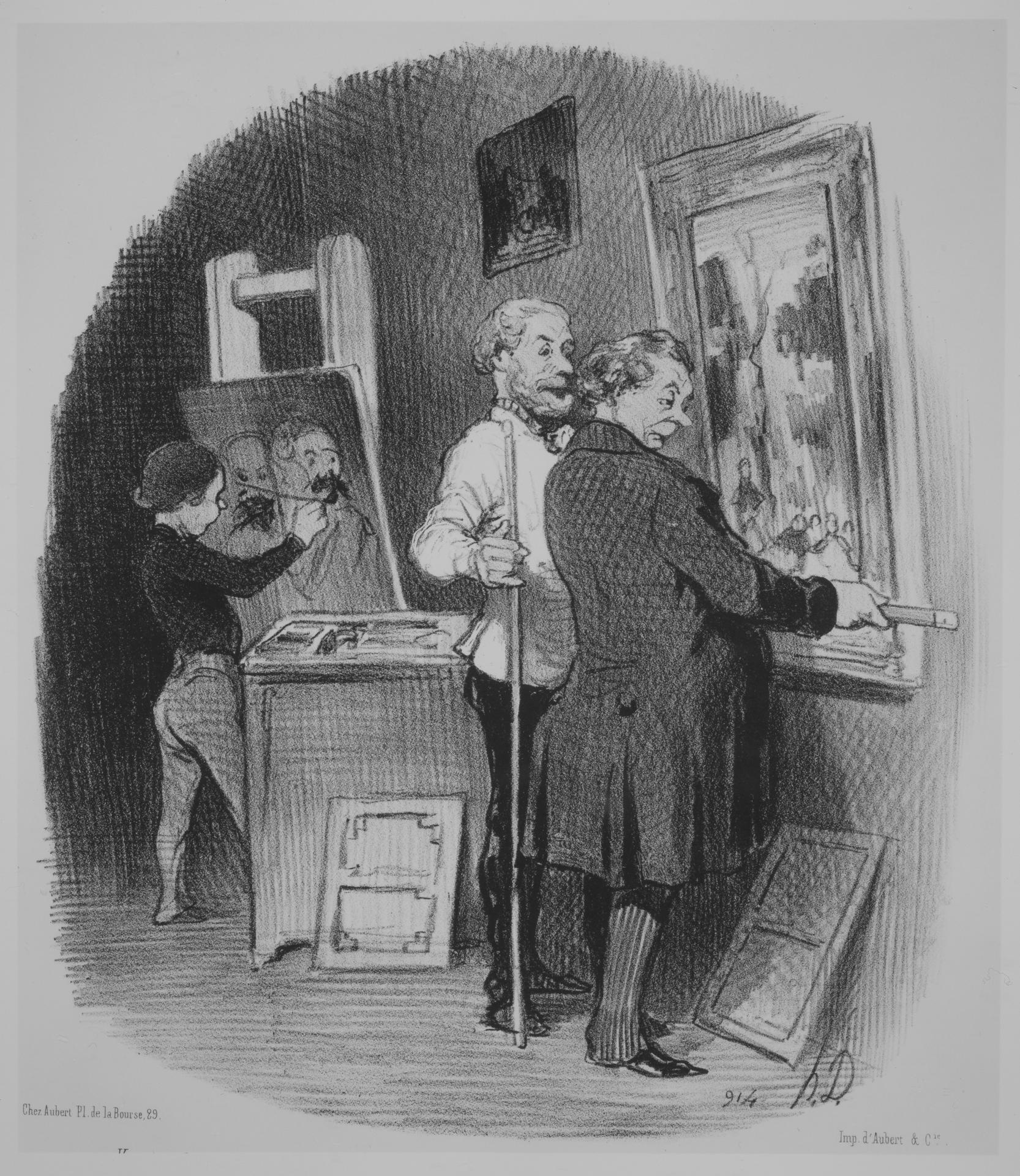
Votre tableau me plairait aussi...., from Les Bons Bourgeois
Original title: Votre tableau me plairait aussi...., from Les Bons Bourgeois, published in Le Charivari, October 12, 1846
kurzbeschreibung
Where many nineteenth-century studio scenes leave the artist to work alone, this 1846 print by Honoré Daumier gathers a small group instead: a boy at the easel and two older men gesturing around him. It belongs to the series 'Les Bons Bourgeois' and survives here as a black-and-white impression in the second state of two (Delteil).
Description
Three figures fill an interior that reads at once as a studio. On the left a boy paints at an easel. In the middle an older gentleman stands with a cane, one hand pointing forward, the other holding an object. Beside him on the right, a second man also grips something and gestures as he speaks. Another picture hangs on the wall. Faces are sharply drawn and the clothing is of the period; light falling from the front picks out people and objects alike.
Context
The lithograph appeared in the satirical journal 'Le Charivari' on 12 October 1846, within the series 'Les Bons Bourgeois'. Daumier used it to needle the bourgeoisie's idea of art and the place of the public in the nineteenth-century art world. The series dates from the July Monarchy, when the rising middle class was shaping French society, and lithography served him as a vehicle for social and political criticism.
Impact
Caricatural exaggeration and comic gesturing give the sheet an immediate appeal. By staging bourgeois art appreciation, Daumier creates an ironic distance that invites a smile. The contrast between the painting boy and the gesturing gentlemen lays bare the gap between artistic practice and middle-class judgment.
Technique
Lithography is a planographic process: the artist draws with greasy chalk on stone. Daumier commanded it with great skill, using fine lines and shading to bring the figures to life. That the sheet is the second of two states points to reworking during printing.
AI-generated description text
Source: Metropolitan Museum of Art · Public Domain (CC0 1.0)