A Summer Sketch: Parisians in the Countryside
Original title: A Summer Sketch: Parisians in the Countryside
kurzbeschreibung
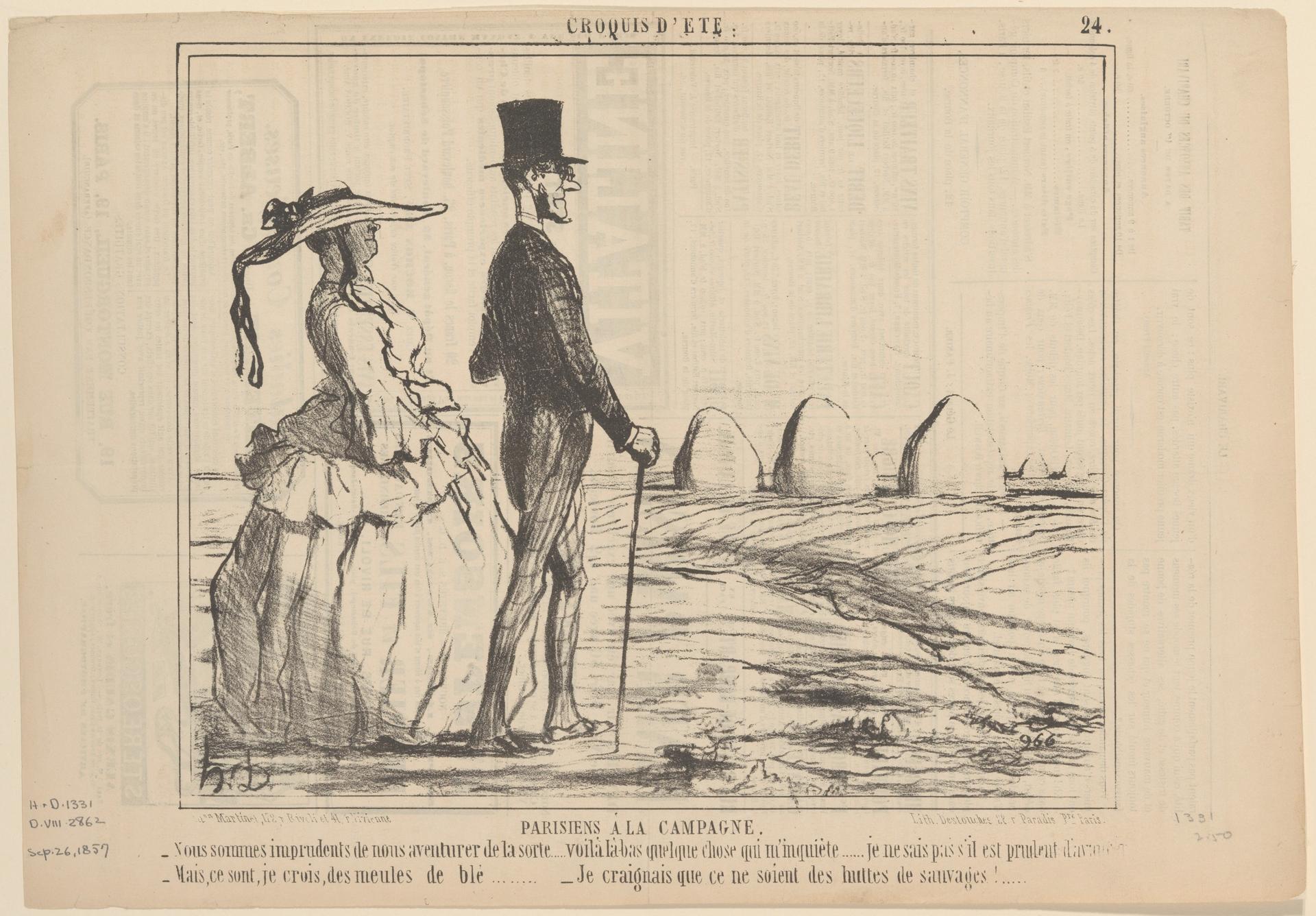
In an 1857 lithograph, Honoré Daumier brings two city dwellers into rural terrain: a gentleman in a top hat and suit, and a lady with a wide-brimmed hat and long dress, both looking out of the picture. Humorous captions accompany the scene, which belongs to Daumier's series on life in the countryside.
Description
The layout is symmetrical: a man and a woman form the central pair, their gaze directed to the right, beyond the edge of the sheet. He wears a top hat and dark suit; she has a fluttering hat and a long dress. Behind them, in a field, small animals—likely mice—scurry about. The print's grays are evenly distributed, with no strong shadows or harsh contrasts. The style remains caricatural, with exaggerated facial features that carry the comic tone.
Context
In 1857 Daumier worked regularly for satirical papers such as Le Charivari, and this print emerged from that milieu. It belongs to the series Croquis d'Été (Summer Sketches), which lampooned the behavior of Parisians in the country. Daumier used lithography to capture social types of his time critically and with wit. The sheet was printed on newsprint, pointing to its first publication in a journal.
Impact
Exaggerated figures and the ironic caption create a comic edge that also prompts reflection. The landscape lies calm and symmetrically ordered, contrasting with the urban clothing of the two—highlighting the absurdity of the situation. Viewers smile and are subtly reminded of the gap between city and country.
Technique
Drawn with a greasy crayon on limestone, from which the print was taken—the lithographic process. The sheet is on thin, machine-made paper, as the satirical print market demanded. Varying printing strengths produce the grays; fine shading is deliberately omitted so that the caricatural effect stands out more clearly.
AI-generated description text
Source: Metropolitan Museum of Art · Public Domain (CC0 1.0)