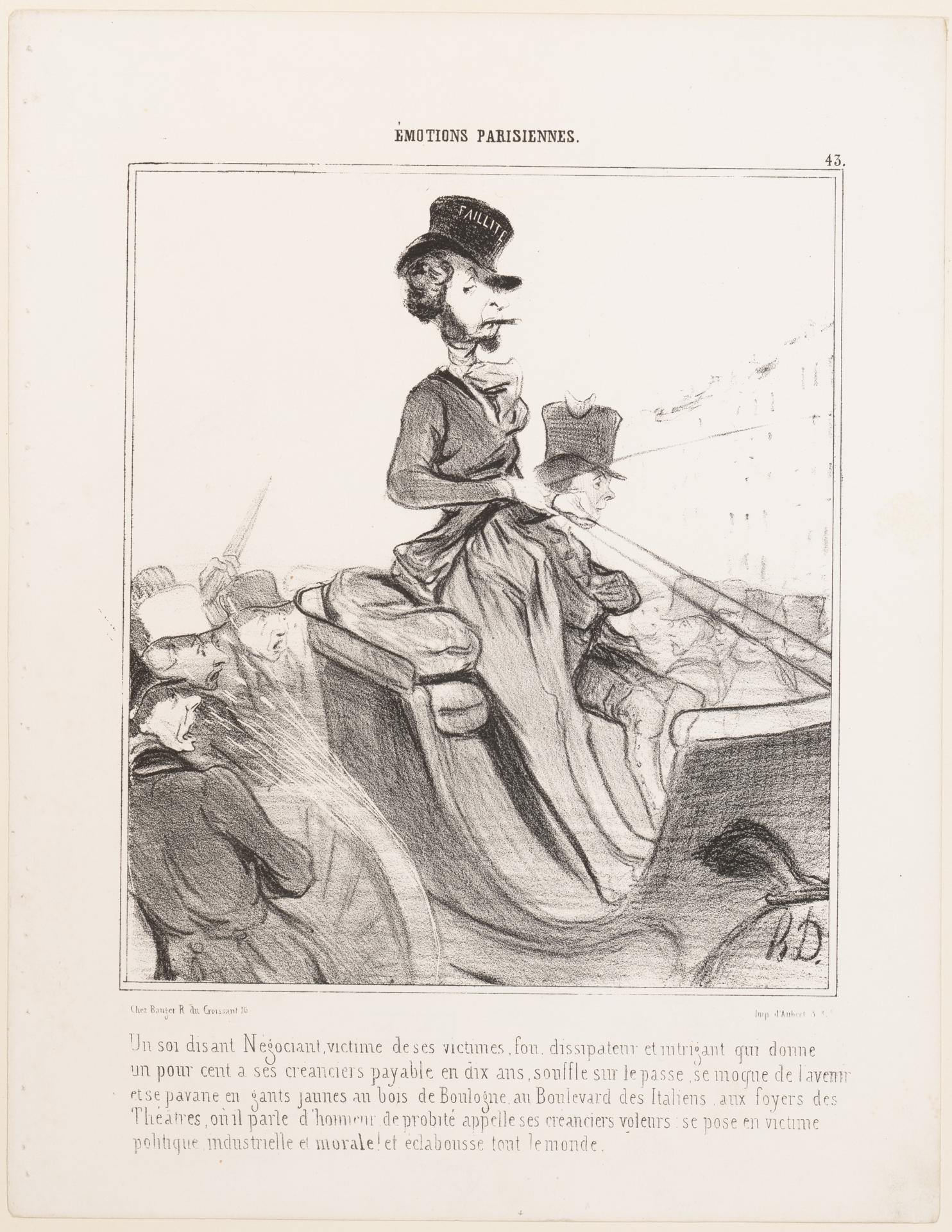
Un soi disant Négociant... (A so-called Merchant...), from Émotions Parisiennes, published in "Le Charivari"
Original title: Un soi disant Négociant... (A so-called Merchant...), from Émotions Parisiennes, published in "Le Charivari"
kurzbeschreibung
Unlike many contemporary satires that target a single vice, this 1840 lithograph by Honoré Daumier layers several meanings at once: a woman on a podium smokes a pipe and wears a cap inscribed "FAILLITE" (bankruptcy). The print belongs to the series Émotions Parisiennes, published in the journal Le Charivari. It is the third state of three (Delteil), sur blanc, and measures 23 × 20 cm in the image area.
Description
What first strikes the eye is the calm of the main figure: a woman in a long dark dress stands elevated on a podium, pipe in mouth, gazing confidently into the distance. Her cap bears the word "FAILLITE". Below her, several uniformed figures crowd together, reaching for her or trying to get to her. Behind them opens a city view with buildings and a river. The grays and blacks are sparing, and the light falls evenly across the scene.
Context
Originally drawn for the satirical paper Le Charivari, known for political and social caricature, the lithograph appeared in 1840. In the series Émotions Parisiennes, Daumier took up everyday life and social ills in Paris. The cap inscribed "FAILLITE" points to economic collapses and their consequences for society. The "so-called merchant" in the title alludes to the gap between appearance and reality in business life under the July Monarchy.
Impact
Humor and criticism are closely intertwined here: the exaggerated woman and the helpless-looking uniformed men create a comic yet accusatory tone. The irony lies above all in the contrast between the woman's calm, self-assured posture and the hectic movements of the figures below her. The restrained color and clear line give the print a bold, immediate expressive power.
Technique
The print was produced as a lithograph on paper (sur blanc) in the third of three states. This process allowed fine lines and shading, characteristic of Daumier's drawing style. At the same time, the prints could be reproduced quickly, which was essential for publication in a journal like Le Charivari.
AI-generated description text
Source: Metropolitan Museum of Art · Public Domain (CC0 1.0)