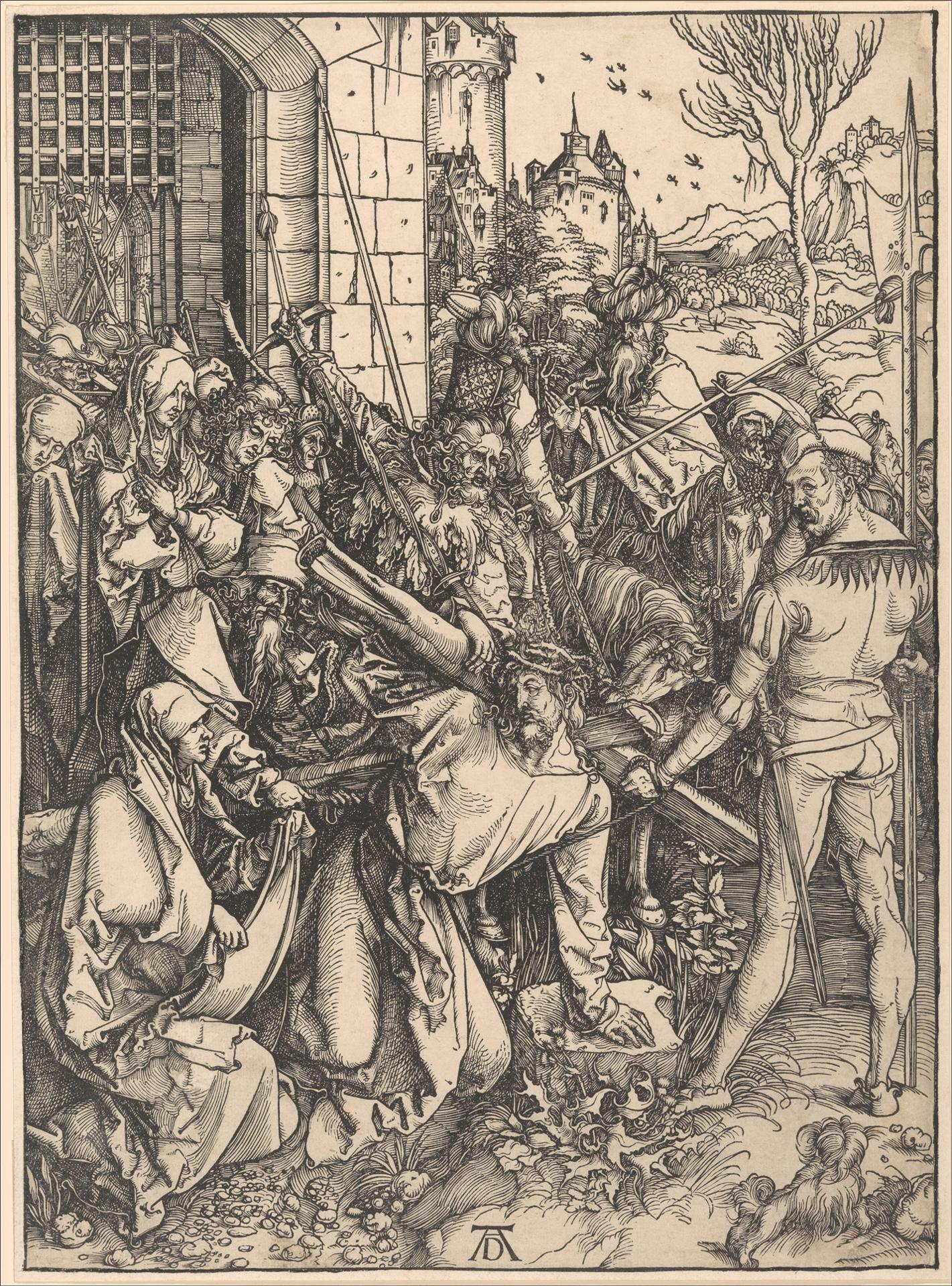
Christ bearing the Cross
Original title: Christ bearing the Cross
kurzbeschreibung
Albrecht Dürer's undated woodcut "Kreuztragung Christi" (38.7 x 28.2 cm) shows Jesus being driven forward by soldiers under the weight of the cross, his wounds visible. The sheet belongs to a Passion series and ranks among the significant achievements of Renaissance printmaking.
Description
Christ is seen at the front, his arms bound to the cross, while soldiers drag him along with force. On the left side, a woman kneels, clinging to a pole, expressing grief and despair. In the surrounding area, lamenting women and observing soldiers appear before a city with fortifications and a castle. Trees and mountains complete the landscape; the light remains diffuse and is created by fine shadings and lines of the woodcut.
Context
The work was created roughly between 1508 and 1512, when Dürer was active in Nuremberg and deeply engaged with the Passion of Christ. It belongs to the so-called "Green Passion" or a related woodcut series intended for a broad public. Dürer used printmaking to spread biblical scenes in large editions and to demonstrate his artistic skill. The detailed execution points to the Renaissance interest in realistic depiction of figures and spatial depth.
Impact
A strong emotional tension runs through the image, intensified by the high-contrast lines and the pressing group of figures. The viewer is drawn immediately into the dramatic event and experiences Christ's burden and despair up close. The precise technique creates a remarkable plasticity and depth unusual for woodcuts of this time.
Technique
Dürer worked the block so that fine, parallel and crossing lines model light and shadow with high artisanal precision. The resulting print brings out the contours and tonal values of the scene: the strained figure of Christ dragged by soldiers, the kneeling woman clutching a pole in grief, and the urban background with fortress-like buildings, trees and hills, all articulated through the characteristic black-and-white linear aesthetic.
AI-generated description text
Source: Metropolitan Museum of Art · Public Domain (CC0 1.0)