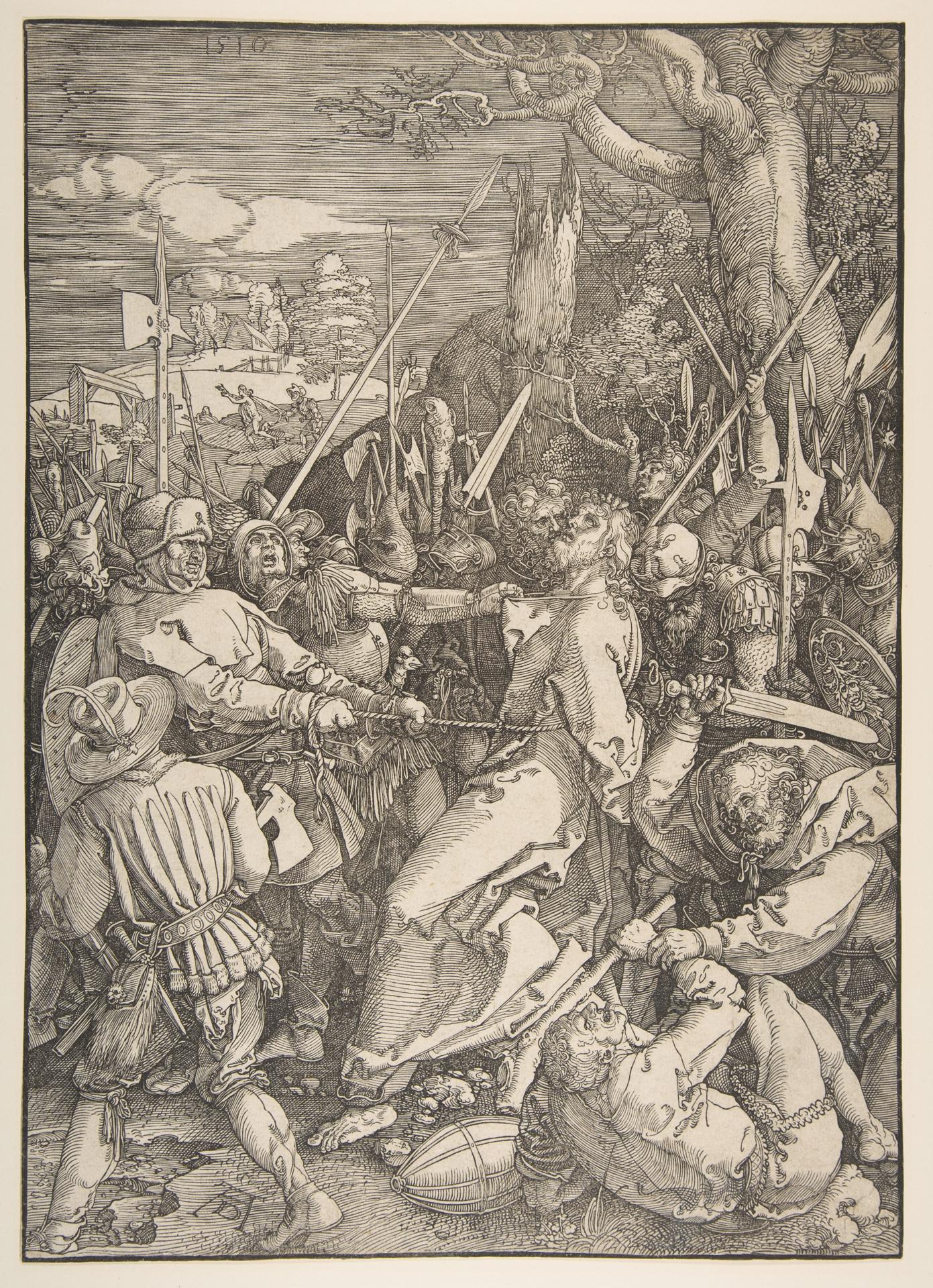
The Betrayal of Christ
Original title: The Betrayal of Christ
kurzbeschreibung
The Betrayal of Christ is a woodcut by Albrecht Dürer, dating to around 1516. It depicts the arrest of Jesus in the Garden of Gethsemane, surrounded by soldiers. The work is a monochromatic print, characteristic of Dürer's mastery of the woodcut medium.
Description
In the center, Christ stands calmly amid a dense group of armed soldiers. Several soldiers, some in armor and helmets, thrust lances and swords toward him, creating a dynamic, crowded composition. The background shows a landscape with trees and a hill, adding depth. The figures move and look in various directions, heightening the sense of chaos. The monochrome print uses even lighting, typical of woodcuts.
Context
Dürer created this woodcut during the early 16th century, a period when he was deeply engaged with religious themes. This work is part of a series on the Passion of Christ, which was popular for devotional use. Dürer's prints were widely distributed, helping to spread Renaissance ideas across Europe. The scene follows the Gospel account of Judas's kiss and the subsequent arrest.
Impact
The dense composition and aggressive poses of the soldiers create a palpable tension. Christ's serene expression contrasts with the surrounding violence, emphasizing his passive acceptance. The fine lines and detailed rendering draw the viewer into the narrative, making the scene both immediate and dramatic.
Technique
This is a woodcut, a relief printing technique where the image is carved into a wooden block. Dürer's skillful use of cross-hatching and varied line weights creates texture and volume. The monochrome ink on paper yields a stark, high-contrast image, typical of early printmaking.
AI-generated description text
Source: Metropolitan Museum of Art · Public domain (CC0)