The Penitent
Original title: The Penitent
kurzbeschreibung
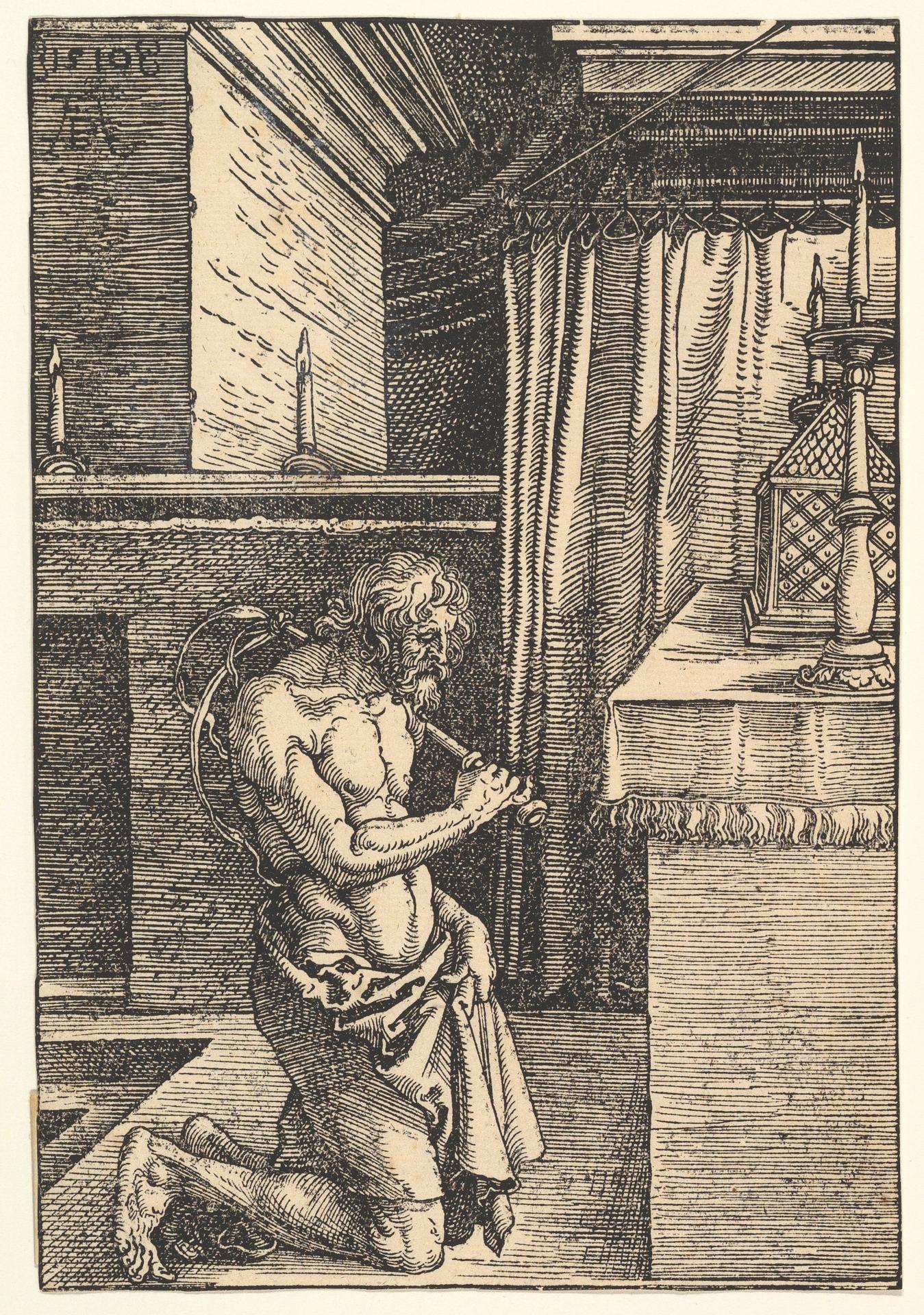
Albrecht Dürer's 'The Penitent' (1510) is a woodcut depicting a barefoot man in a kneeling pose, clothed only in loose trousers. He holds a mirror in his right hand, gazing into it with a contemplative, troubled expression, set in a sparse interior with draped curtains and candle stands.
Description
The composition centers on a bearded man with curly hair, bare-chested, kneeling with his torso exposed. He holds a mirror in his right hand, his face reflecting an introspective, worried look. The background features a room with a curtained wall and a window opening, while on the right, two candle stands with candles are visible. The monochrome print uses varied line thickness to create depth and texture, with even lighting and no visible shadows, typical of woodcuts of this era.
Context
Created in 1510, this woodcut is part of Dürer's series on penance, reflecting the late medieval and Renaissance focus on individual confession and self-examination. Dürer, a leading German Renaissance artist, often explored religious and moral themes, and this work aligns with contemporary devotional practices emphasizing introspection and repentance. The mirror motif suggests a meditation on self-knowledge and moral accountability, themes prevalent in Dürer's broader oeuvre.
Impact
The image conveys a quiet, somber introspection, drawing the viewer into the penitent's private moment of self-scrutiny. The detailed linework and balanced composition lend a sense of solemnity and psychological depth, typical of Dürer's ability to fuse naturalism with spiritual symbolism.
Technique
This is a woodcut, a relief printing technique where the image is carved into a wooden block, inked, and transferred to paper. Dürer's mastery is evident in the fine, varied line work that models form and texture, from the curls of hair to the folds of fabric, without relying on shading or tonal gradation. The even lighting and clean contours are characteristic of his precise cutting style.
AI-generated description text
Source: Metropolitan Museum of Art · Public domain (CC0)