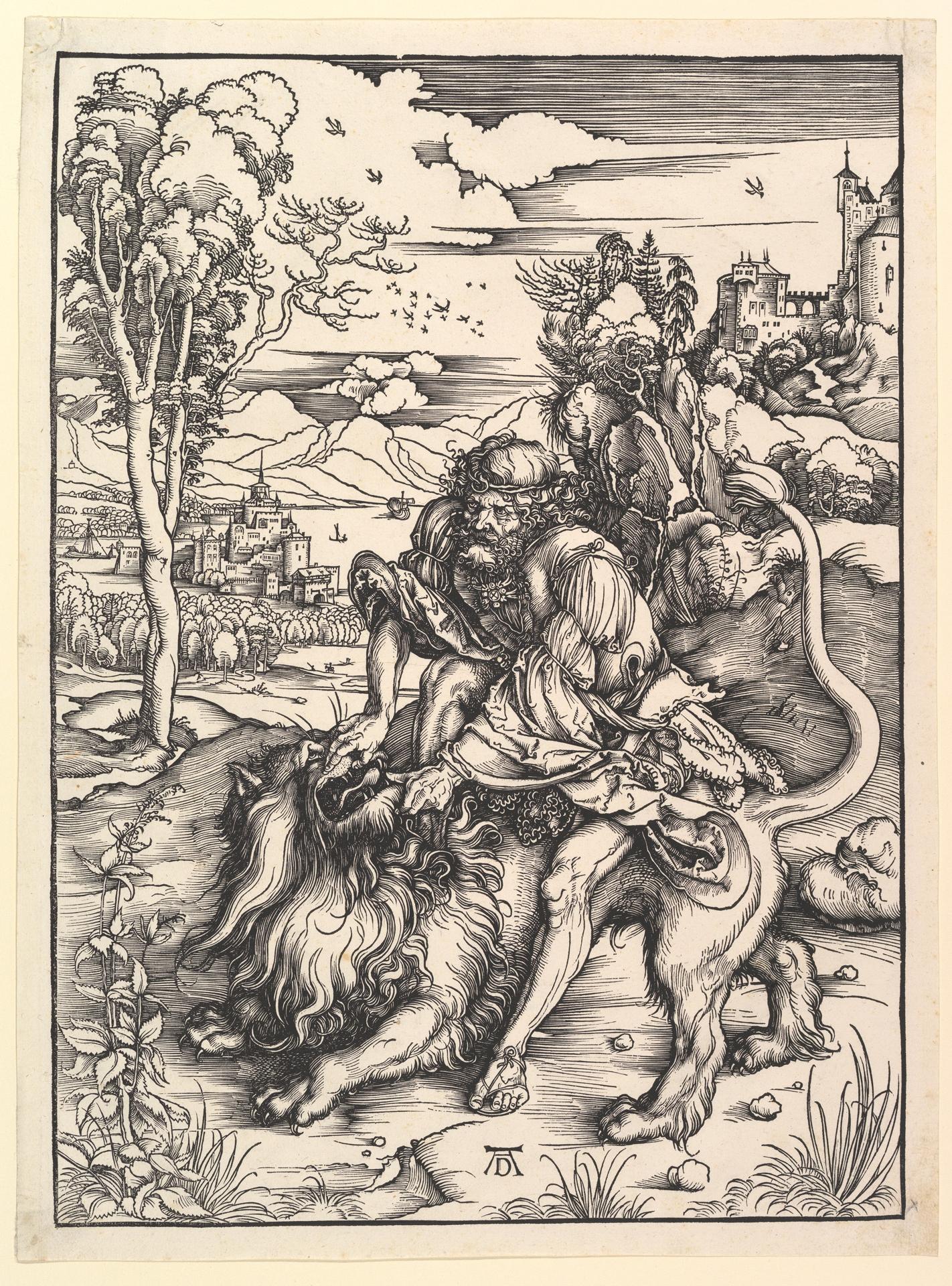
Samson Rending the Lion (ca. 1497–98, Met-Objekt 290)
Original title: Samson Rending the Lion
kurzbeschreibung
Albrecht Dürer's woodcut 'Samson Rending the Lion' dates from around 1497–98. It presents the biblical hero overpowering a lion with his bare hands, a story from the Book of Judges (14:5–6). Bold black lines stand out sharply against the white paper. The sheet measures 37.4 × 27.5 cm and ranks among the early masterpieces of the Nuremberg artist.
Description
Samson's body dominates the center; he wears a simple tunic with a loincloth, and his long, wild hair and incipient beard emphasize his strength. His left hand grips the neck of the lion, which lies on the ground, while his right hand supports him on the ground. The lion is on its back, its long, powerful tail stretching to the right, and its fur is rendered in detailed, fluffy texture. Behind the figure, a landscape opens up with trees, bushes, and a castle on a hill; clouds and birds enliven the sky. Sharp, clear lines create strong contrasts between dark and light areas.
Context
Around 1497–98, Dürer devoted himself intensively to woodcut, pushing its technical possibilities forward. The Samson theme was popular in the Renaissance because it embodied strength and divine election. During this period, Dürer absorbed impressions of the Italian Renaissance from his first journey to Italy (1494–95). The work was probably made as a single-sheet print for the flourishing Nuremberg art market.
Impact
From the first glance, Samson's powerful posture pulls the viewer into the action. The monumental structure and dramatic arrangement make physical violence and divine strength palpable. The finest details—such as in the lion's fur or the landscape—create closeness and make the biblical scene immediately tangible.
Technique
Dürer achieved the dense fur of the lion and the varied foliage of the landscape through a disciplined system of parallel and cross-hatched lines. By varying the spacing and direction of these carved strokes, he translated pure line into convincing areas of light, shadow, and texture. The result is a graphic surface where black lines on white paper generate the illusion of three-dimensional form and depth.
AI-generated description text
Source: Metropolitan Museum of Art · Public Domain (CC0 1.0)