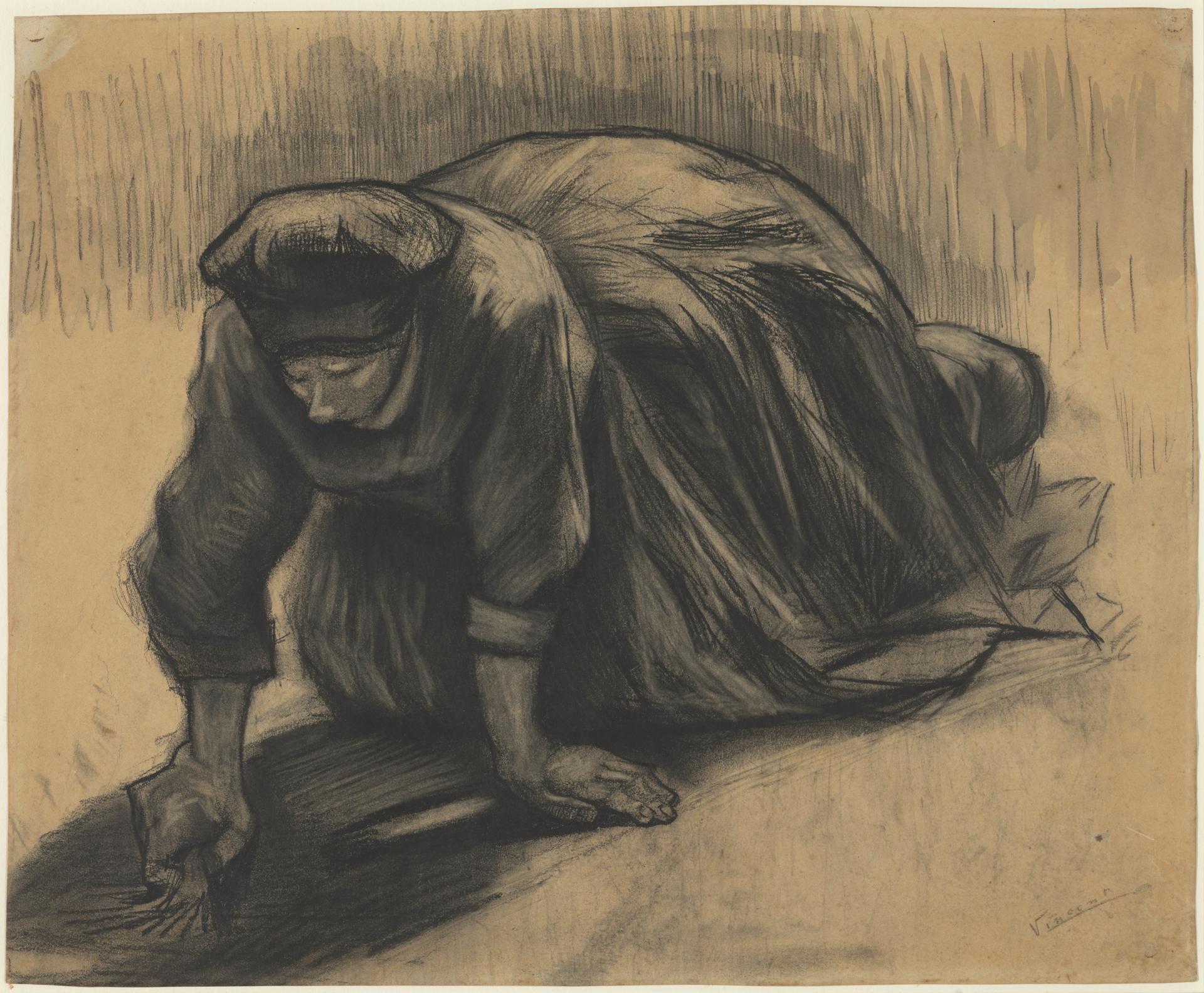
Peasant Woman Kneeling and Pulling Carrots
Original title: Peasant Woman Kneeling and Pulling Carrots
kurzbeschreibung
In 1885, Vincent van Gogh drew a kneeling peasant woman pulling carrots from the ground. The sheet was made with black chalk and brush and ink. It belongs to the period when the artist, in the Netherlands, was deeply engaged with the daily life of rural people.
Description
The woman crouches on all fours, tugging at the carrots; her posture is tense and entirely focused on the task. She wears a simple, long garment and a head covering. The background remains bare, indicated only by horizontal strokes as ground. Grays dominate the monochrome palette and underscore the simplicity of the subject. Brushstrokes and shading bring out the texture of the clothing and the effort of the movement.
Context
This drawing was made in 1885 in Nuenen, where van Gogh intensively studied the lives of peasants and weavers. During those months he produced numerous studies that served as preliminaries for larger paintings, including The Potato Eaters. The sheet reveals the influence of contemporary realist art, such as that of Jean-François Millet, whose depictions of rural laborers van Gogh greatly admired.
Impact
The sheet brings the viewer close to the peasant woman's heavy physical labor. The monochrome execution and emphasized body posture create a serious, almost reverent mood. Thus the drawing directs attention to the dignity of work and the endurance of the woman depicted.
Technique
For contours and hatching, van Gogh used black chalk; brush and ink were added for the darker areas and shadows. This approach allows the figure and her movement to be captured quickly and expressively. The visible brushstrokes and nuanced gray tones give the sheet a lively texture.
AI-generated description text
Source: Metropolitan Museum of Art · Public Domain (CC0 1.0)