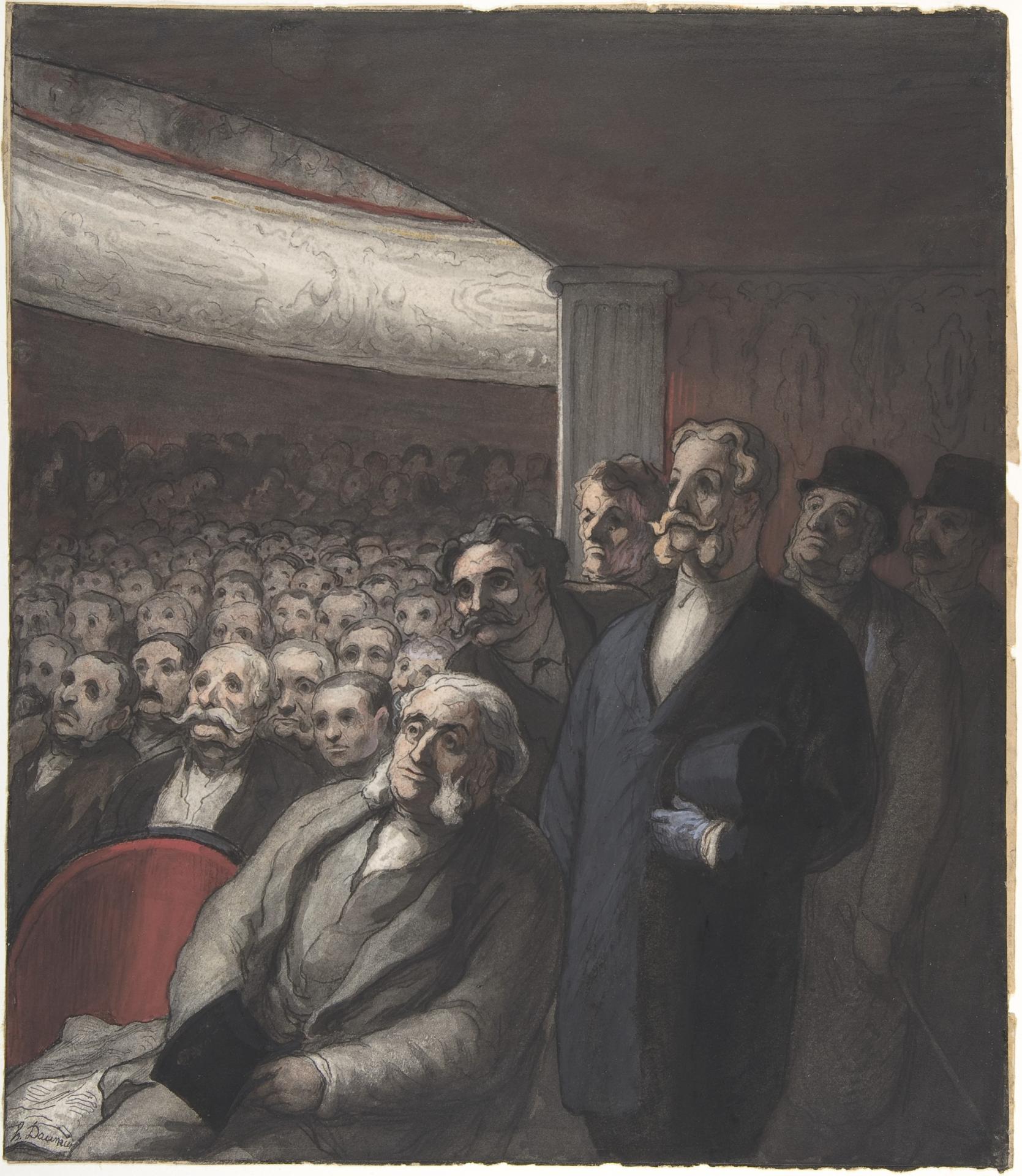
A Theater Audience
Original title: A Theater Audience
kurzbeschreibung
Honoré Daumier made 'A Theater Audience' in the 19th century, capturing a crowd of spectators at a performance. The work is executed in pen and black ink, gouache, and watercolor over black chalk, and measures 34.4 x 29.7 cm.
Description
The eye is first drawn to the brightly lit faces of the spectators, who fill the picture surface as a tightly packed group—mostly men of various ages, some seated, some standing. Each physiognomy is carefully worked out, suggesting close observation. The palette stays muted: dark tones dominate, interspersed with red and gray accents. Light falls from the front, modeling faces and clothing. The layout runs horizontally, with the crowd in the foreground carrying the image, while the background is only barely indicated.
Context
The Frenchman Honoré Daumier (1808–1879) became known above all for his caricatures and for paintings that addressed social and political issues. This sheet dates from the 19th century, when the theater in France drew large audiences as a social meeting place. Daumier often roamed Parisian city life and noted scenes of everyday existence. It is conceivable that this sheet served as a preparatory study for a larger work or was intended as an independent portrayal of the contemporary audience.
Impact
The crowd of spectators meets the viewer directly and vividly, almost like a captured moment. The individually drawn faces and the restrained coloring create a familiar, dense atmosphere that draws the gaze into the action. Between realism and impressionistic touches, the image gains its own expressive power.
Technique
Here Daumier combined pen and black ink with gouache and watercolor, applied over a preliminary drawing in black chalk. This mixed technique allowed him both precise contours and soft color transitions: the gouache provides opaque areas, while the watercolor ensures transparency and lightness.
AI-generated description text
Source: Metropolitan Museum of Art · Public Domain (CC0 1.0)