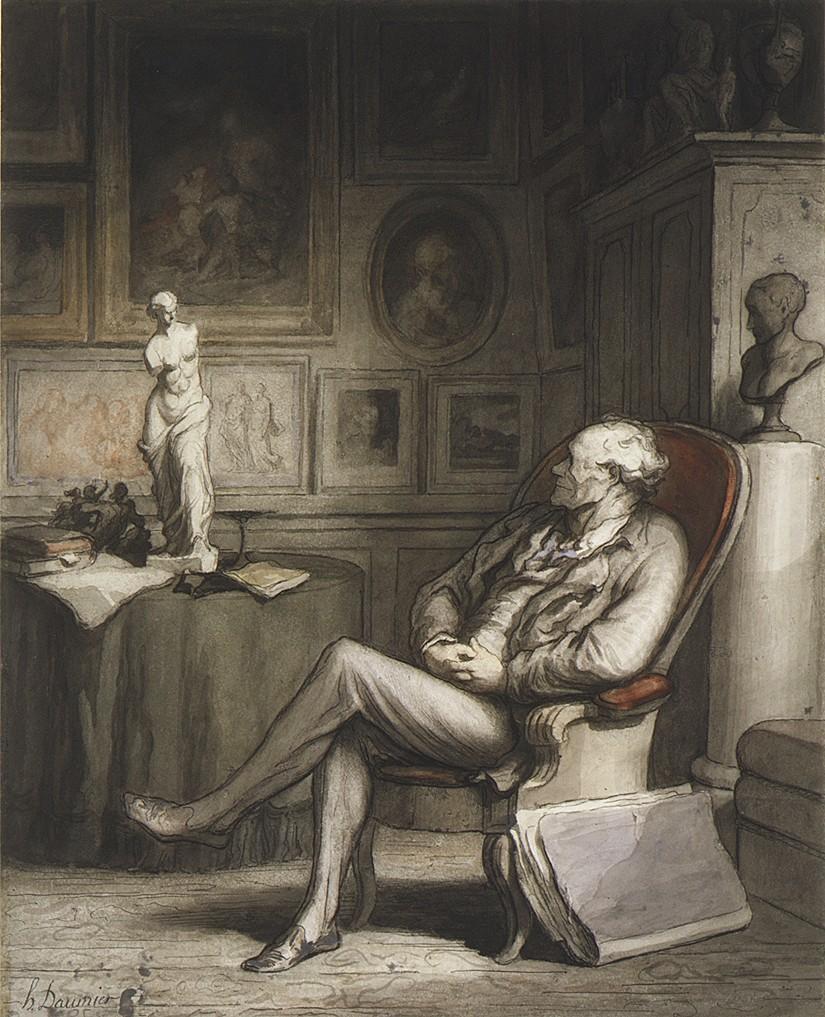
The Connoisseur (ca. 1860–65)
Original title: The Connoisseur
kurzbeschreibung
Unlike many comparable sheets by Daumier, this drawing presents not a satirical but a thoughtful reader: a seated man examines an open book in an interior. Created around 1860–65, the work combines pen and ink, wash, watercolor, lithographic crayon, gouache, and black chalk on wove paper.
Description
A man in shirt and jacket sits with crossed legs before an open book lying on the floor. Behind him, a table with a female statue and more books stands out, and to the right a pedestal with a bust. Paintings and pictures, including a Venus, decorate the walls. Gray dominates the palette, accented by the red of the chair and the white of the bust; subdued light creates a calm, contemplative mood.
Context
In the 1860s, when Daumier turned increasingly to painting and drawing, this sheet was made. The title 'The Connoisseur' alludes to art criticism and collecting in 19th-century Paris. Unlike his well-known satirical portrayals of the bourgeoisie, here the serious engagement with art comes to the fore. Created without commission, the work belongs to a series of depictions of art lovers.
Impact
The arrangement draws the viewer into the man's quiet attention, resulting in a focused and intimate effect. Realistic details and soft, painterly passages interpenetrate, lending the sheet liveliness. The restrained coloring and the sitter's pensive posture create an atmosphere in which reflection on art and beauty unfolds.
Technique
On wove paper, Daumier combined several media: pen and ink for contours, watercolor and gouache for colored accents, lithographic crayon for fine hatching, and black chalk for the underpainting. This mixed technique allowed him both precise lines and soft tonal transitions. Watercolor and gouache give the drawing color depth and luminosity.
AI-generated description text
Source: Metropolitan Museum of Art · Public Domain (CC0 1.0)