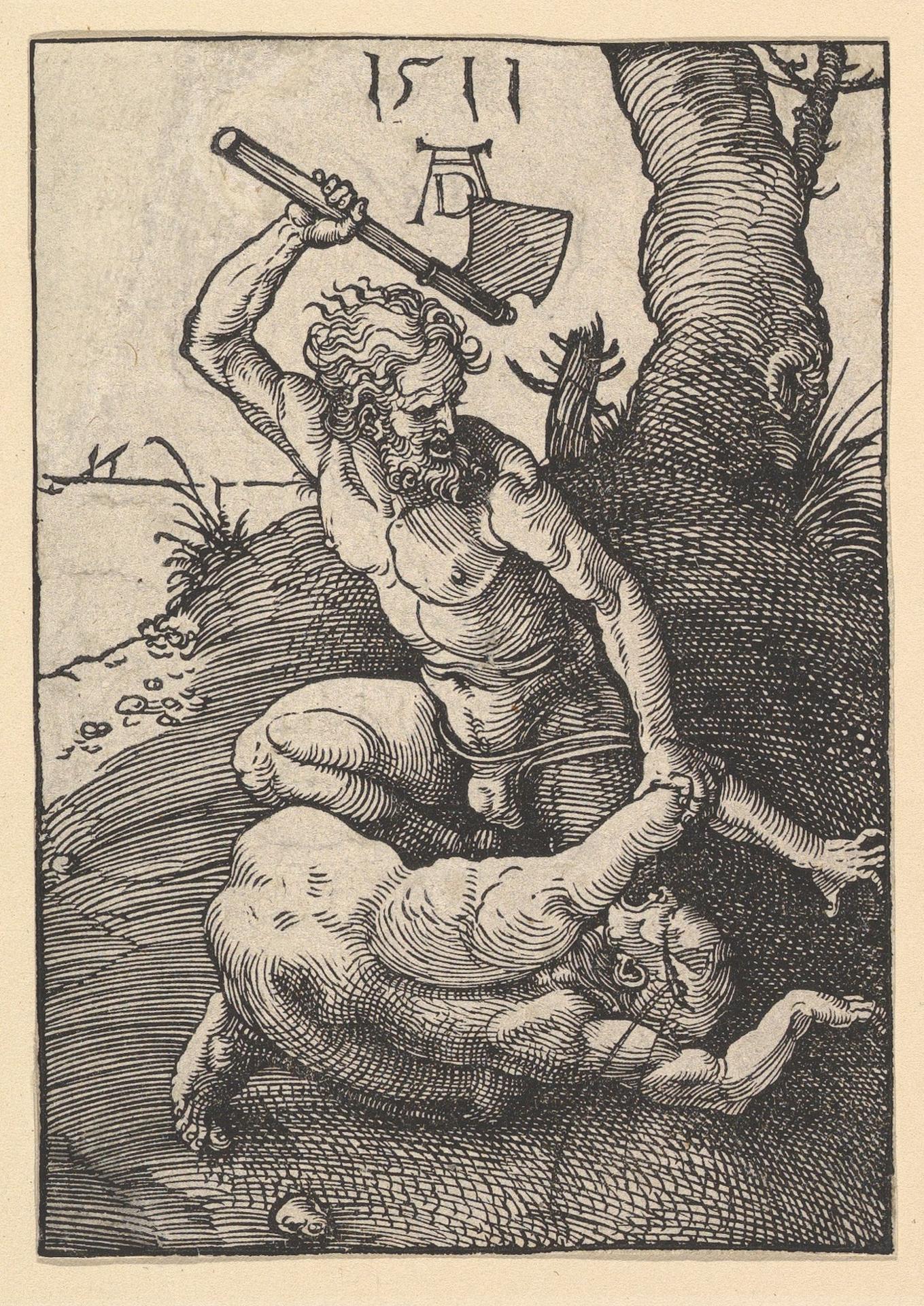
Cain Killing Abel
Original title: Cain Killing Abel
kurzbeschreibung
Albrecht Dürer's woodcut 'Cain Killing Abel' (1511) depicts the biblical moment when Cain strikes his brother Abel with an axe. The scene is rendered in a detailed, expressive style typical of Dürer's graphic work.
Description
In the foreground, Cain, barefoot and wearing breeches tied at the knees, raises an axe above Abel's head. Abel lies on the ground, his face distorted in agony, with arms outstretched. A tree spans the background from right to left, and the year '1511' and the initials 'AD' appear in the upper part of the image. The composition is dense with cross-hatching and varied line work that create texture and shadow.
Context
This woodcut is part of Dürer's series illustrating the Apocalypse, published in 1498 and reissued in 1511. Dürer was a master printmaker whose works circulated widely across Europe, contributing to the spread of Renaissance ideas. The subject draws from the Book of Genesis, a common theme in Christian art of the period.
Impact
The image conveys raw violence and emotional intensity, with Cain's forceful pose contrasting with Abel's passive, suffering form. Dürer's meticulous linework draws the viewer's eye to the dramatic action, making the scene both visually striking and morally compelling.
Technique
The work is a woodcut, a relief printing technique where the image is carved into a wooden block, inked, and pressed onto paper. Dürer's use of fine, parallel lines and cross-hatching demonstrates his exceptional skill in achieving tonal variation through line alone.
AI-generated description text
Source: Metropolitan Museum of Art · Public domain (CC0)