Fish
Original title: Fish
kurzbeschreibung
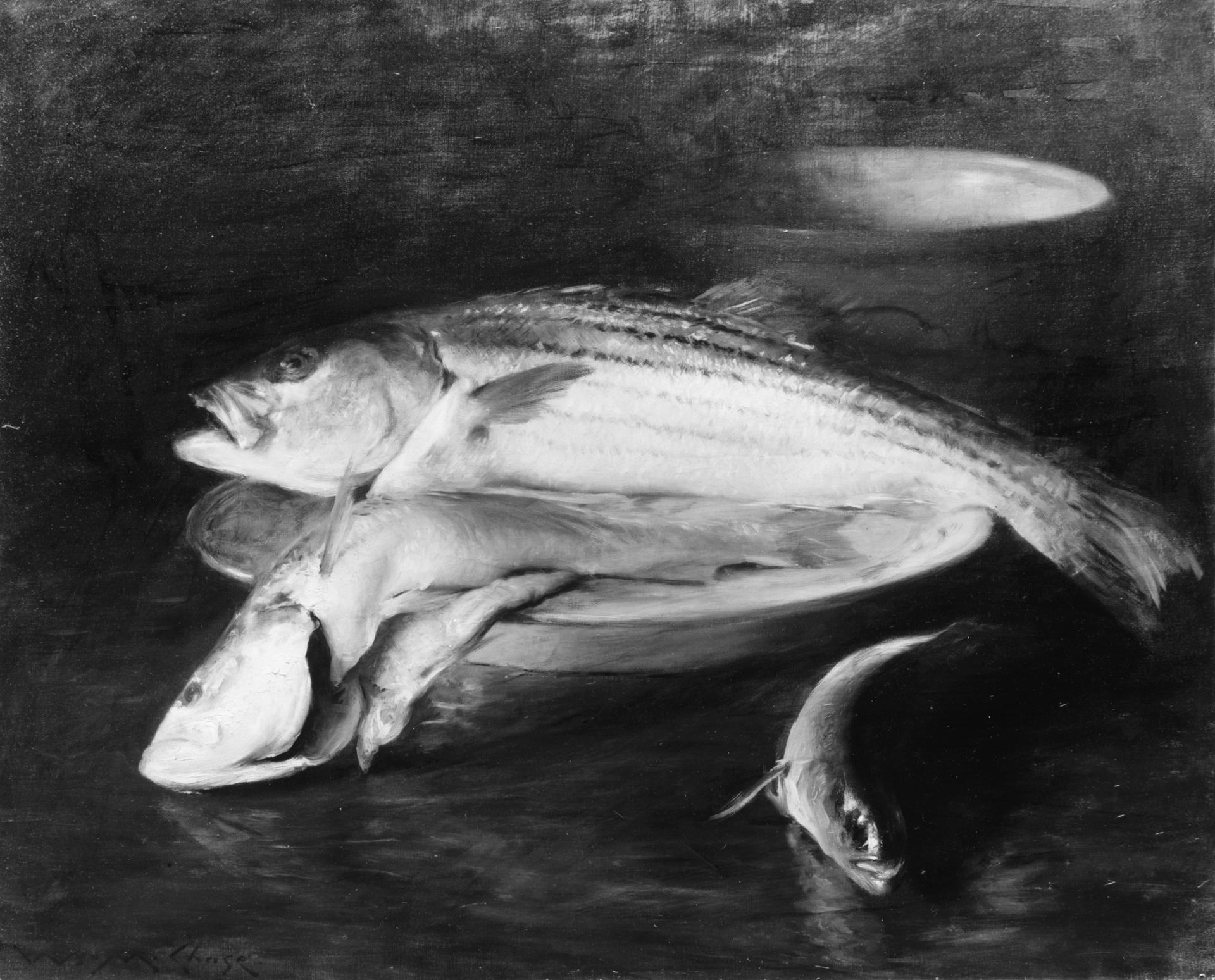
Unlike typical fish still lifes that often include knives or plates, William Merritt Chase's Fische (by 1910) focuses solely on the animals themselves. Four specimens lie on a dark surface, painted in oil on canvas. The realistic rendering directs attention entirely to the bodies and their surfaces.
Description
Four fish are visible: a large one in front overlaps two smaller ones, and another small fish lies at the lower edge. Black-and-white tones dominate, giving fish and background a unified effect. Light falling from above models the forms and emphasizes the texture of the skins. With no other objects or background elements, the layout remains simple and clear.
Context
Chase was among the leading American Impressionists and influential as a teacher; he became known for still lifes and portraits. In his later career he turned increasingly to everyday objects. He taught at the Chase School of Art, later Parsons School of Design, and shaped many artists of his time. There is no documentation on the exact creation of this painting; it belongs to a group of still lifes made in his studios in New York and Long Island.
Impact
The restrained color and clear structure give the image a calm, collected presence. The realistic portrayal of the fish feels immediate and sensual, without romantic elevation. The viewer's gaze is drawn to forms and textures, creating a meditative mood.
Technique
Oil on canvas allowed Chase fine details and soft transitions. The monochromatic palette suggests a deliberate reduction, perhaps with black-and-white tones and subtle gray gradations. The light directed from above creates plastic effects and highlights the material quality of the fish skins.
AI-generated description text
Source: Metropolitan Museum of Art · Public Domain (CC0 1.0)