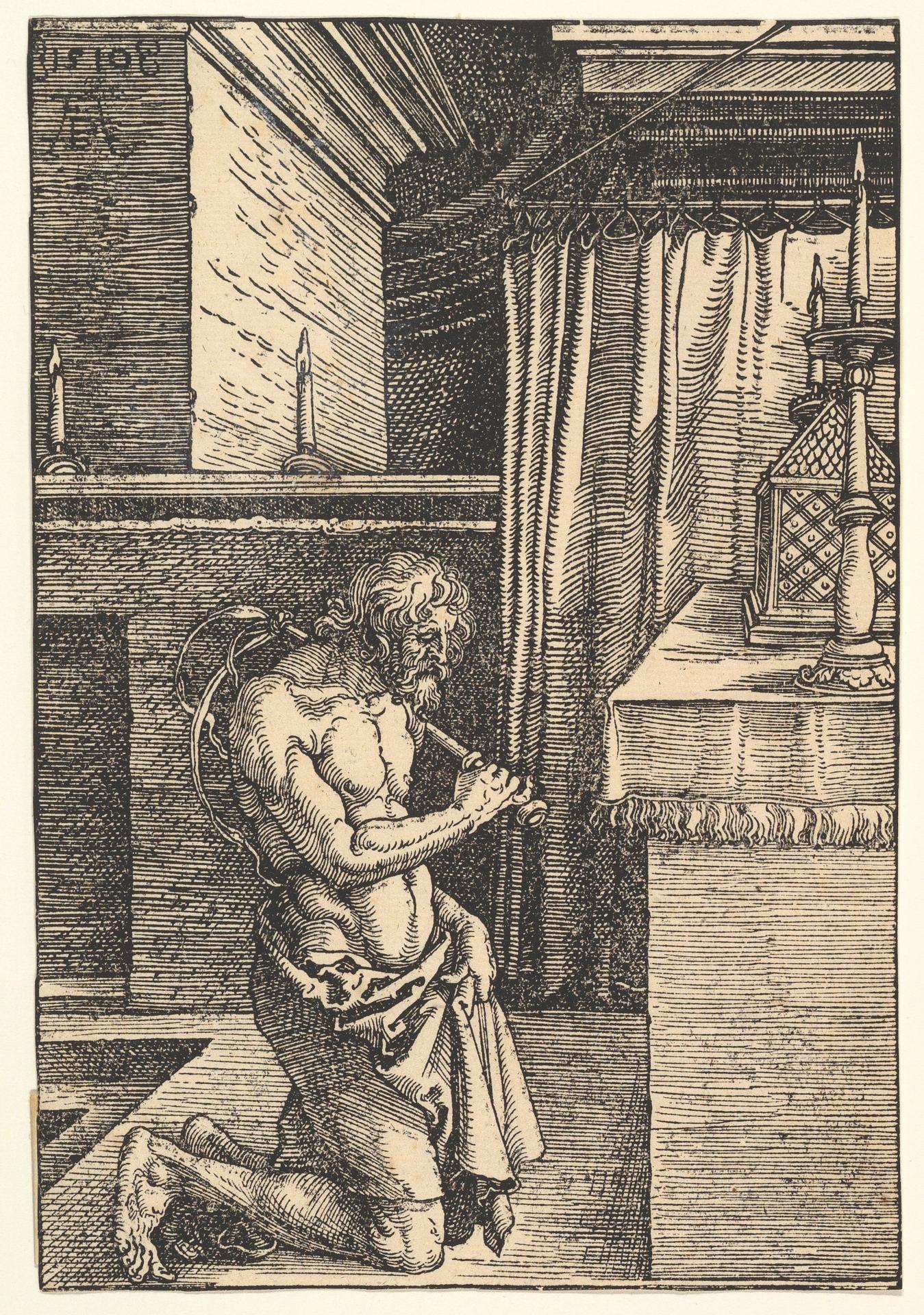
The Penitent
Original title: The Penitent
kurzbeschreibung
Albrecht Dürer's 'The Penitent' (1510) is a woodcut depicting a bearded man in a kneeling pose, dressed in a simple robe and holding a book. The figure's unkempt hair and downward gaze suggest a state of penance or introspection, set within a room with a draped window and candlelit wall.
Description
The composition centers on a kneeling man, his left hand holding a book while his right hand touches his face, his gaze directed downward. His hair is curly and disheveled, and his robe is tied at the hips with a belt. Behind him, a curtain partially covers a window opening, and two candleholders with lit candles are mounted on the wall. The room features a wooden floor and vertically lined wooden walls, with light entering through the window to create a dramatic, mysterious atmosphere.
Context
This woodcut was created in 1510, a period when Dürer was producing a series of religious and moral subjects. The theme of penitence aligns with contemporary devotional practices, emphasizing personal reflection and repentance. Dürer, already established as a master printmaker in Nuremberg, often explored such themes in his graphic works, catering to a growing audience for religious prints.
Impact
The interplay of light and shadow, with the window as a light source, gives the scene a contemplative and somewhat somber mood. The detailed linework and the figure's expressive posture draw the viewer into the penitent's moment of private reflection, evoking a sense of solemnity and spiritual depth.
Technique
Executed as a woodcut, the image is carved into a wooden block, with the raised areas inked for printing. The sharp, dense linework demonstrates Dürer's skill in rendering texture and detail, from the folds of the robe to the individual strands of hair, achieving a high level of precision in the medium.
AI-generated description text
Source: Metropolitan Museum of Art · Public domain (CC0)