The Titan's Goblet
Original title: The Titan's Goblet
kurzbeschreibung
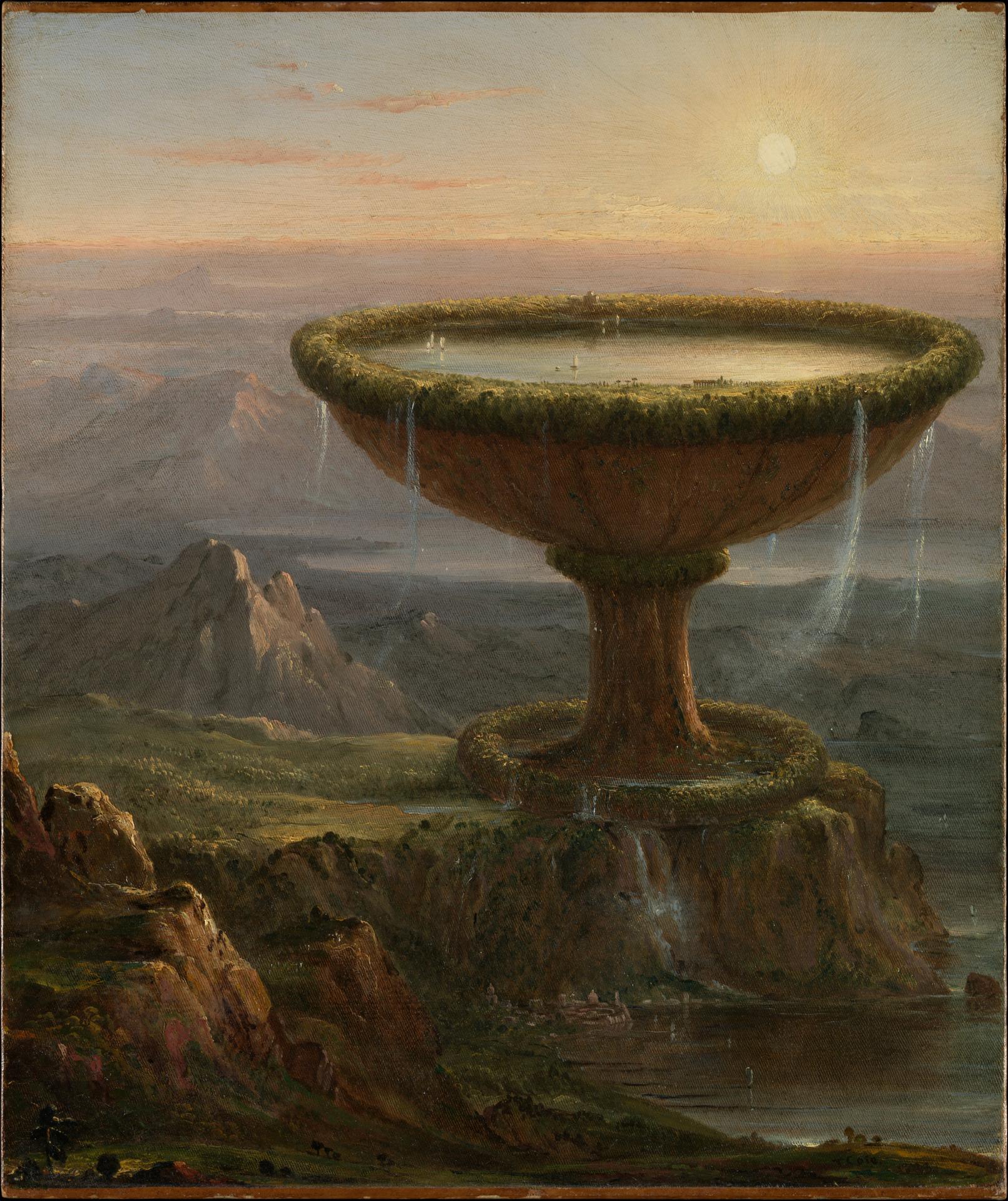
Painted in oil in 1833, Thomas Cole's "The Titan's Cup" gives a vast landscape over to a gigantic, cup-shaped rock. Close observation of nature meets a frankly fantastical conceit, and the two hold together without either giving way.
Description
A great stylized cup rises out of a rock formation, grass growing over its rim. Water gathered inside feeds several fountains that shoot upward. Beyond it stretches an open country of mountains under the light of a gentle sunrise or sunset. Browns, greens and blues set the muted, earthy palette, and the soft light leaves a calm, almost dreamlike mood.
Context
Cole, founder of the Hudson River School, made the work in New York in 1833, when romantic landscape painting was thriving in the United States and exalted the sublimity of nature. The cup as a titanic artifact nods to the mythic notion of giants who shaped the earth. In this period Cole was working closely with allegory and with the relation between humanity and nature.
Impact
An odd tension arises between the realistic landscape and the fantastic motif. The cup's monumental scale unsettles the human vantage point and draws the viewer into looking longer. Quiet lighting and earthy color produce a still, elevated atmosphere.
Technique
Oil on canvas, 49.2 × 41 cm. With fine brushwork Cole drew out the details of the vegetation and the soft transitions of light. Glazing let him render the atmospheric depth of the sky and the transparency of the water.
AI-generated description text
Source: Metropolitan Museum of Art · Public Domain (CC0 1.0)