The Fountain, No. 1: The Wounded Indian Slaking His Death Thirst
Original title: The Fountain, No. 1: The Wounded Indian Slaking His Death Thirst
kurzbeschreibung
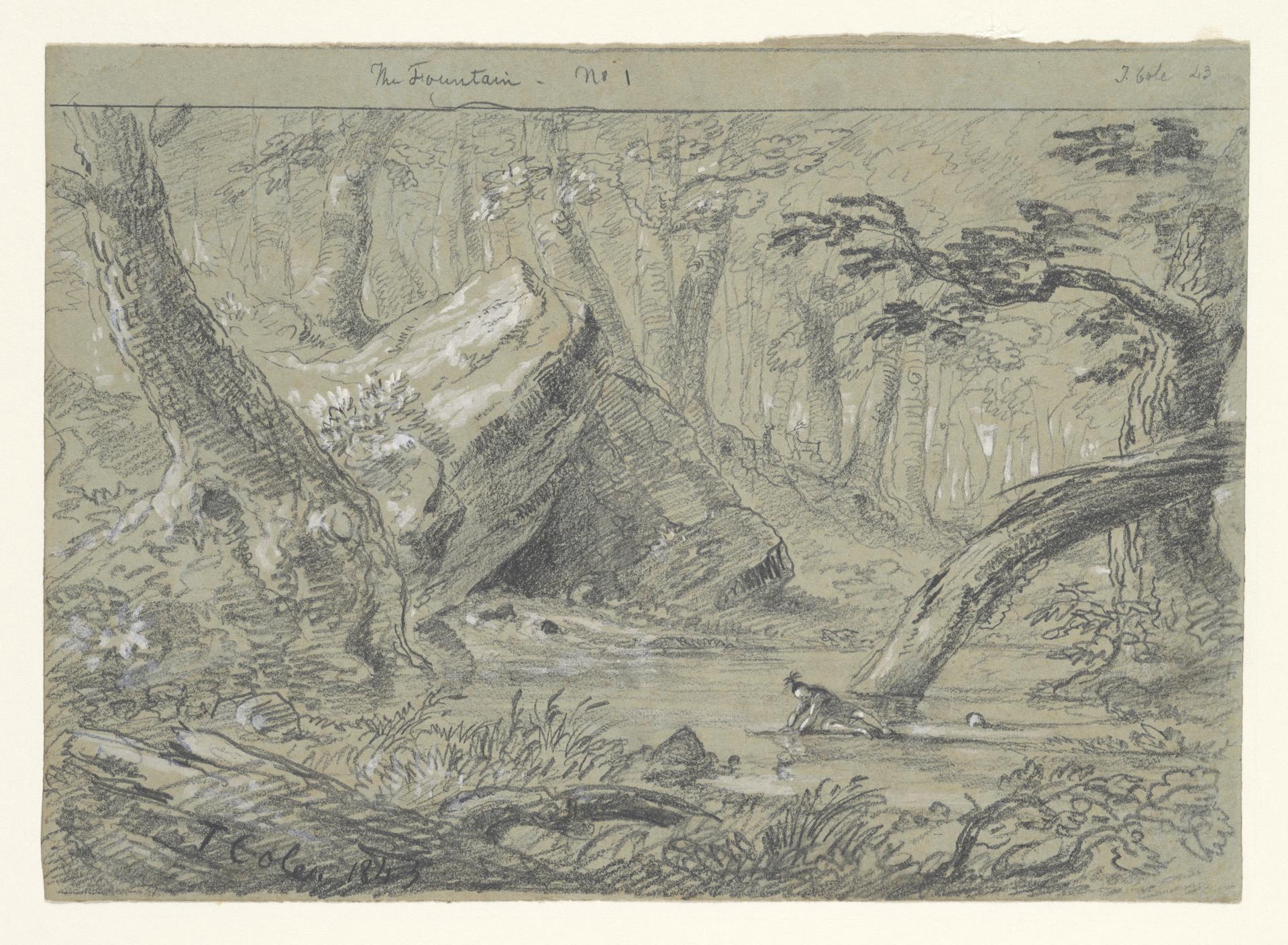
A wounded Native American kneels at a spring and drinks to quench his thirst — Thomas Cole captured this motif in a drawing in 1843. Executed in graphite and white gouache on green paper, the sheet belongs to a series devoted to the decline of the indigenous peoples of America.
Description
A large boulder anchors the foreground, trees and shrubs stand around it, and a river or stream runs through the image. A figure in traditional dress kneels in the water, drinking from a spring with his head bowed. Beyond him a dense forest with tall trees stretches into the distance. The tones stay largely grey, achieved through graphite and white gouache on green paper; the light feels even and diffuse, with no hard shadows.
Context
The 1843 sheet is part of a series in which Thomas Cole addresses the fate of Native Americans — a theme widespread in Romanticism. The image of the dying Indian reflects the contemporary idea of the 'noble savage' and the sorrow over the loss of indigenous cultures. Cole, a co-founder of the Hudson River School, often linked landscape with moral and historical narratives in his work.
Impact
A melancholy, almost elegiac mood emanates from the quiet gesture of the drinking Indian and the sombre grey landscape. The restrained colour and diffuse light heighten the impression of transience and silent resignation.
Technique
Cole used the graphite pencil for fine contours and shading, while white gouache sets light accents and renders the water. The green paper acts as a mid-tone ground and gives the sheet its particular tonality. By combining pencil and bodycolour, natural details could be captured precisely and realistically.
AI-generated description text
Source: Metropolitan Museum of Art · Public Domain (CC0 1.0)