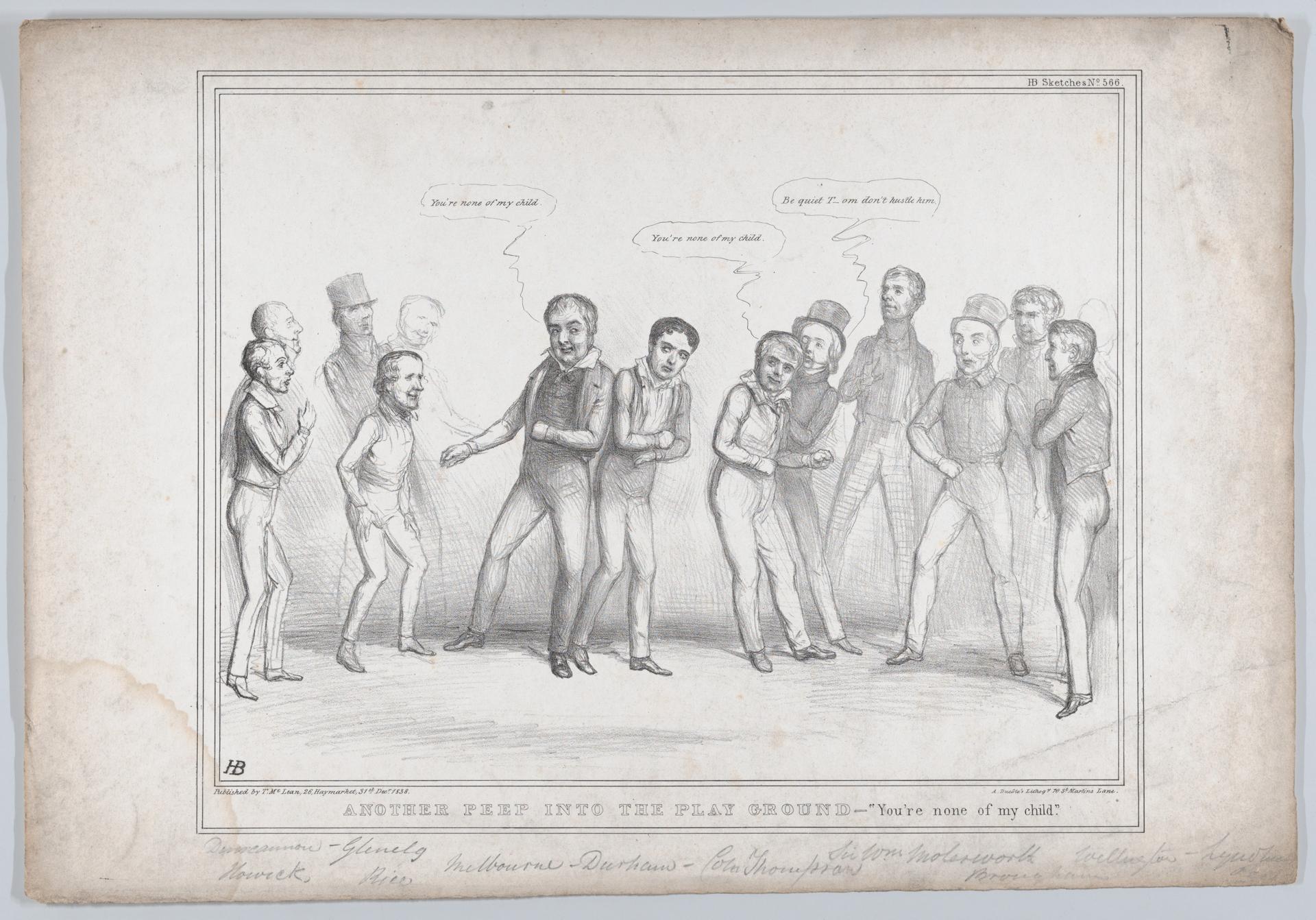
Another Peep into the Play-Ground – "You're none of my child"
Original title: Another Peep into the Play-Ground – "You're none of my child"
kurzbeschreibung
Unlike many political caricatures of its day, John Doyle's 1838 lithograph stages a political dispute as a playground scene. Ten men in 19th-century dress, with hats and coats, appear; some of them have speech bubbles reading "You're none of my child" and "Be quiet, I am don't hustle him". The sheet presents a quarrel among those depicted, using the playground as its metaphor.
Description
The layout feels balanced: the ten men stand in a row, some in front and some behind, their postures ranging from folded arms to gestures to conversation. Above their heads float dialogue bubbles with the quoted lines. Light is flat and shadowless, as the lithographic process dictates. This arrangement sets the image apart from more dynamic caricatures.
Context
John Doyle, an Irish-British caricaturist, published political satires under the initials H.B. The sheet is dated 31 December 1838, a period of political tension in Britain. It presumably targets a specific debate, with the playground metaphor mocking the childish behaviour of politicians. Doyle's comments on the politics of the day were known for their bite and humour.
Impact
The symmetrical row and exaggerated gestures make the caricature immediately legible. By casting a serious subject in playful imagery, it creates an ironic distance that invites reflection. The humorous tone softens the criticism without blunting it. In this way the sheet stands apart from didactic treatments.
Technique
Lithography, a planographic process, was common for caricatures in the 19th century. It allows fine lines and even tonal distribution, as seen here. The sheet measures 30.2 × 44 cm and is printed on paper, which favoured the mass circulation of such satires. The technique differs from the woodcuts also widespread at the time.
AI-generated description text
Source: Metropolitan Museum of Art · Public Domain (CC0 1.0)