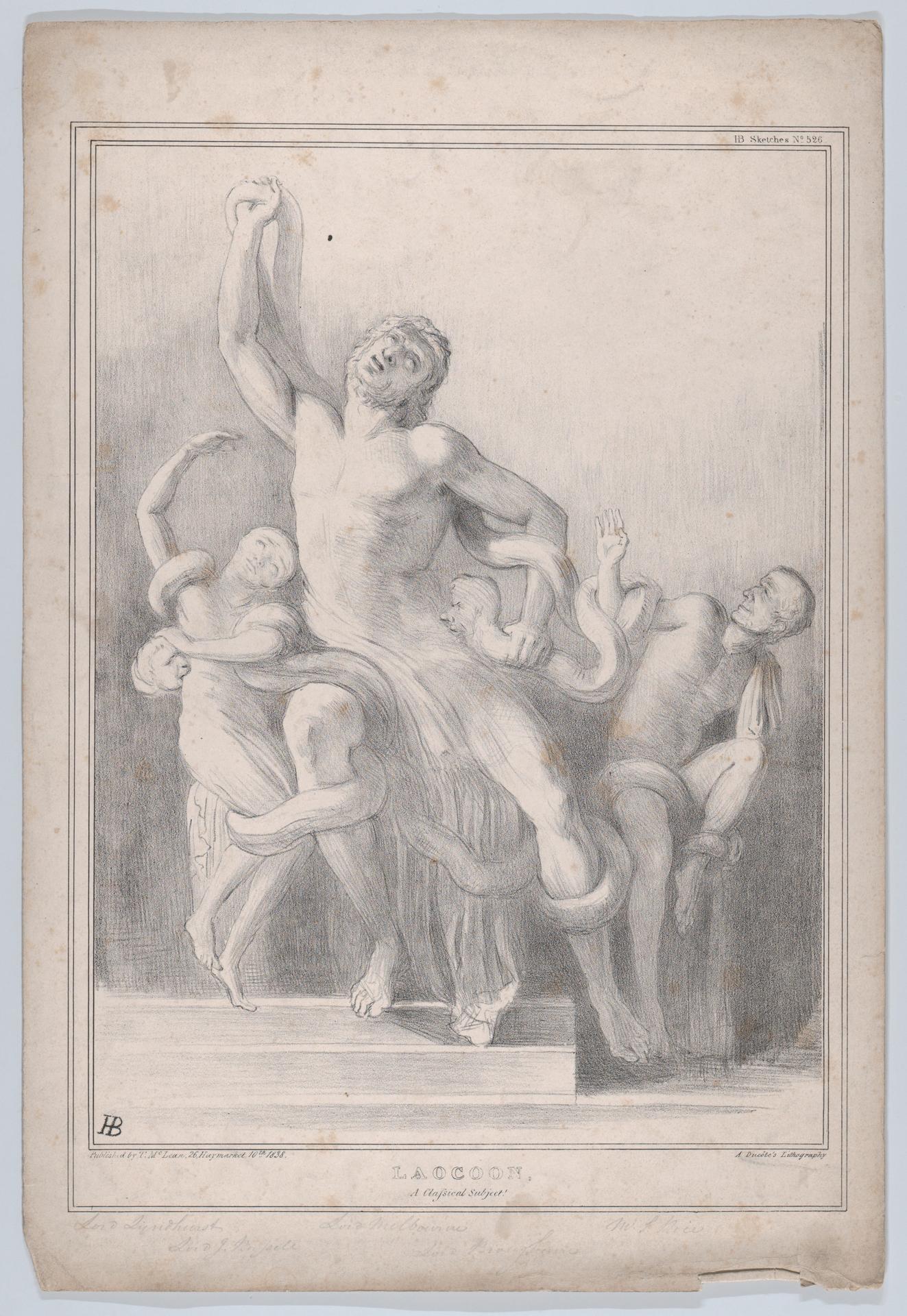
Laocoon: A Classical Subject
Original title: Laocoon: A Classical Subject
kurzbeschreibung
John Doyle's 1838 lithograph takes up the ancient tale of Laocoön, the Trojan priest attacked by serpents together with his sons. Measuring 43.4 × 29.3 cm, the sheet belongs to the printmaking of the nineteenth century.
Description
A man wrapped in several snakes thrusts one arm upward to fend them off. Beside him stand a woman and a child, likewise threatened by the creatures. The bodies are given in restless, expressive poses that stress the violence of the event. The arrangement is markedly asymmetrical and draws the eye to the male protagonist. Gradations of grey in the lithograph separate the figures from the ground, while visible strokes and hatching emphasise the texture of the surfaces.
Context
The lithograph was made on 10 March 1838, at a time when classical subjects found wide favour in art. The motif goes back to the ancient Laocoön group, rediscovered in Rome in 1506 and regarded ever since as a model of pathos. Doyle, an Irish-British caricaturist known above all for political satires, also turned to classical themes. His sheet forms part of the Victorian engagement with antiquity.
Impact
The agitated poses and the menace of the snakes produce an immediate drama. Expressive figures and strongly contrasted shading create an intense, almost theatrical mood. The viewer is drawn into the emotional tension of the event.
Technique
This lithograph is a planographic process: the drawing is made with greasy chalk on stone and then printed. The method allows subtle shading and finely detailed lines, as the visible strokes of the figures make clear. The sheet is in portrait format and measures 43.4 × 29.3 cm.
AI-generated description text
Source: Metropolitan Museum of Art · Public Domain (CC0 1.0)